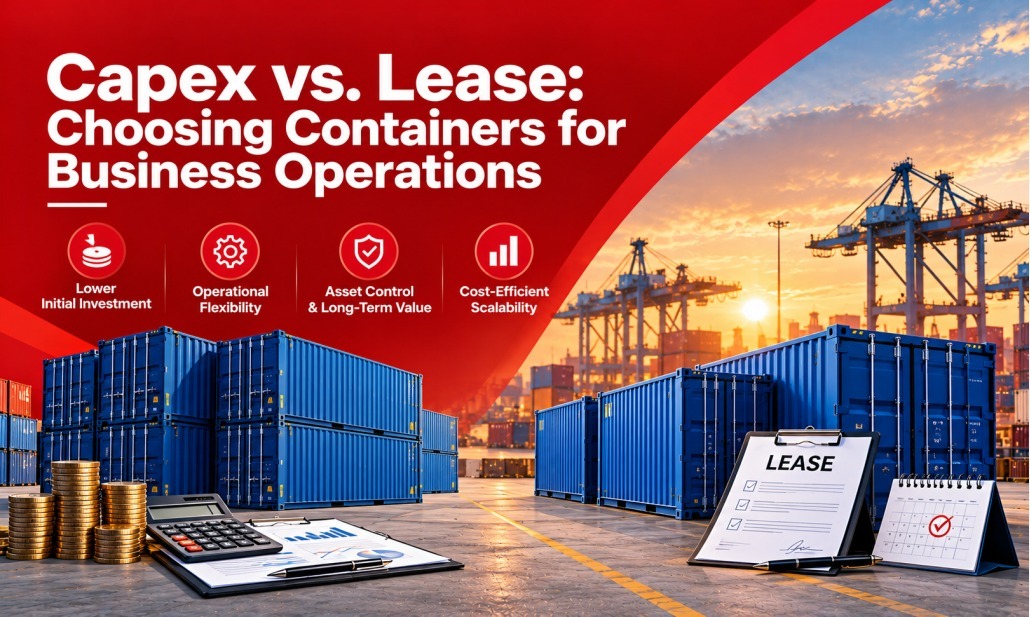
Buying a container ties up capital but gives your business control over an asset. Leasing can preserve cash and offer flexibility when demand changes. Neither option is automatically cheaper.
For companies sourcing containers for business operations, the decision depends on how frequently the units will be used, how long they are needed and what it costs to maintain, relocate and eventually replace them. Comparing these factors helps businesses avoid unnecessary spending and underused assets.
Capex vs. Lease: Which Option Suits Your Business?
Capital expenditure (Capex) means purchasing a container as a business asset. Leasing allows a company to use a container for an agreed period in exchange for recurring payments.
Buying generally suits predictable, long-term requirements. Leasing may work better for temporary projects, seasonal demand or uncertain volumes. When evaluating containers for business use, consider utilisation, maintenance, delivery arrangements and end-of-use obligations alongside the initial cost.
1. When Does Buying Containers Make More Financial Sense?
Buying is worth considering when containers have a clear, continuing role in your operations. A manufacturer moving materials between the same facilities every week, for example, may need dedicated units for several years.
Ownership offers greater control over deployment and, where technically appropriate, modifications. However, the business remains responsible for maintenance, storage, applicable insurance and eventual disposal.
Consider a manufacturer running regular inter-factory movements. If its containers are used consistently and remain suitable for the operation, purchasing may offer better long-term value than repeatedly leasing units.
The calculation changes when demand is irregular. An owned container sitting idle still ties up capital and may incur storage or repositioning costs.
Buying containers for business operations is worth evaluating when demand is stable, utilisation is high, the design is likely to remain relevant and the business has a maintenance plan.
The key question: What will the container cost to own and operate over its expected useful life, after accounting for its likely residual value?
2. When Is Leasing the Better Option?
Leasing can make more sense when a business needs containers for a defined period or cannot confidently predict future demand.
Consider an engineering company handling an eight-month project. It may need additional containers during installation and commissioning but have little use for them once the work is complete. Leasing can align capacity with the project instead of leaving the company with idle assets.
Seasonal businesses face a similar challenge. Purchasing enough containers for a short production peak can leave capital tied up during quieter months.
However, leasing is not automatically flexible. Minimum rental periods, notice requirements, availability and return conditions can restrict your options.
Before signing, check the lease duration, extension terms, maintenance responsibilities, permitted use and end-of-lease inspection process. Clarify who pays for relocation and how damage is assessed.
Leasing is worth considering when container requirements are temporary, cash preservation is important or future demand remains uncertain.
3. How Should You Compare the Total Cost of Containers for Business?
A purchase price and a monthly lease payment are not directly comparable unless both options cover the same period and level of use. A proper comparison should include the costs that arise throughout the container's use.
|
Cost factor |
Buying (Capex) |
Leasing |
|
Initial cash requirement |
Usually higher |
Usually lower, depending on terms |
|
Recurring payments |
Operating costs remain |
Payments continue for the agreed term |
|
Maintenance and repairs |
Generally the owner's responsibility |
Depends on the contract |
|
Flexibility to exit |
Requires redeployment, resale or disposal |
Depends on termination and return terms |
|
Residual value |
Possible resale value |
Usually no ownership value |
|
Idle-container risk |
Capital remains tied up |
Rental may continue while unused |
For a fair comparison, include delivery, handling, storage, maintenance, relocation and end-of-use costs. For a purchase, account for financing costs where applicable and any realistic resale value. For a lease, include deposits, minimum terms, extensions and return charges.
A useful starting point is:
Net ownership cost = Purchase cost + Operating costs − Expected residual value
Compare this with total lease payments and additional charges over the same period. This is a simplified comparison, not a complete financial model; financing, tax and accounting treatment may affect the final decision.
4. How Does Container Utilisation Change the Decision?
A container that is used regularly creates value. One that sits idle for months may not justify the same investment.
Map expected use by month, location and purpose before deciding how many containers for business operations you actually need. Annual averages can hide important gaps.
For example, a distributor may need twenty additional containers during a festive-season peak but only eight during quieter months. Buying all twenty may be sensible if demand remains high in subsequent years. If the peak is temporary, leasing the extra capacity may reduce the risk of holding unused assets.
Location matters, too. A container can be available within the fleet but unavailable where it is needed. Repositioning it to another facility takes time and may involve additional transport costs.
Review actual utilisation, idle periods, repositioning requirements and likely demand over the planned period of use. These figures provide a stronger basis for deciding whether to buy, lease or combine both options.
5. Does Container Type Affect the Buying or Leasing Decision?
Yes. The intended application can change both the economics and the available sourcing options.
A standard dry van used for regular movements may be straightforward to compare across purchase and lease options. A specialised unit designed for particular loading arrangements or industrial equipment requires a closer review.
Transafe Services offers ISO freight containers in configurations including dry van, side access, open-top, hard-top and flat rack designs, alongside specialised container solutions. Explore Transafe's ISO freight container range to understand the available configurations.
For customised containers for business applications, consider how long the design will remain useful. A unit built around a specific production line may serve the business for years if the process remains unchanged. If equipment or site layouts are likely to change soon, committing capital to that design may be less attractive.
Ask whether the required configuration is available under the proposed arrangement, what modifications are permitted and who is responsible for repairs.
Choosing a Container Manufacturing Company in India
When evaluating a container manufacturing company in India, look beyond the initial quotation. Technical suitability, manufacturing capabilities, specification consistency and delivery planning all affect the value you receive.
Transafe Services manufactures ISO freight containers and specialised solutions for transportation, infrastructure and industrial applications. Businesses can use its product range as a starting point for discussing the required configuration, intended use and technical specifications.
Before committing to a purchase, confirm the agreed design, inspection requirements and delivery schedule. If leasing is being considered, establish who owns the unit, who maintains it and whether the agreement allows the intended use. These details help determine whether the sourcing arrangement fits your operation rather than simply meeting an immediate requirement.
Conclusion
The right choice between Capex and leasing depends on how containers will be used, not on a universal rule about which option costs less.
Buying may suit stable, long-term demand where ownership justifies the capital commitment. Leasing may be better for temporary projects, seasonal peaks or uncertain requirements, provided the contract offers suitable terms.
For businesses sourcing containers for business operations, comparing total costs, utilisation, maintenance and end-of-use obligations creates a more reliable basis for deciding. The goal is to choose a sourcing arrangement that meets operational needs without tying up unnecessary resources.
FAQs
1. Is it better to buy or lease containers for business operations?
Buying may suit stable, long-term requirements with consistent utilisation. Leasing can suit temporary projects, seasonal demand or uncertain future needs. Compare total costs and contract terms before deciding.
2. What costs should businesses include when comparing Capex and leasing?
Include purchase or lease payments, delivery, handling, maintenance, storage, financing where applicable, insurance, relocation and end-of-use costs. Account for expected resale value when evaluating ownership.
3. When does leasing containers make more sense for a small business?
Leasing may be suitable when cash flow is tight, demand changes frequently or containers are needed for a defined project. Check minimum terms and return conditions to ensure the agreement offers the flexibility you need.
4. What should businesses look for in a container manufacturing company in India?
Assess technical specifications, container suitability, manufacturing capabilities, inspection requirements and delivery schedules. Confirm that the supplier can meet the intended operational requirements before committing.
5. How can a business calculate whether buying containers is worthwhile?
Estimate ownership costs over the expected useful period, including maintenance, financing and other operating expenses, then subtract the expected residual value. Compare that amount with the full cost of leasing over the same period and level of use.