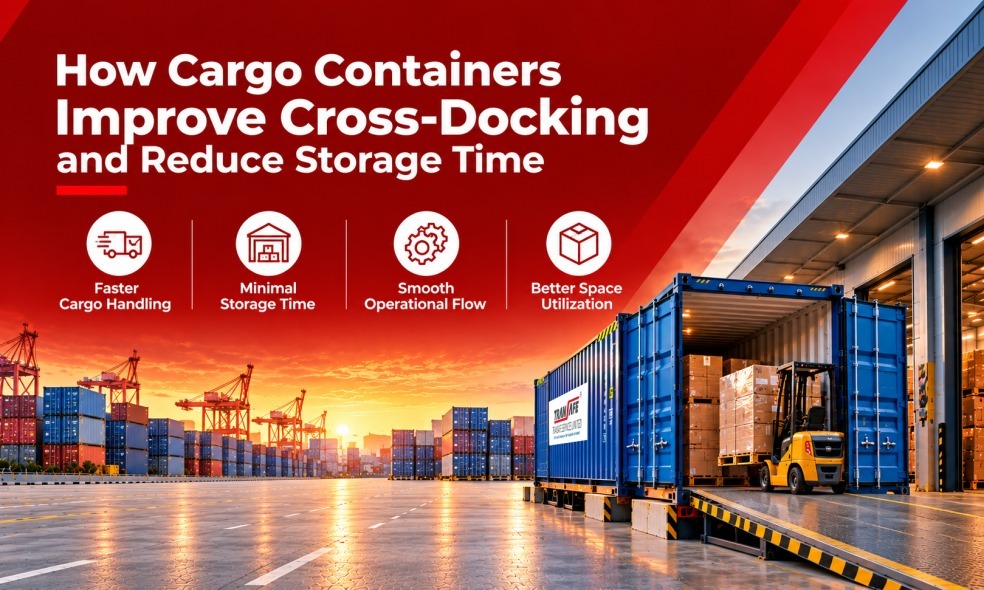
Goods do not always spend time in a warehouse because they need to be stored. Often, they are waiting for an outbound vehicle, a free loading bay or confirmation of their next destination. These delays occupy space, tie up labour and slow deliveries.
Cross-docking helps businesses move eligible goods from incoming to outgoing transport with little or no storage in between. Cargo containers support this process when their design, loading arrangements and transport schedules are aligned with the facility's operations. The container matters, but coordination determines the result.
What Is Cross-Docking in Logistics?
Cross-docking is a logistics process in which incoming goods are received, sorted or consolidated and transferred to outbound vehicles with minimal time in storage. Unlike conventional warehousing, where products may be stored before picking and dispatch, cross-docking prioritises a planned transfer between inbound and outbound movements.
For example, a manufacturer may send products to a distribution hub serving several cities. The facility sorts the goods by destination and loads them onto separate vehicles. When orders, labour and transport capacity are ready, products can move through the hub without occupying storage space for extended periods.
Cargo containers support the transport and handling stages of this process. However, cross-docking usually involves unloading, sorting and reloading goods; it does not necessarily mean transferring an entire container directly between vehicles.
1. How Cargo Containers Help Reduce Warehouse Dwell Time
Warehouse dwell time increases when goods arrive before the receiving team, sorting area or outbound vehicle is ready. Cargo containers can help keep goods organised during transport, but they cannot compensate for poor scheduling.
Three factors make a practical difference.
Coordinated arrival times: Inbound vehicles should arrive close to their assigned receiving slots. Early arrivals can create yard congestion, while late arrivals may cause outbound vehicles to wait.
Prepared cargo information: Labels, packing lists and destination details should be available before goods reach the dock. Staff should not have to identify every carton from scratch.
Confirmed outbound capacity: The facility needs to know which vehicle will carry each group of goods and when it will depart.
Consider a distributor receiving products from several suppliers for delivery to different retail locations. If one supplier arrives late, the team may have to hold the other goods while deciding whether to wait, dispatch partially or rearrange the outbound loads. A clear cut-off policy helps prevent one delayed arrival from disrupting the entire operation.
The objective is simple: reduce the time goods spend waiting between handling stages.
2. Select Cargo Containers for the Actual Handling Process
The container should suit the cargo, the loading method and the receiving facility. A standard end-door container may work well for palletised goods loaded from the rear. Other applications may benefit from different access arrangements.
Transafe Services manufactures ISO freight containers in several configurations, including dry van, side access, open-top, hard-top and flat rack designs. Each serves a different loading or cargo requirement. Businesses can explore the ISO freight container range when assessing suitable options.
Side access containers, for example, can help when cargo needs to be accessed from the side rather than through the end doors. This may be useful for certain palletised or bulky loads, provided the dock layout and handling equipment can accommodate the arrangement.
But specialised equipment is not automatically better. If goods are uniform, loaded in a straightforward sequence and unloaded at a compatible dock, a standard container may be the more practical choice.
When evaluating a freight cargo container, consider its internal dimensions, door access, loading equipment requirements and how the goods will be removed. A container that is easy to load at the factory but awkward to unload at the receiving facility can create delays at the very point where the operation is meant to save time.
3. Coordinate Dock Schedules and Transport Arrivals
Cross-docking depends on timing. If several vehicles arrive together, the facility may run short of dock doors, forklifts or sorting space. Goods then accumulate in temporary holding areas, reducing the benefit of the process.
This is a practical concern for Indian manufacturers and distributors collecting goods from multiple industrial locations, where traffic conditions and loading delays can make arrival times unpredictable.
A workable plan should account for:
-
Inbound and outbound vehicle schedules.
-
Available dock doors and material-handling equipment.
-
Cargo volume and unloading time.
-
Destination sorting and dispatch priorities.
-
A contingency for late arrivals or unavailable vehicles.
For example, a distributor receiving components from three suppliers for two factories should not assume that all loads can be unloaded at once. Staggering arrival slots and preparing outbound assignments beforehand can prevent congestion.
Schedules also need some flexibility. A plan that leaves no room for delays can cause missed connections when a vehicle is held up on the road. Reliable coordination matters more than an unrealistically tight timetable.
4. Reduce Double Handling of Containerized Cargo
Every additional move takes time. Goods may be unloaded, placed in a holding area, sorted again and then moved to an outbound vehicle. Some handling is unavoidable, but poorly planned transfers add labour and increase the risk of damage or misplacement.
Containerized cargo moves more efficiently when its destination and handling requirements are clear before arrival. Correct labels, pallet identification and accurate order information help staff direct goods to the right outbound vehicle without repeatedly checking paperwork.
The handling method also matters. Heavy equipment may need dedicated lifting arrangements, while mixed cartons may require a defined sorting area. If the facility lacks the right equipment to unload a container safely, the load can remain idle even when the next vehicle is ready.
Before investing in a different container design, identify the actual bottleneck. If outbound orders are not confirmed, equipment changes will not solve the problem. If poor access or slow unloading is the issue, the container configuration and dock setup deserve closer attention.
5. Measure Whether Cross-Docking Is Actually Working
Less storage time is useful, but it is not the only measure of performance. A facility can clear goods quickly and still create missed deliveries, loading errors or additional transport movements.
Track a few practical measures:
-
Dwell time: How long goods remain at the facility before moving out.
-
Dock turnaround: How long vehicles occupy receiving and dispatch bays.
-
On-time departure: Whether outbound vehicles leave as scheduled.
-
Handling errors: How often goods are miscounted, misrouted or damaged.
-
Cost per movement: Whether faster transfers reduce total handling and transport costs.
Review these measures together. If dwell time falls but errors increase, the process may simply be moving work faster without improving its quality.
For small and mid-sized businesses, this review can reveal whether delays come from container access, labour availability, poor supplier coordination or unrealistic dispatch schedules. Fix the cause rather than adding capacity blindly.
How Transafe Services Supports Efficient Cargo Movement
Choosing suitable container equipment is one part of improving cargo flow. Transafe Services designs and manufactures ISO freight containers for general and specialised transportation requirements, including side access, open-top, hard-top and flat rack configurations. Its container product range helps businesses assess equipment according to cargo dimensions, loading methods and operating needs.
For cross-docking applications, the useful question is not simply which container holds the most cargo. It is which design allows goods to be loaded, transported and unloaded safely with the available equipment and facility layout.
Conclusion
Cargo containers can support faster cross-docking when the equipment suits the load and the facility is ready to receive, sort and dispatch goods. They do not reduce storage time on their own.
The strongest results come from coordinated arrival slots, prepared cargo information, suitable handling equipment and confirmed outbound capacity. For businesses seeking better warehouse flow, start by identifying where goods spend the most time waiting. That is usually the best place to improve the process.
Frequently Asked Questions
1. How do cargo containers help with cross-docking?
They provide an organised unit for transporting goods and can support planned unloading, sorting and transfer to outbound vehicles. The benefits depend on container access, dock readiness and transport coordination.
2. Does cross-docking eliminate warehouse storage?
No. It reduces or avoids storage for suitable goods, but some products may still require inspection, sorting, consolidation or temporary holding.
3. Which cargo containers are suitable for cross-docking?
The choice depends on cargo dimensions, loading methods and facility layout. Standard dry van containers suit many general cargo movements, while side access or specialised containers may suit particular handling requirements.
4. How can businesses reduce delays at cross-docking facilities?
Coordinate inbound arrivals with outbound departures, prepare cargo information in advance, assign dock space and ensure staff and handling equipment are available.
5. Is cross-docking suitable for small and mid-sized businesses?
Yes, when demand is sufficiently predictable, goods move regularly and inbound deliveries can be coordinated with outbound orders. Businesses should compare potential savings in storage and handling with the planning and transport requirements.