India is building manufacturing capacity at a serious pace and the logistics infrastructure supporting that growth has to keep up. For many industries, 20 feet containers are an important part of that growing logistics network.
For exporters, engineering companies, automotive suppliers and growing manufacturers, these units are not simply steel boxes. They affect loading, yard movement, transportation planning, storage, rail connectivity and export readiness. Get the specification wrong and the problem follows the cargo through the network.
We have seen this repeatedly: the cheapest container decision is rarely the cheapest logistics decision.
Why 20 feet containers matter to Make in India
A strong manufacturing ecosystem needs predictable movement between suppliers, factories, warehouses, ports and customers. 20 feet containers work particularly well for dense, heavy or batch-sized cargo.
For many SMEs, these units can be more practical than larger alternatives when cargo reaches payload limits before it fills the available volume. That matters for engineering components, castings, machinery parts, fabricated products and industrial equipment.
The advantage is also their intermodal compatibility. A properly specified unit can move by road, rail and sea without forcing the cargo into a new handling format at every stage.
For supply-chain managers, that continuity matters.
Advanced manufacturing is more than welding steel
Modern 20 feet containers require engineering discipline. The factory must consider floor loading, corner fittings, door configuration, ventilation, corrosion protection, lifting and stacking requirements.
An efficient manufacturing process therefore starts with the cargo and its operating environment.
For these units, seemingly minor design decisions can create significant operational consequences. Floor construction affects heavy equipment loading. Door geometry affects forklift access. Ventilation can influence condensation risk. Surface treatment affects durability when units spend years moving between industrial yards, highways, rail terminals and ports.
The useful procurement question is not simply, “Is this a new container?”
It is: “Is this container engineered for our actual logistics cycle?”
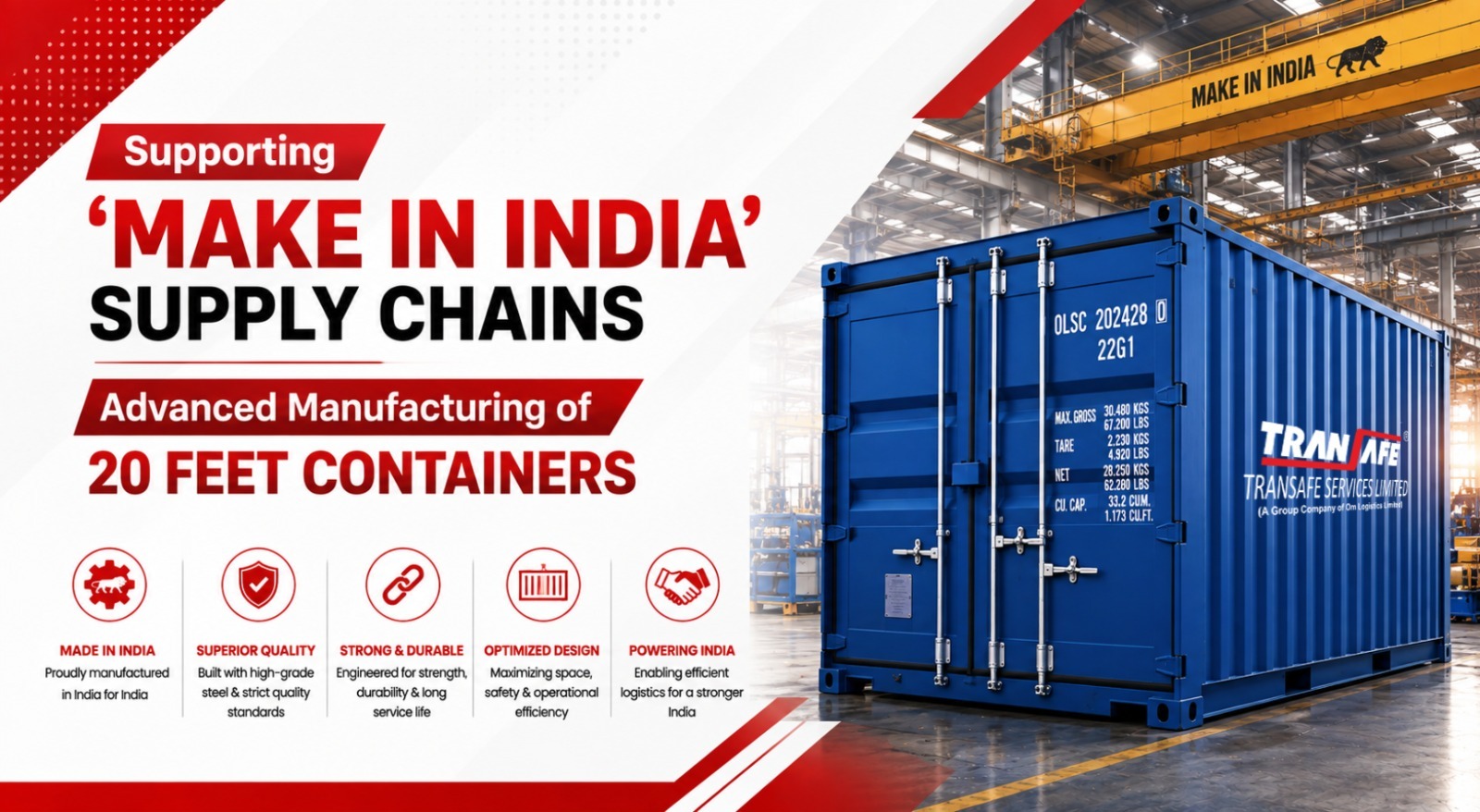
Transafe Services manufactures ISO freight containers aligned with ISO 1496-1 requirements and offers standard as well as customised formats. Its facilities in Kharagpur, Coimbatore and Dharuhera support production across major Indian industrial regions.
20 feet containers and India’s distributed manufacturing network
India does not have one manufacturing corridor. Automotive, engineering, textile, electronics, chemicals and consumer-product clusters are spread across different states and that makes location an important part of buying 20 feet containers.
A container manufactured or positioned closer to a plant can reduce unnecessary empty movement before cargo even enters the transportation cycle. It does not automatically mean lower total cost. Road restrictions, depot capacity, crane access and delivery schedules still matter.
But proximity can simplify the first mile.
For this equipment, this is one of the less visible cost factors. Procurement teams often compare manufacturing quotations while overlooking positioning costs, waiting time and empty movement.
We would rather evaluate the complete operating route.
Standard unit or high cube container?
A standard container is not always the right specification.
A high cube container provides additional internal height and can be useful for bulky, lightweight cargo, packaging-heavy products and equipment requiring additional vertical clearance.
The decision becomes more important when comparing standard 20 feet containers with a 20 ft high cube container.
More height sounds attractive. It is not always useful.
If payload, floor loading, axle limits or warehouse clearance are the real constraints, additional height may add little value.
When procurement teams search for 20 ft high cube container dimensions, they should look beyond headline external measurements. Door aperture, internal clearance, tare weight, floor construction and the loading method can be more important operationally.
The same principle applies to an hc container. It should solve a measured capacity problem rather than become a default upgrade.
20 ft high cube container dimensions: what planners should actually measure
Typical ISO dimensions place a 20-foot container at approximately 6.058 metres long and 2.438 metres wide. Standard height is approximately 2.591 metres, while a high cube version is approximately 2.896 metres high.
Those 20 ft high cube container dimensions are useful for initial planning, but warehouse teams should validate the actual unit specification.
For 20 feet containers, practical checks include:
-
Forklift entry and turning space;
-
Pallet pattern and usable floor area;
-
Cargo centre of gravity;
-
Door opening clearance;
-
Lifting and handling equipment;
-
Trailer, rail and yard compatibility.
The same checks should be applied when reviewing high cube dimensions for oversized packaging or tall assemblies.
This is where these units stop being catalogue products and become operational assets.
Manufacturing quality becomes a logistics issue
Quality problems rarely remain at the manufacturing plant.
A badly aligned door can slow loading. Poor floor construction can restrict equipment. Inconsistent fittings can complicate lifting and stacking. Weak corrosion protection can increase maintenance requirements over the useful life of the asset.
That is why buyers should evaluate 20 feet containers through manufacturing controls, inspection processes, documentation and intended use.
For export-oriented manufacturers, applicable ISO and customer requirements should be established before production begins. Transafe states that its ISO freight containers are designed around ISO 1496-1 requirements for road, rail and marine transportation.
For these units, compliance is not paperwork added at the end. It should be part of the specification from the beginning.
The hidden cost behind a container purchase
The purchase cost of 20 feet containers is only one part of the economics.
The wider cost can include:
-
Empty repositioning;
-
Yard occupancy;
-
Loading labour;
-
Handling equipment time;
-
Factory-gate waiting;
-
Repairs and maintenance;
-
Missed dispatch windows;
-
Unnecessary depot transfers.
This is why two apparently similar units can have very different total operating costs.
A unit that arrives late can disrupt production. A technically excellent container sitting too far from the plant can create avoidable positioning expenses. A specification that does not suit the cargo can increase handling time every time the unit is loaded.
For small and mid-sized businesses, the consequences can be sharper because there is usually less buffer capacity.
How to select 20 feet containers for a manufacturing supply chain
Start with the cargo.
Define its weight, dimensions, packaging, pallet pattern, loading method, frequency of movement and transportation modes. Then map the route.
For 20 feet containers, procurement teams should answer six questions:
-
Will the unit serve domestic distribution, exports, or both?
-
Is the cargo weight-heavy or volume-heavy?
-
Does it require ventilation, side access, open-top loading or another configuration?
-
Where will empty units be stored?
-
Which inspection and certification requirements apply?
-
Can the manufacturer maintain the same specification across repeat orders?
For many businesses, 20 feet containers are an effective baseline. But the best units are the ones that remove friction across the entire movement cycle.
When a high cube container earns its place
A high cube container makes sense when vertical space is genuinely limiting.
Think packaged machinery, lightweight fabricated assemblies, certain industrial products or cargo requiring protective packaging.
It can be the wrong choice when the real constraint is road clearance, axle weight, crane capacity or warehouse height.
The same rule applies to an hc container.
Before choosing a 20 ft high cube container, measure the cargo and the loading environment. Compare those requirements with the relevant dimensions, including door clearance and usable internal height.
This sounds basic. It prevents expensive mistakes.
For businesses moving these units regularly, those checks can also improve loading consistency from one dispatch to the next.
Why Indian manufacturing of containers strengthens resilience
Domestic production does more than support the Make in India objective. It shortens the feedback loop between the customer, engineer and manufacturer.
Suppose an engineering company needs a modified access arrangement. Or an exporter requires a specific internal configuration. Or a manufacturer wants a container adapted to specialised equipment.
With 20 feet containers, those requirements are easier to address when engineering and manufacturing teams can discuss the application directly.
Transafe's portfolio extends beyond conventional ISO freight containers into customised and specialised solutions, including containerised substations, equipment enclosures and other application-specific units.
That capability matters because Indian manufacturing is becoming more specialised. One standard configuration cannot solve every movement problem.
Why Transafe is relevant to this decision
Transafe Services brings more than three decades of container manufacturing experience and operates facilities in Kharagpur, Coimbatore and Dharuhera. The company manufactures ISO freight containers as well as specialised and customised container solutions.
For a company evaluating 20 feet containers, the better starting point is a technical discussion around cargo profile, route, loading method, compliance and expected usage.
That approach produces a defensible specification instead of a catalogue-driven purchase.
For manufacturers building the next phase of India's industrial capacity, 20 feet containers may look like a small procurement decision. Operationally, they are part of the infrastructure that keeps production moving.
The right units will not repair a weak supply chain. But the wrong ones can quietly make a good one more expensive.
FAQs
1. What are 20 feet containers mainly used for?
20 feet containers are widely used for general cargo, particularly dense or heavy goods where payload and practical loading matter more than maximum cubic capacity.
2. When should a business choose a high cube container?
Choose a high cube container when additional internal height improves cargo fit or packaging efficiency. Check route restrictions, handling equipment and warehouse clearance first.
3. What should I check in 20 ft high cube container dimensions?
Review external and internal length, width and height, door aperture, floor height, tare weight and usable clearance. The 20 ft high cube container dimensions shown in a brochure should always be checked against the actual cargo.
4. Are 20 feet containers suitable for Indian domestic logistics?
Yes. 20 feet containers can support road and rail movement and can be integrated into domestic distribution, industrial storage and export operations, subject to route and equipment requirements.
5. Can Transafe customise a container?
Yes. Transafe manufactures ISO freight containers and customised solutions for specialised industrial applications, supported by facilities in Kharagpur, Coimbatore and Dharuhera. Its offering covers standard 20 feet containers, specialised units and customised container derivatives.