Cargo movement is not always uniform. Certain consignments challenge conventional container formats due to excess height, concentrated weight or complex handling requirements. In such scenarios, container design becomes a strategic enabler rather than a passive asset. The open top container, particularly in the 20 ft container configuration, addresses these challenges through engineered flexibility backed by ISO compliance.
Let’s presents a structured and technical view of the 20 ft container specifications, dimensions, capacity, performance factors and industrial relevance, aligned precisely.
What Is an Open Top Container?
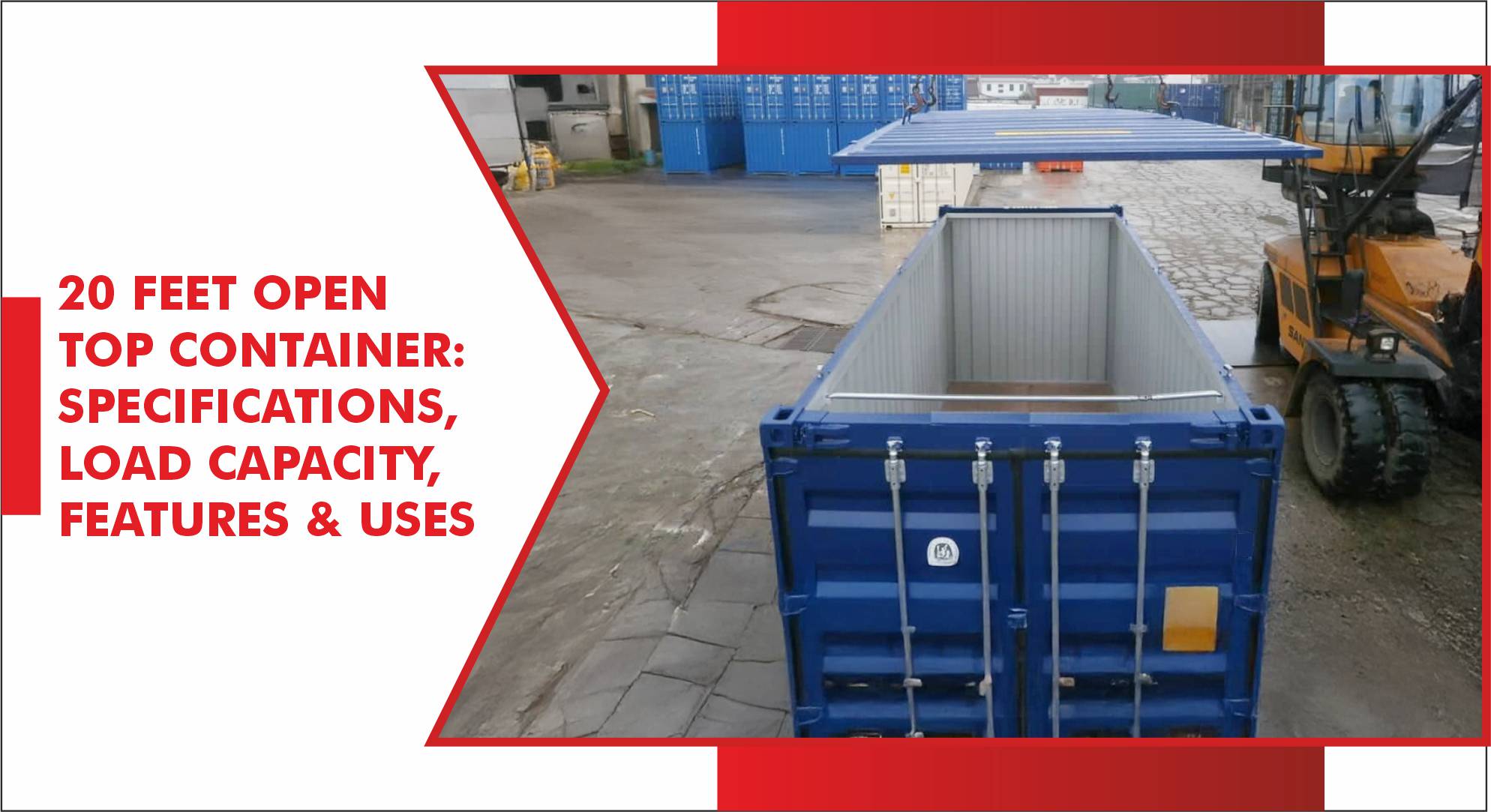
An open top container is a type of ISO freight container designed without a permanent steel roof. The absence of a fixed top allows cargo to be loaded vertically using cranes or lifting equipment. Once loading is completed, the container can be secured using a tarpaulin cover supported by removable steel bows.
Despite the open roof, the container maintains structural integrity through reinforced top rails and end frames. These containers are manufactured in accordance with ISO 1496-1, ensuring compatibility across road, rail and sea transport.
Overview of 20 ft. Container Applications and Storage Containers
The 20 ft container is widely adopted due to its operational versatility and infrastructure compatibility. When configured as an open top unit, its usability extends across sectors requiring non-standard cargo handling.
Storage containers and open top containers are extensively used in:
-
Transportation and project logistics
-
Construction and infrastructure projects
-
Oil field and energy installations
-
Telecom and utility equipment handling
-
Scientific research and space-related sectors
-
Power generation and defence services
-
Offshore operations
These containers support both domestic distribution and overseas shipping without compromising regulatory acceptance.
20 ft. Container Specifications Explained
Clear understanding of 20 ft container specifications is essential for logistics planning, compliance management and asset optimization. Open top containers follow the same foundational engineering principles as general-purpose containers, with specific design adjustments to accommodate the open roof.
Core Container Specifications
-
Manufactured as Series 1 ISO freight containers
-
Fully compliant with ISO 1496-1 standards
-
Intermodal usability across road, rail and ship
-
High-tensile weathering steel construction
-
Reinforced corner posts and top rails
-
Forklift pockets and standard corner castings
These container specifications ensure reliability under heavy load and repeated handling cycles.
20 ft. Container Size and Open Top Container Dimensions
Dimensional accuracy plays a critical role in cargo compatibility and route planning.
Standard 20 ft Container Size
|
Parameter |
Measurement |
|
External Length |
6,058 mm |
|
External Width |
2,438 mm |
|
External Height |
2,591 mm |
|
Internal Length |
Approx. 5,900 mm |
|
Internal Width |
Approx. 2,350 mm |
|
Internal Height |
Approx. 2,350 mm |
Open Top Container Dimensions
-
Full-length roof opening
-
No fixed height restriction during loading
-
Tarpaulin cover adds marginal height after securing
These open top container dimensions allow efficient handling of over-height cargo without altering container footprint.
Understanding 20 ft. Container Capacity and Load Handling
The 20 ft container capacity is defined by both structural limits and regulatory weight thresholds.
Load Capacity Overview
-
Maximum Gross Weight: ~30,480 kg
-
Tare Weight: ~2,300–2,400 kg
-
Maximum Payload: ~28,000 kg
Load Handling Advantages
-
Vertical placement of heavy machinery
-
Reduced dismantling of oversized equipment
-
Improved load stability for dense cargo
The 20 ft container capacity supports high-load applications while maintaining safe handling margins.
Key Container Specifications That Impact Performance
Certain technical attributes directly influence operational efficiency and long-term performance.
Structural Performance Factors
-
Reinforced header rails compensate for open roof
-
High-load corner castings support lifting operations
-
Marine-grade plywood flooring resists point loads
Compliance and Durability Factors
-
CSC certification for international shipping
-
Corrosion-resistant steel for extended service life
-
Design compatibility with standard handling equipment
These container specifications ensure predictable performance across varied operating environments.
Features and Benefits of Open Top Container Design
The open top configuration delivers functional benefits without deviating from ISO standards.
Key Design Features
-
Fully open roof for crane-assisted loading
-
Removable tarpaulin cover for weather protection
-
Steel bows to support covering system
-
Internal lashing rings for cargo securing
Operational Benefits
-
Faster loading and unloading cycles
-
Improved safety during heavy cargo handling
-
Flexibility for irregular and tall consignments
The open top container design prioritizes operational control and cargo integrity.
Industrial Uses of Open Top Container and Storage Containers
Open top containers and storage containers serve as both transport assets and static infrastructure.
Common Industrial Applications
-
Heavy machinery and plant equipment
-
Steel structures and fabricated assemblies
-
Power transformers and generators
-
Oil and gas equipment modules
-
Telecom shelters and integrated systems
Their adaptability supports temporary storage, long-haul transport and project-based deployment.
Maintenance and Safety Guidelines for Open Top Containers
Structured maintenance protects asset value and ensures compliance.
Maintenance Practices
-
Inspection of tarpaulin and steel bows
-
Corrosion monitoring on exposed rails
-
Floor condition checks under heavy loads
Safety Guidelines
-
Uniform load distribution
-
Secure lashing before transit
-
Weatherproof covering during storage
Adherence to these practices reduces operational risk and extends service life.
Why Quality Container Specifications Matter for Long-Term Use
Consistent container specifications directly impact lifecycle cost, safety and reliability.
High-quality containers deliver:
-
Lower maintenance frequency
-
Global acceptance across transport modes
-
Predictable performance under load
For long-term deployment, specification discipline translates into sustained operational efficiency.
Conclusion
The 20 Feet Open Top Container remains a critical solution for industries managing complex cargo profiles. Supported by defined 20 ft container specifications, optimized 20 ft container size, reliable 20 ft container capacity and compliant open top container dimensions, it delivers controlled flexibility without sacrificing structural discipline.
Across transportation, storage and project logistics, the open top container continues to serve as a dependable asset where conventional containers reach their operational limits.
Frequently Asked Questions
Are open top containers suitable for overseas shipping?
Yes. When secured with tarpaulin and compliant lashing, they meet sea transport requirements.
Can open top containers be used as storage containers?
Yes. They are frequently used for on-site storage of heavy or oversized equipment.
Does the open roof compromise container strength?
No. Structural reinforcements maintain load-bearing capability.