A 40 ft container is often selected because it feels like the safe middle ground: plenty of room, familiar handling and broad availability. But cargo rarely behaves neatly. This equipment can run out of usable space before it reaches its practical weight limit or become weight-constrained while plenty of floor area is still empty.
That distinction affects warehouse work, inland transport, loading time and the cost of avoidable inefficiency. The equipment should be assessed before booking.
The short answer: it depends on your cargo
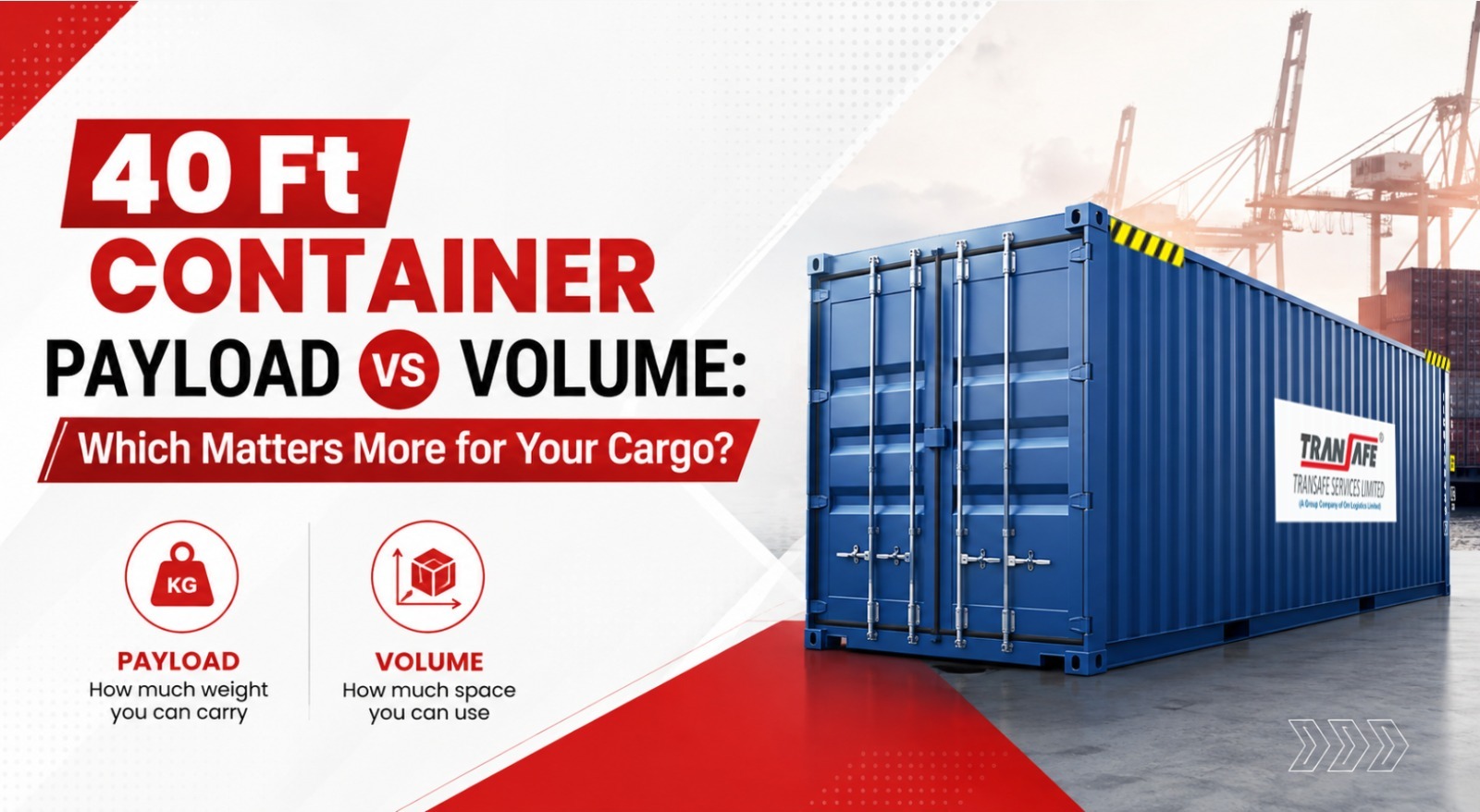
For this container size, payload and volume are separate constraints.
-
Volume matters more when cargo is light, bulky or awkward to stack.
-
Payload matters more when cargo is dense, heavy or concentrated.
-
Both matter when pallets, machinery, packaging and route restrictions interact.
We do not recommend choosing a 40 ft container from a catalogue specification alone. Start with the packed cargo. Then consider how it will be loaded, secured, moved and unloaded.
This equipment is a piece of transportation equipment, not simply a large box. It still needs route planning.
When volume becomes the real constraint
A 40 ft container is particularly useful for high-volume, low-density cargo: packaged consumer goods, furniture components, textiles, insulation products and many lightweight industrial items.
Here, the problem is not usually weight. It is wasted air.
The unit may have plenty of theoretical capacity, yet the loading team can still finish with frustrating gaps because carton sizes do not align, pallets leave unusable spaces, fragile products cannot be stacked, or a machine forces an awkward loading pattern.
This is where experience matters. With the right loading plan, better packing can sometimes achieve more than simply moving to a different equipment type.
Before loading, check:
-
Packed carton dimensions, not product dimensions
-
Pallet or skid footprint
-
Stacking limits
-
Access requirements
-
Protective packing and dunnage
-
Loading sequence
The last point is often overlooked. The equipment is only as efficient as its loading sequence.
When payload matters more
A 40 ft container becomes a different operational problem when cargo is dense.
Steel components, machinery, castings, engineering equipment and other heavy goods can approach practical weight limits while leaving visible empty space. A unit that looks half empty can still be operationally full.
That is not a contradiction. A 40 ft container can be space-rich and weight-limited.
The cargo may be limited by permissible gross weight, road conditions, vehicle configuration, axle considerations or the need to distribute weight correctly. The equipment must therefore be considered together with its inland leg, not as an isolated piece of equipment.
The loading plan still has to respect the cargo. For Indian logistics operations, this distinction matters during the hand-off between factory, truck, terminal and final destination.
Payload is not just the total weight
With a 40 ft container, where the weight sits can matter almost as much as how much it weighs.
Dense cargo concentrated in one area can create handling and stability concerns. The same total weight arranged in a balanced pattern can behave very differently.
We prefer to review the loading arrangement before the cargo reaches the gate. Corrections are easier at the warehouse than after the truck is waiting and the loading window is closing.
For this equipment, the practical check is straightforward:
Total packed weight + total packed volume + loading geometry + route constraints = the real equipment decision.
That formula is more useful than looking at capacity in isolation. The 40 ft container is judged by usable capacity, not theoretical capacity.
Standard height or high cube?
A 40 ft hc container becomes relevant when vertical space, rather than floor space, is holding the loading plan back.
A 40 ft hc container can make sense for light, stackable cargo where additional internal height can actually be used. It is less useful when products cannot be stacked or when warehouse equipment and loading procedures do not suit the extra height.
The right high-cube unit is therefore not automatically the tallest option. For buyers comparing a 40 feet high cube container, ask whether the extra height will be filled safely and efficiently.
A catalogue measurement is not the same as usable capacity. The loading plan still governs the actual utilisation of the equipment.
A 40 ft hc container should be assessed against door access, internal dimensions, floor condition, handling equipment and loading sequence. The right high-cube unit for one product may be a poor choice for another.
A practical loading example
Consider two manufacturers working with a 40 ft container.
The first sends lightweight packaged products. The unit is likely to become volume-constrained first. The loading team should focus on carton orientation, stacking, pallet configuration and void reduction.
The second sends dense engineering parts. A 40 ft container may reach a practical weight constraint before the available volume is exhausted. The priority becomes payload, distribution, securing and the inland vehicle.
Same container size. Different bottleneck. The equipment exposes that difference quickly.
This is why a 40 ft container should be selected from the cargo profile rather than from habit. The equipment should fit the workflow, too.
The warehouse can make or break container utilisation
A 40 ft container may be perfectly suited to the cargo and still be poorly utilised if the warehouse loading process is rushed.
Forklift reach, pallet-jack access, crate orientation, lashing points, blocking and bracing all affect the final arrangement inside the unit. It is a working space with operational constraints.
The answer is not always a larger unit. Sometimes the existing equipment needs a better load plan.
For project cargo or unusual industrial loads, a standard 40 ft container may not be appropriate at all. Transafe Services manufactures ISO freight containers and cargo-specific designs for heavy, oversized, ventilated and top-loaded applications.
Where customised containers change the conversation
Some cargo should not be forced into a standard 40 ft container.
Transafe Services specialises in ISO containers and customised container derivatives, including freight containers, offshore containers, containerised substations and special-purpose solutions. The company also highlights customisation for application-specific requirements.
For a business repeatedly handling unusual equipment, the question should move from “Which 40 ft container should we use?” to “What configuration will make this cargo safer and easier to move?”
That shift can remove recurring warehouse problems. It can also make the equipment easier to manage.
A 40 ft container remains the right answer for many conventional loads, but the right equipment is ultimately defined by the cargo. The container size is not the decision by itself.
Why Indian route planning matters
A 40 ft container does not move directly from a factory floor to its final destination. It passes through several operating environments.
The equipment must be compatible with the truck, gate process, lifting equipment, terminal handling and delivery conditions. A plan that works at the loading bay can still create trouble later.
For SMEs, this is where small planning errors become frustrating operational delays. Equipment loaded without considering the inland leg can create avoidable changes after the cargo is already packed.
The practical lesson is simple: involve transport planning before the warehouse starts loading. A 40 ft container works best when every hand-off is planned.
Final decision: payload or volume?
So, for a 40 ft container, which matters more?
Whichever constraint your cargo reaches first. The equipment makes that trade-off visible.
Choose volume when the unit is filled by light, bulky goods. Choose payload when dense cargo reaches its practical weight limit first. Consider a 40 ft hc container when vertical space is genuinely usable. Evaluate a 40 feet high cube container when the cargo profile supports it.
The best 40 ft hc container is the one that fits the cargo, handling method, route and compliance requirements. The equipment should be selected with the same discipline.
Our approach is simple: understand the cargo, map the route, test the loading pattern, then choose the equipment. That keeps the container choice tied to the real operation.
That is how a 40 ft container becomes a logistics tool rather than just another booking decision.
FAQs
Is a 40 ft container better for heavy or bulky cargo?
A 40 ft container can suit both. Heavy cargo makes payload and distribution the priority; bulky cargo makes volume and packing efficiency the priority.
When should I choose a 40 ft hc container?
A 40 ft hc container is worth considering when light or stackable cargo can safely use additional vertical space. The best 40 ft hc container depends on the actual loading plan.
Is a 40 feet high cube container always more efficient?
No. A 40 feet high cube container is useful only when the extra height can be safely and practically used. Compare each high-cube option against the actual cargo geometry.
What is the best 40 ft hc container for industrial cargo?
The best 40 ft hc container depends on dimensions, weight, handling method, securing needs and route conditions. Non-standard cargo may need a customised solution.
Can Transafe Services provide customised containers?
Yes. Transafe Services states that it designs and manufactures ISO containers and customised solutions for specialised applications, including heavy, oversized, ventilated and top-loaded cargo.