India’s rapid growth across logistics, infrastructure, manufacturing sectors and global trade has made ISO shipping containers a critical asset rather than a supporting component. Movement of cargo today demands uniformity, structural reliability and global acceptance across transport modes. This is where an established ISO shipping container manufacturer in India plays a decisive role.
ISO shipping container manufacturing is governed by clearly defined international standards that ensure consistency in design, dimensions, load capacity and handling. Containers built under ISO norms are engineered for seamless movement across road, rail and sea without operational disruption. Such standardization enables predictable performance, faster turnaround at ports and compatibility with global material-handling infrastructure.
What Makes an ISO-Certified Container Manufacturer Reliable
Reliability in container manufacturing is defined by measurable compliance, not claims. An ISO certified container manufacturer adheres to documented processes, audited systems and internationally accepted engineering benchmarks.
Key reliability markers include:
-
Compliance with ISO 1496-1 standards for Series 1 freight containers
-
Consistent material traceability and fabrication controls
-
Structural integrity validated through load and stress testing
-
Intermodal compatibility across road, rail and sea
ISO certified manufacturing ensures containers perform predictably under diverse climatic, mechanical and operational conditions.
Types of Shipping Containers Manufactured in India
A leading container manufacturer in India offers a broad portfolio aligned to cargo characteristics, handling methods and industry requirements.
ISO Freight Containers (ISO 1496-1): Manufactured for general cargo transport with global intermodal acceptance.
Standard dimensions include:
-
20 ft: Standard and High Cube
-
40 ft: Standard and High Cube
Dry Van Containers: Enclosed units with end or dual-end doors. Available in standard and high cube configurations.
Side Access Containers: Side-opening doors combined with end doors. Designed for efficient loading in restricted spaces.
Open Top Containers: Roofless design for top-loaded cargo. Tarpaulin coverage available where required.
Hard Top Containers: Removable steel roof. Suitable for heavy or over-height cargo handled by cranes.
Flat Rack Containers: Engineered for heavy-lift, over-width and over-height cargo transportation.
Ventilated Containers: Designed for passive airflow during transit. Commonly used for moisture-sensitive cargo.
Coil-Tainers: Hinged steel roof with reinforced flooring. Optimized for steel coils and dense cargo.
Dwarf Containers: Compact, durable and space-efficient. Used where footprint constraints apply.
Container Manufacturing Process, Materials & Engineering Standards
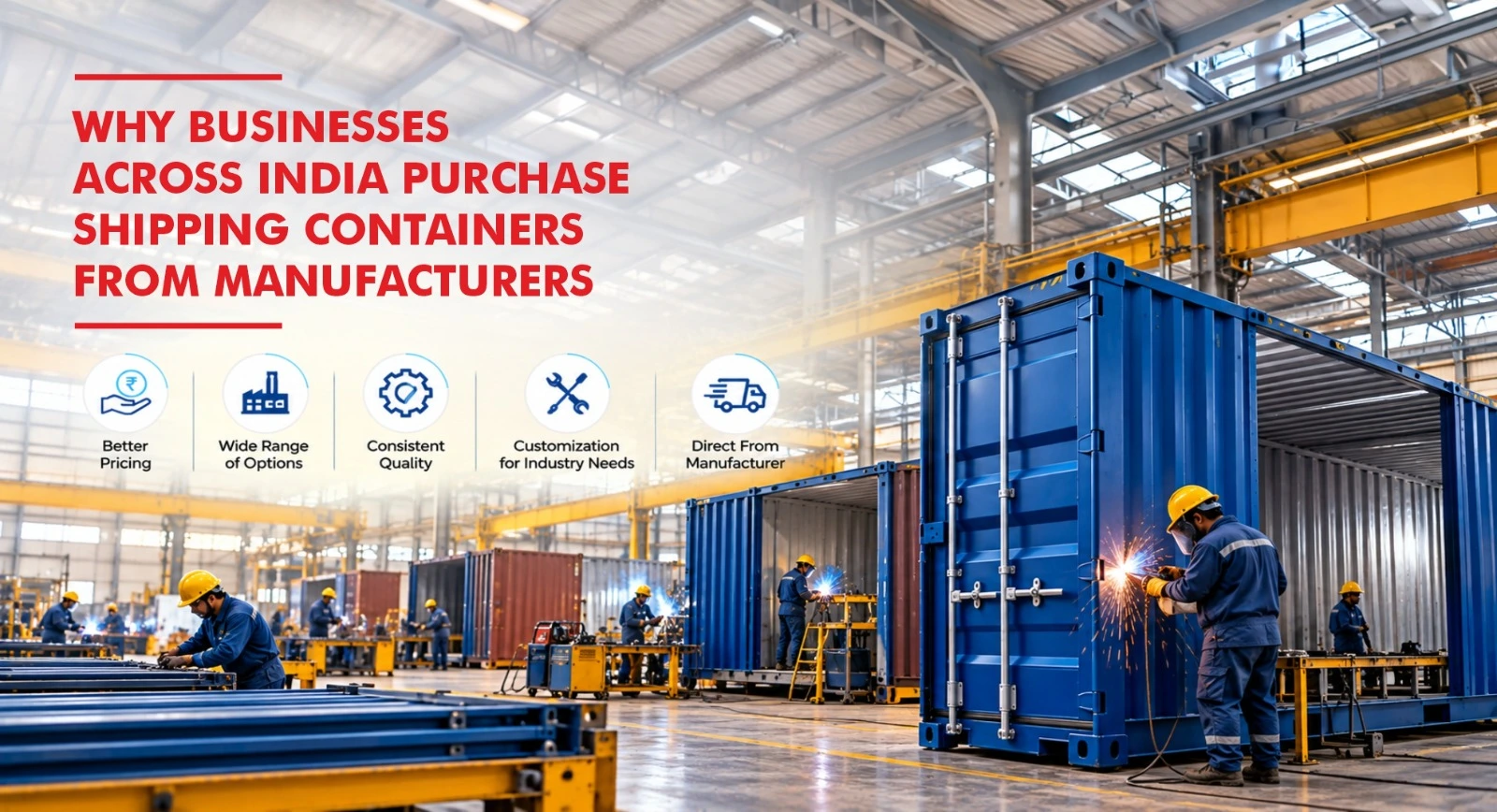
The container manufacturing process follows a controlled, sequential workflow.
Core stages include:
-
Design validation and structural modeling
-
High-grade steel selection
-
Precision cutting, forming and welding
-
Surface treatment and corrosion protection
-
Assembly, finishing and fit-out
Engineering standards govern wall thickness, corner castings, flooring systems and door hardware. This ensures compatibility with global handling equipment and long-term durability.
Quality Control, Testing & ISO Compliance Assurance
Quality assurance is embedded across the production lifecycle. ISO certified facilities operate under documented inspection protocols.
Testing frameworks typically include:
-
Load testing
-
Stacking and racking tests
-
Water tightness verification
-
Door operation and sealing checks
-
Dimensional accuracy inspections
ISO compliance is not limited to certification audits. It is reflected in repeatable manufacturing outcomes and predictable container performance.
Shipping Container Price in India – Cost Factors & Buying Guide
Shipping container price in India varies based on multiple technical and commercial variables.
Primary cost drivers include:
-
Container size and type
-
Steel grade and thickness
-
ISO certification requirements
-
Order volume and delivery timelines
|
Container Type |
Key Cost Influencers |
Price Sensitivity |
|
Standard Dry Container |
Steel grade, size |
Moderate |
|
High Cube Container |
Height, reinforcement |
Medium |
|
Specialized Containers |
Design complexity |
High |
Evaluating shipping container price in India requires balancing upfront cost against lifecycle performance and compliance value.
Industrial Applications of Shipping Containers Across Sectors
Modern shipping containers extend far beyond freight movement.
Key application sectors include:
-
Transportation and logistics
-
Industrial storage and warehousing
-
Infrastructure and construction sites
-
Oil and gas operations
-
Power generation projects
-
Defence and security installations
-
Research and scientific facilities
-
Offshore platforms
Versatility positions the shipping container as a mobile, scalable infrastructure asset.
How to Choose the Best Container Manufacturer in India
Selecting the right container manufacturing company in India requires structured evaluation.
Decision criteria include:
-
Proven ISO certified manufacturing credentials
-
Portfolio diversity across container types
-
Quality testing infrastructure
-
Domestic and export delivery experience
Long-term reliability often outweighs marginal cost advantages.
Why Businesses Trust Us as Their Container Manufacturing Partner
Trust is earned through consistency, not positioning statements.
Business confidence is driven by:
-
ISO-aligned manufacturing systems
-
Global compliance readiness
-
Sectoral experience across industries
-
Transparent commercial practices
This trust converts suppliers into strategic manufacturing partners.
Key Benefits of Choosing an ISO-Certified Shipping Container Manufacturer
An ISO certified shipping container manufacturer delivers measurable advantages.
Key benefits include:
-
Regulatory acceptance across global trade lanes
-
Structural reliability under heavy-duty operations
-
Lower lifecycle maintenance costs
-
Consistent quality across production batches
-
Reduced operational risk
ISO certification functions as a commercial and technical risk mitigator.
Conclusion – Choosing the Right Shipping Container Manufacturing Company in India
A trusted shipping container manufacturer in India operates at the intersection of engineering precision, regulatory compliance and industrial scalability. A reliable shipping container manufacturer in India focuses exclusively on producing ISO-compliant freight containers that meet these exacting requirements. Manufacturing processes emphasize structural strength, corrosion resistance, precise fabrication and rigorous testing to support long-distance transportation, repeated stacking and harsh operating environments. Each container is designed to withstand mechanical stress while maintaining cargo safety and dimensional stability.
India’s role in global trade and infrastructure development demands containers built to international benchmarks. The right shipping container manufacturer in India combines ISO certified systems, engineering discipline and industry insight.
A dependable container manufacturing company in India supports growth, compliance and operational continuity. Selection decisions made today directly impact performance across years of service.
Frequently Asked Questions (FAQs)
What standards define an ISO certified shipping container?
ISO 1496-1 governs design, dimensions, strength and testing requirements.
How is shipping container price in India calculated?
Pricing depends on size, steel specification, customization scope, certification and order volume.
Which industries commonly use custom shipping containers?
Construction, oil and gas, defence, telecom, power and research sectors.
Why choose an ISO certified container manufacturer?
ISO certification ensures predictable quality, safety and global operational acceptance.