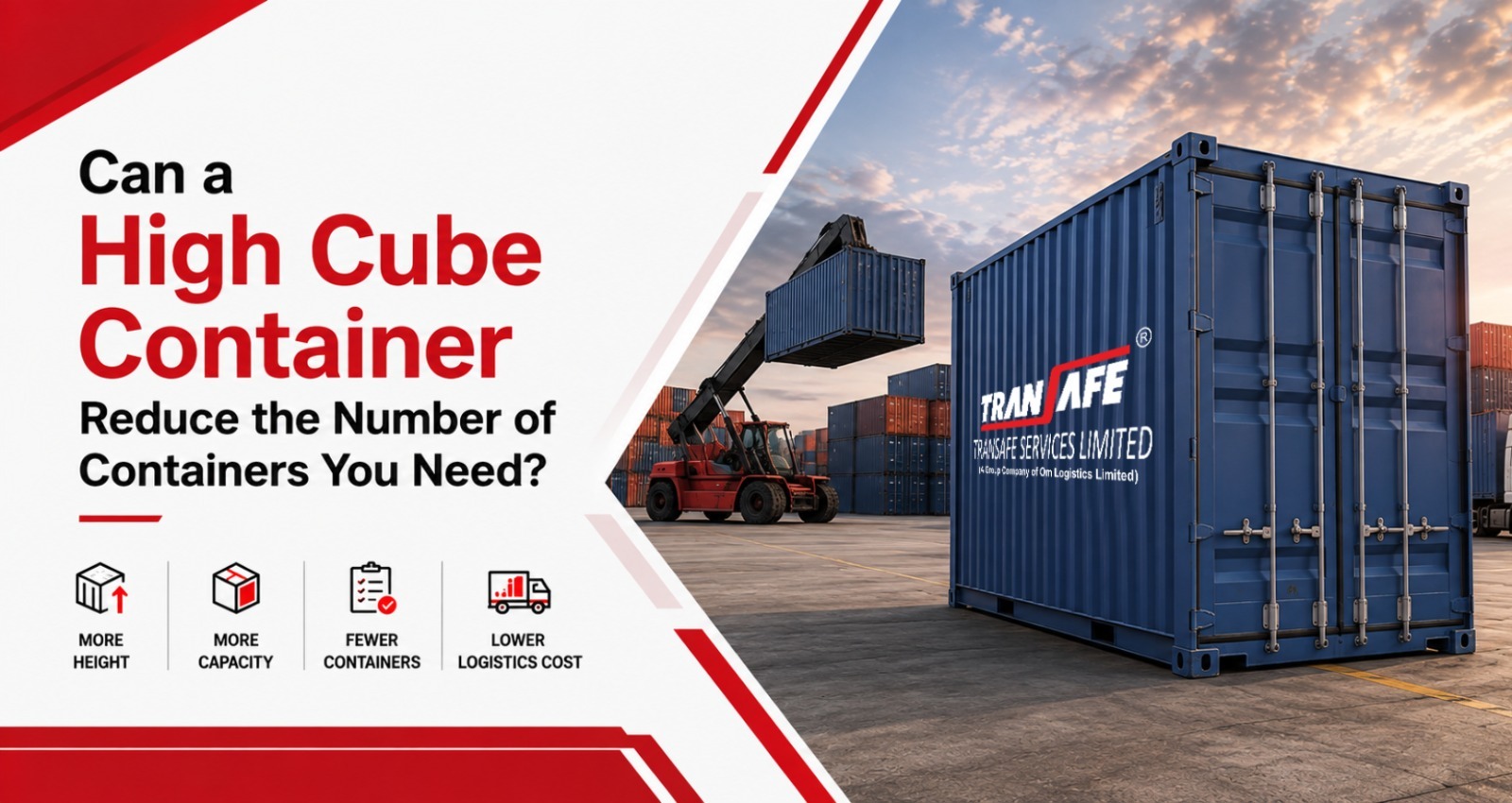
Sometimes, yes. But not simply because it is taller.
A high cube container gives you more usable vertical space than a standard-height container. That sounds straightforward until you start loading real cargo into it. A pallet may not stack safely. A machine may be too heavy long before the available volume is used. Your road route may impose restrictions. Or the extra height may simply sit unused.
So the better question is this:
Can the additional space in a high cube container help you move the same amount of cargo in fewer containers?
For the right cargo, it can. For the wrong cargo, you may gain height without gaining much operational value.
Start with the cargo, not the container
This is where container planning often goes wrong.
A business decides it needs a high cube because it has heard that the container offers more space. Then the procurement team starts looking at containers for sale.
We prefer to reverse that order.
First look at the cargo profile.
Is it light but bulky? Can it be stacked? Is its height consistent from one pallet to the next? Does the packaging leave unused space above the load? Are the goods flexible enough to be arranged differently?
These questions tell you much more than the product label.
A textile exporter, for example, may have a very different requirement from a manufacturer moving dense metal components. Both may use containers, but only one may benefit significantly from extra cubic capacity.
That distinction becomes important when the goal is reducing container count.
Where the extra height can make a real difference
A high cube container is roughly one foot taller externally than a standard-height container. The additional internal clearance can create useful capacity for cargo that is volume-limited rather than weight-limited.
That is the sweet spot.
Think about products such as packaged furniture, certain textile products, insulation materials, retail goods or other relatively light products that occupy a lot of cubic space.
If the standard container reaches its practical height limit while there is still unused payload capacity, the additional clearance can allow more goods to go into the same unit and that can change the loading plan.
Instead of spreading the same quantity across several containers, the logistics team may be able to consolidate more of it into fewer units.
But there is a catch.
More cubic capacity does not mean more permissible weight.
That is one of the easiest mistakes to make when comparing standard and high cube containers.
Volume is not the same as payload
Imagine two businesses.
The first exports lightweight packaged products. Its containers regularly reach the roof before they reach their permitted gross weight.
The second moves dense machinery parts. The container becomes weight-limited long before all available vertical space is used.
The high cube has a much stronger case for the first business. For the second, the extra height may make very little difference. This is why experienced logistics teams look at both weight utilisation and volume utilisation.
If you are consistently running out of cubic space, a high cube may help; if you are hitting payload limits first, adding height will not solve the problem. It sounds obvious on paper, yet it is surprisingly easy to overlook during procurement discussions.
Can one high cube replace two standard containers?
Not automatically. The answer depends on what is being loaded and how efficiently it can be arranged.
Suppose your existing cargo requires two standard containers because each unit runs out of usable height. If the products can be safely stacked higher in a high cube, you may be able to consolidate the load.
But the calculation needs to include more than the internal dimensions.
Consider:
-
Pallet dimensions
-
Pallet orientation
-
Stackability
-
Packaging strength
-
Cargo weight
-
Aisle or access requirements
-
Loading equipment
-
Door opening dimensions
-
Legal road weight limits
-
Destination handling conditions
A container can have spare cubic metres on paper and still be unable to accept another pallet. That is why load planning matters more than brochure capacity.
Pallet geometry can make or break the calculation
This is one of those details that becomes obvious only when you are standing beside a loaded container.
A pallet does not become more efficient simply because the container is taller.
If the goods cannot be stacked, the extra height may provide little practical benefit. If two pallets can be safely stacked, however, that same vertical space suddenly becomes valuable.
Packaging plays a role too. A product packed into rigid cartons may have one loading pattern. The same product packed differently could produce another.
Even a few centimetres of unused clearance across hundreds of pallets can add up. Before deciding that a high cube will reduce container count, businesses should take an actual SKU or pallet profile and work through the loading pattern.
Use the cargo you actually move. Not an idealised example.
When a high cube will not reduce your container count
There are several situations where buying a high cube may change the container specification without changing the number of containers required.
Heavy cargo is the obvious example.
If a container reaches its allowable weight before its available volume is used, additional height has limited value. There are also cargoes that cannot be stacked because of their shape, fragility or handling requirements. Then there are route restrictions.
A container may have more internal space, but the complete vehicle combination still has to comply with applicable road, bridge, terminal and handling restrictions. The extra height needs to make sense within the actual route.
This is particularly relevant in India, where a container journey can involve very different road and terminal conditions depending on the origin, destination and corridor.
A high cube is not a shortcut around transportation constraints.
Fewer containers can mean fewer handling events
When consolidation genuinely works, the benefit is not limited to the physical container.
Fewer containers can mean fewer units to:
-
Book and position
-
Load and seal
-
Move to the terminal
-
Handle during transfers
-
Track through the logistics process
-
Unload at destination
That can simplify operations. There is also a human benefit. Warehouse teams have fewer units to prepare at the same time, and transport planners have fewer movements to coordinate.
But we should be careful with the phrase “cost saving.”
The high cube itself does not guarantee a lower logistics bill. The business case depends on the complete movement: container availability, inland transport, terminal handling, ocean or rail arrangements, loading efficiency and the commercial terms attached to the movement.
The useful question is therefore not “Is a high cube cheaper?”
It is:
“Does the high cube allow us to move more saleable cargo per container without creating a problem somewhere else in the chain?”
What about businesses buying containers for their own operations?
The same thinking applies to a container purchase for storage or repeated logistics use.
If a company regularly stores bulky, lightweight inventory, the additional vertical clearance can make a high cube more useful than a standard ISO container. But if the container is being used for dense raw materials, the extra height may not justify choosing the larger format.
There is another point worth considering: how the container will be handled after purchase.
Will it remain at one site? Will it move between warehouses? Will it enter the export chain? Will forklifts or other equipment be used inside it?
A container that works well as static storage may not necessarily be the right choice for repeated transportation operations.
The intended life of the asset should be part of the buying decision.
High cube versus standard: a practical way to decide
Rather than relying on a generic list of benefits, we would use a simple test.
Choose a high cube when:
-
Your cargo is regularly limited by volume rather than weight.
-
Extra height allows additional safe stacking.
-
Your pallet or product dimensions make good use of the additional clearance.
-
Your route and handling arrangements can accommodate the container.
-
The additional capacity can reduce the number of units required over a meaningful period.
Think twice when:
-
Your cargo reaches its weight limit first.
-
Goods cannot be stacked.
-
Your loading pattern leaves substantial unused space even in a standard container.
-
The extra height creates handling or route complications.
-
You are choosing it simply because “more space must be better.”
That last assumption causes more poor container decisions than most people realise.
Matching the Container to the Cargo
Transafe Services manufactures high cube ISO freight containers in addition to its wider range of standard and specialised container solutions. Its published range includes both 20-ft and 40-ft high cube configurations, while its broader manufacturing portfolio covers applications across transportation, construction, power, telecom, defence, offshore and other industrial sectors.
For a business evaluating high cube containers, that manufacturing background is useful because the right specification starts with the intended application. A company moving high-volume export cargo may need one configuration, while a manufacturer using containers for equipment, storage or a specialised project may have very different requirements. Transafe's wider customised-container capability also means the discussion does not have to stop at standard catalogue formats.
Conclusion
A high cube container can help reduce container count when your cargo is bulky, lightweight and able to use the extra height. But if weight or non-stackable cargo is the limiting factor, the additional space may not make much difference.
Before choosing one, look at your actual cargo, loading pattern and route. The best container is not the biggest one. It is the one that matches the cargo.
Frequently Asked Questions
1. Can a high cube container reduce the number of containers required?
Yes, in the right circumstances. It can accommodate more cubic volume than a standard-height container, particularly for lightweight, bulky or stackable goods. However, the actual reduction depends on cargo dimensions, weight, packaging and loading arrangements.
2. Is a high cube container better for heavy cargo?
Not necessarily. Heavy cargo often reaches the permissible weight limit before the available volume is used. In that situation, the additional height may provide little practical benefit.
3. Does a high cube container have more weight capacity?
Not simply because it is taller. A high cube primarily provides additional internal volume. The applicable maximum gross weight and payload depend on the container specification and the operating requirements.
4. Can a high cube container replace two standard containers?
Sometimes, but there is no universal rule. The answer depends on how the cargo can be stacked and arranged, its total weight and the practical loading capacity of each container.
5. What should I consider before buying a high cube container?
Start with the cargo profile and intended use. Review volume, weight, pallet dimensions, stackability, handling equipment, route conditions, applicable standards and how frequently the container will be used. For businesses looking at containers for sale, these factors are more useful than comparing height alone.