A site office sounds like a small decision until the project starts moving.
Then the questions arrive: Will it need to move? How will trucks access it? Can electrical systems be installed safely? What happens during monsoon? Will the unit still work properly six months from now?
For many Indian businesses, the real choice is not simply container office vs portable cabin. It is about matching the structure to the way the project actually operates.
For construction sites, warehouses, manufacturing units, logistics yards and remote industrial projects, the right choice can reduce site disruption, relocation effort and avoidable operating costs.
So, which one makes more sense?
The answer depends on your workflow.
Container Office vs Portable Cabin: What Is the Real Difference?
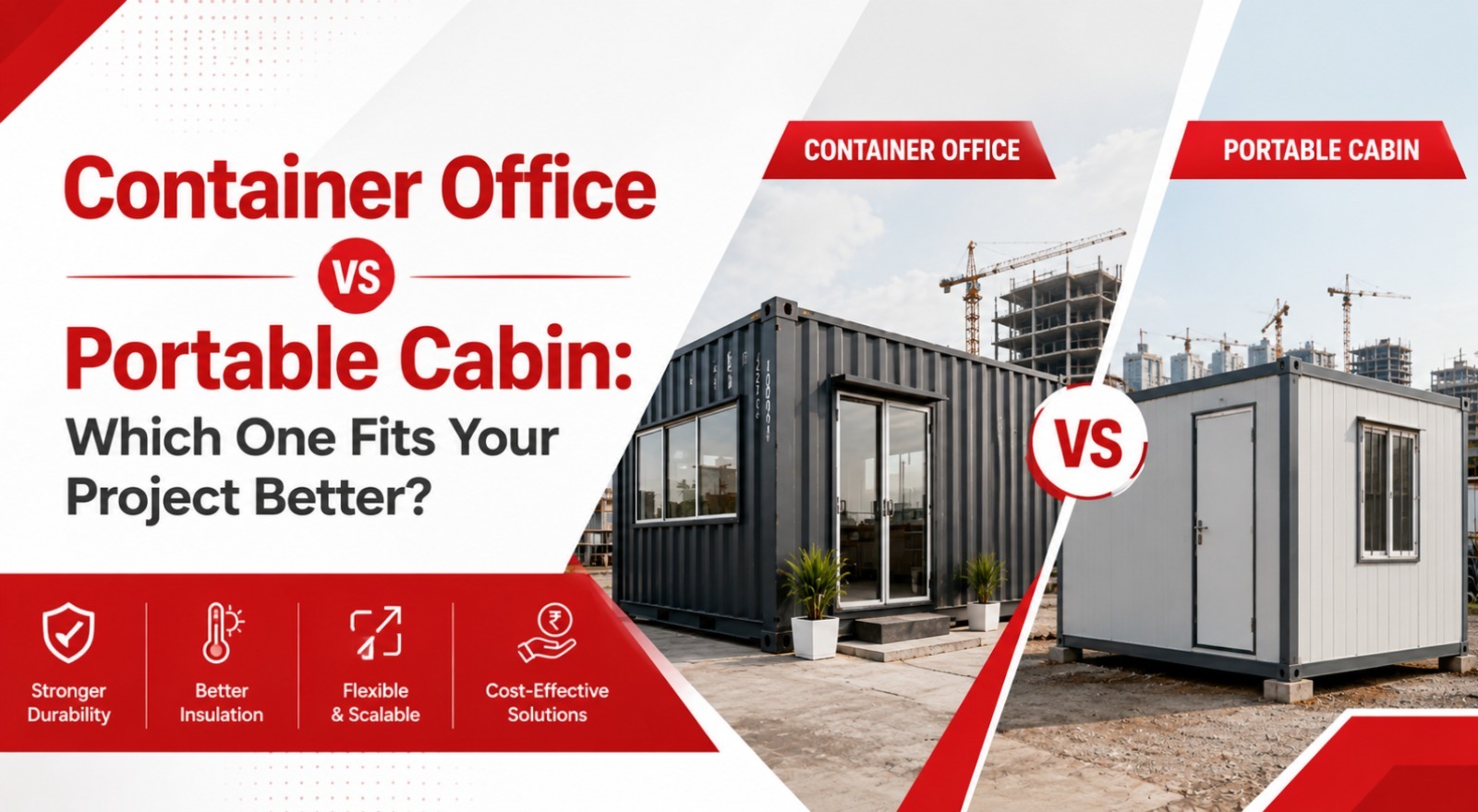
A container office is generally built around a stronger, transportation-oriented steel structure. A portable cabin is usually designed primarily as relocatable site infrastructure.
That distinction matters.
A cabin may be perfectly adequate when the requirement is a straightforward office, security room or temporary staff facility. A container-based solution becomes more attractive when the unit must withstand demanding handling, frequent movement, industrial conditions or integration with specialised equipment.
Think beyond the walls.
Your decision should account for:
-
How often the unit will be relocated
-
Road access and lifting arrangements
-
Expected project duration
-
Weather exposure
-
Electrical and HVAC requirements
-
Security requirements
-
Internal layout
-
Future reuse
-
Compliance and safety expectations
-
Whether the unit could eventually serve another operational purpose
This is where procurement teams sometimes make the wrong comparison. They compare two structures on appearance and initial requirement instead of comparing their total operational usefulness.
When a Container Office Makes More Sense
A container office is usually the stronger option when the structure needs to behave like an asset rather than a disposable site facility.
Consider a logistics yard where supervisors coordinate vehicle movements, documentation and loading activity. The office may be moved as the yard layout changes. It needs secure doors, reliable electrical systems, practical access and enough durability to survive repeated handling.
A purpose-built container office can be configured around that reality.
The same logic applies to manufacturing projects, infrastructure works, power installations and remote industrial locations.
Container-based structures can also be adapted for applications beyond a basic office. Transafe Services, for example, manufactures customised containers and derivatives including bunk houses, M-Rooms, operators' cabins, E-House containers, containerised substations and other specialised units.
That flexibility becomes valuable when the project changes halfway through.
And projects do change.
When a Portable Cabin Is the Better Choice
Portable cabins still have a very practical place in Indian project operations.
If you need a relatively simple office for a limited-duration construction site, contractor facility or security point, a portable cabin can be a sensible solution.
It may be preferable when:
-
The unit will remain at one location for most of its useful life
-
The internal requirement is straightforward
-
There is limited need for specialised equipment
-
The project does not involve repeated transportation
-
Speed of basic site deployment matters more than extensive customisation
The mistake is assuming that one option is universally better.
It isn't.
A portable cabin can be the right answer for a simple site office. A container office can be the better answer for a demanding operational environment.
Container Office vs Portable Cabin: The Five Factors That Actually Matter
1. Relocation Frequency
Ask a simple question: How many times will we move it?
If the answer is once, almost any properly engineered portable structure may work.
If the answer is several times, transportation becomes a major consideration.
Every relocation involves lifting, loading, securing, road movement, unloading, positioning and reconnecting utilities. A structure designed with transport and handling in mind can make this process considerably more manageable.
This is particularly relevant to contractors working across multiple project locations.
2. Site Conditions
Indian operating conditions are not gentle on temporary infrastructure.
Heat, dust, heavy rain, coastal humidity and uneven project sites all expose weaknesses quickly.
A structure that looks adequate during a factory inspection can become uncomfortable or difficult to maintain once installed at an exposed site.
Insulation, ventilation, flooring, roof design, drainage, electrical protection and access therefore deserve more attention than the exterior finish.
For specialised container applications, Transafe Services highlights customised construction, insulation and controlled internal environments for applications such as E-House and electrical installations.
3. Security and Asset Protection
A site office may contain more than desks.
It could hold laptops, project documents, communication equipment, drawings, control systems or valuable operational records.
For a logistics operation, the office may also sit beside expensive cargo and equipment.
That changes the requirement.
Door construction, locking arrangements, structural strength, access points and placement should be considered as part of the site's security plan rather than treated as finishing details.
4. Customisation
A basic four-person office has very different requirements from an operations room.
You may need:
-
Partitioned work areas
-
Electrical panels
-
Cable routing
-
Air conditioning
-
Data and communication points
-
Windows positioned for visibility
-
Storage
-
False flooring
-
Equipment mounting
-
Additional access doors
This is one area where a customised container can offer considerable value.
Transafe's product range includes purpose-built and application-specific containers rather than only standard freight units. Its facilities in Dharuhera, Kharagpur and Coimbatore support production for customers across different industrial sectors.
5. What Happens After the Project?
This question is often ignored during procurement.
Suppose your construction project ends. What happens to the office?
A well-designed portable asset can be moved to another site, repurposed as a store, converted for equipment use or retained as part of the company's temporary infrastructure pool.
That residual usefulness changes the economics.
The cheapest structure at the time of purchase is not necessarily the cheapest structure over three projects.
The Global Container Angle: Why Standardisation Matters
The phrase global container usually brings freight movement to mind, but the underlying principle is useful for project infrastructure too: standardised dimensions, transportation compatibility and predictable handling can simplify movement.
That matters when equipment, people and infrastructure cross locations.
Businesses already familiar with container logistics understand this advantage. Containers are designed around established handling systems involving road transport, lifting equipment, yards and terminals.
A project-specific container office may not automatically become an ISO freight container simply because it uses a container form factor. Its intended application, construction, fittings and certification requirements still need to be assessed.
This distinction is important.
Do not buy a structure because it looks like a shipping container. Buy it because its engineering matches the job.
How Container Logistics Changes the Decision
The structure itself is only one part of the equation.
Think about the entire movement cycle.
Where will the unit be manufactured? How will it reach the site? What lifting equipment will be required? Is there sufficient access for the vehicle? Where will it sit? Can it be moved without major site preparation? What happens to electrical and HVAC connections after relocation?
These questions sit squarely within container logistics.
A good supplier should be able to discuss more than fabrication. The conversation should include handling, delivery, positioning, application requirements and future movement.
Transafe's operating model is built around container manufacturing, specialised applications and strategically positioned facilities intended to support production and delivery across India. The company also offers container leasing for businesses that need scalable container availability for domestic and EXIM operations.
For an SME, that broader capability can simplify vendor management.
Fewer handoffs. Less coordination.
A Practical Decision Matrix
|
Project requirement |
Better fit |
|
Short-term basic site office |
Portable cabin |
|
Repeated relocation |
Container office |
|
Harsh industrial environment |
Container office |
|
Simple security room |
Portable cabin |
|
Specialised electrical/control application |
Custom container |
|
Multiple future uses |
Container office |
|
Highly customised internal layout |
Custom container |
|
Fixed temporary facility with basic requirements |
Portable cabin |
There will always be exceptions. That is why the site assessment should happen before the purchase order.
What Should Procurement Teams Ask Before Ordering?
We recommend getting answers to these questions first:
How long will we use it?
A three-month requirement should not automatically be evaluated like a three-year operating asset.
How many relocations are expected?
Movement changes both structural and logistics requirements.
What equipment will be installed inside?
Electrical panels, servers, HVAC systems and specialised equipment can dramatically change the specification.
What are the local site conditions?
Heat, rainfall, dust, corrosion and access constraints should influence the design.
Who will handle future modifications?
A structure may look economical until every modification requires another contractor.
Can the unit be reused?
Future deployment is an important part of lifecycle value.
Why Transafe Services Is a Relevant Choice
Transafe Services is not limited to conventional freight containers. The company manufactures ISO freight containers as well as customised and specialised container solutions for sectors including transportation, construction, power, telecom, research, defence and offshore applications.
Its experience is particularly relevant when the requirement sits somewhere between a simple site office and a highly engineered industrial enclosure.
The company states that it operates with ISO 9001:2015, ISO 45001:2018 and ISO 14001:2015 certifications, alongside a nationwide manufacturing and depot presence.
That matters because container selection is ultimately an engineering and operations decision, not merely a purchase decision.
Final Verdict: Choose for the Project, Not the Product Name
There is no universal winner in the container office vs portable cabin debate.
Choose a portable cabin when simplicity, basic accommodation and limited relocation are your priorities.
Choose a container office when durability, repeated movement, security, customisation and future reuse carry more weight.
For SMEs, the most sensible approach is to calculate the operational requirement first and select the structure second. That small change in thinking can prevent a surprisingly expensive mistake. Because a site office is never just a room. It is part of the operation.
FAQs
1. Is a container office better than a portable cabin?
Not always. A container office is generally more suitable for demanding environments, repeated relocation and customised industrial applications. A portable cabin can be more appropriate for straightforward, short-duration site requirements.
2. Can a container office be customised?
Yes. Depending on the application, container-based structures can be configured with partitions, insulation, HVAC, electrical systems, cable routing, specialist access arrangements and equipment provisions.
3. Are container offices suitable for logistics and warehouse operations?
Yes. They can work well as site offices, control rooms, security offices, supervisor cabins and operational support spaces where durability and mobility are important.
4. What should I consider before choosing between a container office and a portable cabin?
Start with project duration, relocation frequency, site conditions, security, internal equipment, utility requirements, access for transportation and whether the unit will be reused after the project.
5. Can Transafe Services manufacture customised container solutions?
Yes. Transafe Services manufactures ISO freight containers along with customised and specialised container solutions, including bunk houses, operators' cabins, M-Rooms, E-House containers and containerised substations.