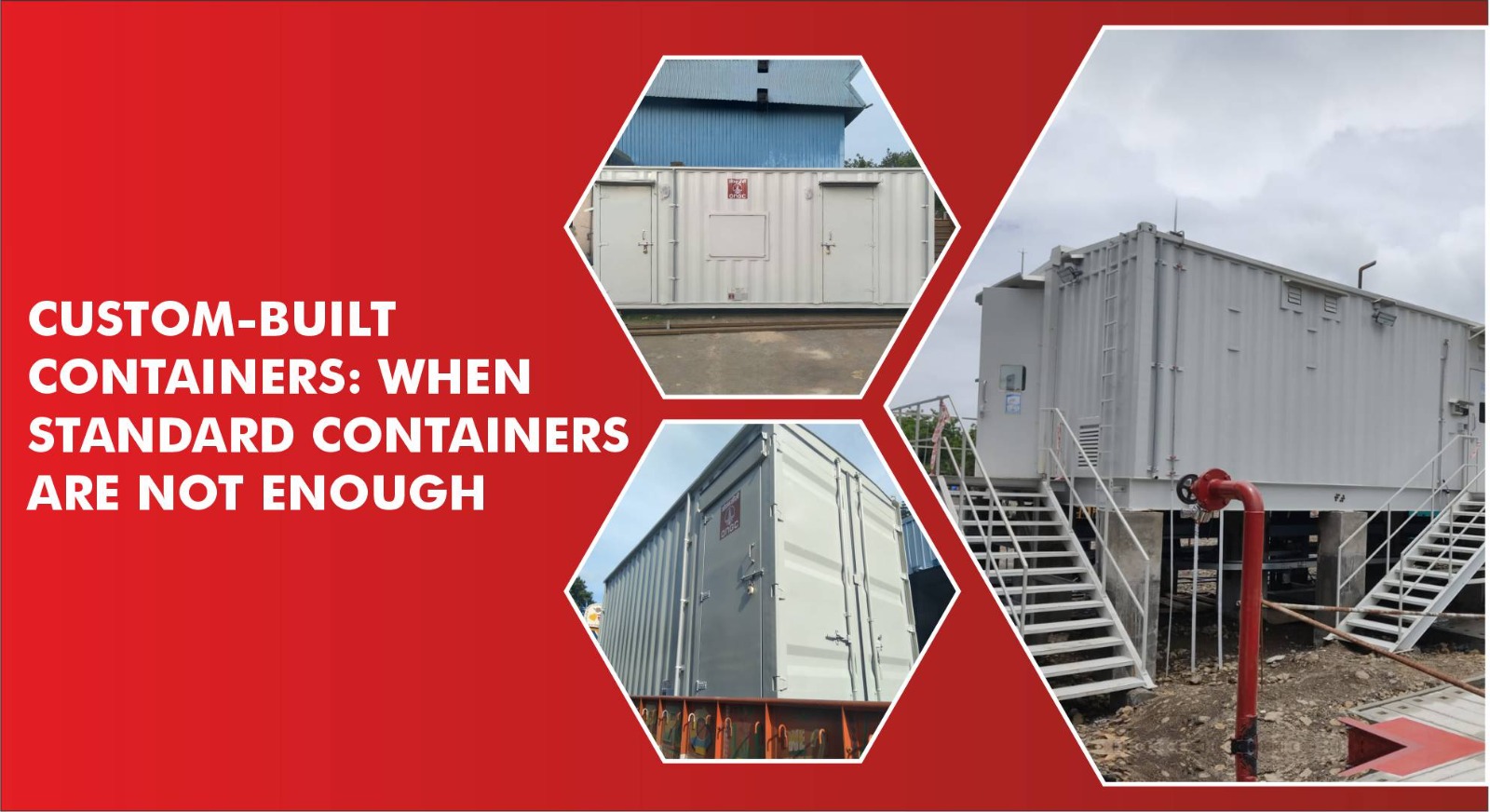
Handling specialized operations increasingly rely on engineered container solutions that move beyond the constraints of standard ISO units. Complex industrial workflows, strategic missions / projects and high-value cargo demand infrastructure that aligns with precise operational, environmental and safety requirements. Custom containers provide this flexibility through tailored design, advanced fabrication methods and application-specific integrations.
What Are Custom-Built Containers?
Custom-built containers are engineered structures designed to accommodate applications where standard containers fall short. They retain the structural integrity and mobility of ISO-grade containers but integrate specialized features to support technical, industrial and mission-critical deployments.
Such containers can be modified to host sensitive equipment, manage controlled environments, support electrical and mechanical installations or transport delicate hardware that requires stringent handling. Their design aligns with operational parameters, regulatory needs, environmental exposure and safety protocols.
Custom solutions are widely used across aerospace, defence, research institutions, offshore industries, energy utilities and specialized logistics environments.
Why Are Custom Containers Needed for Specialized Projects?
Specialized projects frequently involve equipment that demands precise conditions, non-standard dimensions or advanced operational capabilities. Generic containers lack the adaptability to handle such variables.
Primary drivers for customization include:
-
Unconventional Dimensions (ODC): Oversized or irregular equipment requires bespoke structural layouts.
-
Sensitive Payloads: Scientific instruments, satellite components and defence systems need controlled environments for transit and storage.
-
Mission-Critical Operations: Research, exploration and defence activities require containerized infrastructure capable of functioning as mobile labs, control units or technical rooms.
-
Compliance Requirements: Certain applications necessitate certification from bodies such as DNV or require shielding, insulation or specialized safety systems.
-
Harsh Environments: Offshore, desert, marine and remote terrains demand durable materials and weather-resistant design.
Custom containers bridge these gaps with precision-driven engineering, ensuring performance, safety and reliability.
What Customization Options Are Available in Containers?
Customization spans structural, mechanical, electrical and environmental aspects depending on the application. Below is a structured overview of common modifications.
Structural & Dimensional Enhancements
-
Extended lengths, increased height or multi-segment formats
-
Heavy-grade frames for heavy-duty deployment
-
False flooring for cable ducts, ventilation routing or utility layout
-
Additional access points, doors, hatches or removable walls
Environmental Control Features
-
Thermal insulation
-
Controlled temperature and humidity systems
-
EMI shielding
-
Dustproof and waterproof sealing for rugged conditions
Operational Integrations
-
Control consoles, monitoring tools and surveillance systems
-
Electrical panel mounting systems for AIS/GIS equipment
-
Power distribution modules, UPS and genset integration
-
Workstations, storage modules and equipment racks
Safety & Compliance Enhancements
-
DNV-certified configurations
-
Fire-rated materials and suppression systems
-
Anti-static flooring
-
Hazard-specific firefighting equipment
Mobility & Handling Features
-
Shock-absorbing frames for fragile cargo
-
Tie-down systems for aerospace hardware
-
Lift points, skids and mobility aids
A properly customized container functions as an operational asset rather than a storage unit.
How Are Custom Containers Designed & Manufactured?
The development framework for custom-built containers involves a systematic engineering process that ensures precision, compliance and application alignment.
1. Requirement Engineering
Stakeholders outline payload characteristics, operational environment, safety needs and compliance mandates. Detailed feasibility studies and load assessments guide the foundational design.
2. Conceptual & Detailed Design
Engineers translate requirements into CAD models, structural drawings and technical specifications. Simulations validate load capacity, thermal efficiency, vibration resistance and electrical layout.
3. Fabrication & Assembly
Special-grade steel, insulated panels, shielding materials and engineered components are fabricated according to design. Container modification, structural reinforcement and internal fitting take shape at this stage.
4. System Integration
Electrical systems, control modules, HVAC equipment, EMI shielding or mission-specific components are integrated. Each element is configured for safe and efficient operation.
5. Testing & Certification
The container undergoes:
-
Structural stability tests
-
Shock and vibration testing
-
EMI/EMC compliance checks
-
Environmental and insulation validation
-
Certification where required (ISO, DNV, industry-specific norms)
6. Deployment & Support
The final unit is delivered with transport-ready packaging and operational manuals. After-sales support includes maintenance, retrofits and lifecycle optimization.
Key Benefits of Using Custom-Built Containers
|
Benefit |
Strategic Impact |
|
Application-Specific Design |
Ensures seamless alignment with operational workflows |
|
Enhanced Payload Protection |
Safeguards delicate, high-value and sensitive equipment |
|
Mobility & Deployment Efficiency |
Enables quick setup in remote or harsh environments |
|
Compliance & Safety Assurance |
Supports industry-specific regulations and certifications |
|
Space Optimization |
Engineering-driven layout improves accessibility and workflow |
|
Multi-Functional Capabilities |
Converts containers into mobile labs, control rooms or power units |
Common Projects & Industries Using Custom Containers
Custom containers serve a wide range of technical and mission-driven sectors. Below is an overview of prominent applications.
1. Strategic & Research Applications
Containers designed for research, defence and space missions demand precision engineering and specialty features. These units support sensitive equipment, mission-critical electronics and controlled environments.
Examples include:
-
EMI Shielded GENSET Container
A specialized EMI-shielded genset container engineered for LRDE to support radar-related defence applications. -
DNV-Certified Control Room Container
Developed for NIOT’s deep-sea exploration mission, this container meets stringent DNV standards for offshore deployment. -
Custom Transportation Containers
Purpose-built units for ISRO group companies (VSSC, LPSC, URSC, SDSC) to transport satellite hardware for missions such as Chandrayaan I, II, III, Gaganyaan, Aditya L1 and more.
These applications require unmatched accuracy in fabrication, environmental control and safety compliance.
2. Containerized Substations
Electrical substations in containerized format streamline installation and commissioning for power utilities and industrial operations.
Notable features include:
-
Custom-built configurations for AIS/GIS panels, transformers and switchgear
-
False flooring for cable management
-
Insulated interiors for stable operational environments
-
Multi-segment formats for large substation setups
-
Accessories such as cable cellars, staircases and platforms
These units enable modular power infrastructure in greenfield or remote locations.
3. Special-Purpose Containers
Purpose-driven designs support specialized functions across sectors.
Medical Room Containers
Equipped with medical equipment, sanitation systems and climate control for use in field hospitals, community clinics or emergency response zones.
Control Room Containers
Configured with workstations, communication systems and monitoring setups for large-scale projects, utility operations and industrial processes.
Fire-Fighting Containers
Built to house firefighting gear, water tanks, hoses and emergency tools for deployment in construction sites, industrial zones or remote operational hubs.
FAQs
1. Do custom containers adhere to ISO standards?
Structural specifications typically follow ISO standards unless the application requires deviations, which are engineered with appropriate reinforcement.
2. Can custom containers support extreme environments?
Yes, it has been built to perform in tough conditions. It is tailored with insulation, weatherproofing, corrosion-resistant coatings or EMI shielding to function reliably in harsh environments.
3. Are they suitable for transporting delicate equipment?
Yes. Shock-proof mounts, internal padding, humidity control and vibration-resistant frameworks can be integrated.
4. What industries most commonly use custom containers?
Aerospace, defence, marine research, energy utilities, industrial manufacturing, healthcare and emergency services.
5. Can operational equipment be mounted permanently inside the container?
Yes. Containers can be engineered as fully functional units with onboard systems, cable routing, ventilation and integrated electrical infrastructure.