Introduction to Flat Rack Containers
Cargo profiles are no longer limited to uniform boxes or palletized goods. Industrial growth, infrastructure expansion and global project cargo have increased the movement of heavy, wide and tall equipment. Standard containers often fall short in such scenarios. Flat rack containers address this gap with a design focused on strength, accessibility and load flexibility.
What Is a Flat Rack and Flat Container?
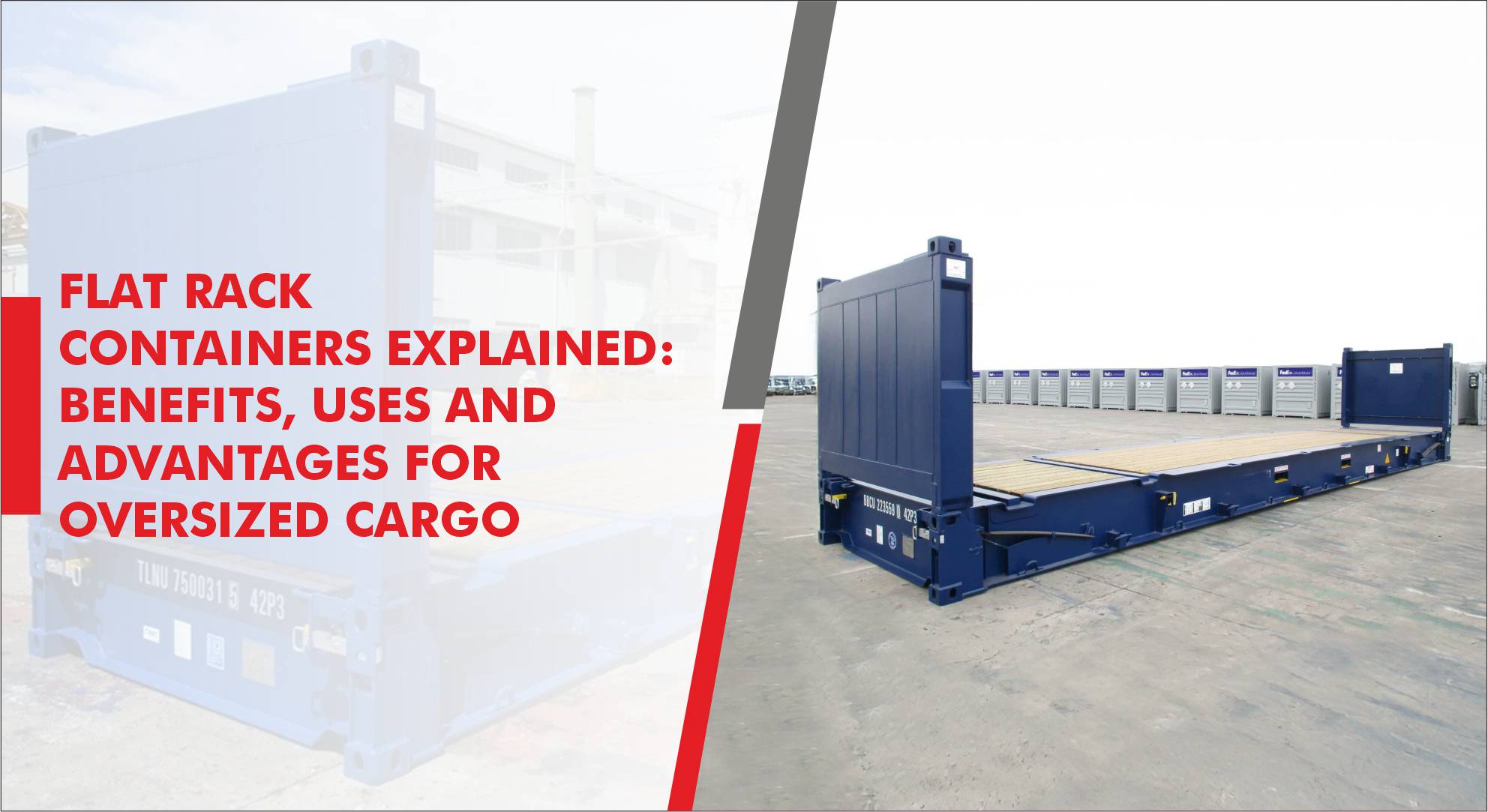
A flat rack is a type of ISO freight container designed without fixed side walls and in many cases, without a fixed roof. The structure typically consists of a strong base and end walls, either fixed or collapsible.
The term flat container is sometimes used interchangeably in industry conversations, though flat rack containers are purpose-built for cargo that exceeds standard container dimensions or weight limits.
Key structural features include:
-
Steel base for heavy loads
-
End walls for vertical support and lashing
-
Open sides allowing side or top loading
-
Compatibility with standard container handling equipment
Use of Shipping Containers for Oversized Cargo
The use of shipping containers has evolved beyond conventional freight. Flat rack containers play a critical role in transporting oversized cargo and oversize freight that cannot be dismantled or containerized traditionally.
Common cargo profiles include:
-
Construction machinery
-
Power generation equipment
-
Industrial boilers and transformers
-
Steel structures and pipes
-
Offshore and oilfield components
Such cargo demands secure lashing, controlled weight distribution and compliance with international transport norms. Flat rack containers meet these operational requirements without compromising safety.
Key Benefits and Advantages of Flat Rack Containers
Flat rack containers offer a set of advantages that directly address oversized cargo challenges.
Operational advantages:
-
Side and top loading flexibility
-
High load-bearing capacity
-
Ease of securing irregular cargo
-
Compatibility with sea, rail and road transport
Commercial advantages:
-
Reduced need for cargo dismantling
-
Lower risk of damage during handling
-
Optimized space utilization for over-width and over-height cargo
Aligned with ISO 1496-1 standards, ISO freight containers in flat rack configuration ensure global acceptance and regulatory compliance across shipping lanes.
Flat Rack Container Dimensions and Load Capacity
Flat rack container dimensions are standardized to align with global shipping infrastructure while allowing dimensional flexibility for cargo.
|
Specification |
20 ft Flat Rack |
40 ft Flat Rack |
|
External Length |
~6.06 m |
~12.19 m |
|
External Width |
~2.44 m |
~2.44 m |
|
Base Width |
~2.24 m |
~2.24 m |
|
Max Payload |
Up to 30 MT |
Up to 40–45 MT |
Load capacity depends on design, steel grade and end-wall configuration. Heavy-lift applications rely on engineered bases and certified lashing points.
40 ft Flat Rack Container Dimensions Explained
The 40ft flat rack container dimensions make it suitable for long and heavy cargo that exceeds the limits of a standard 40 ft container.
Typical characteristics:
-
Extended base length for long cargo
-
Higher payload tolerance
-
Multiple lashing rings for load security
-
Stackable design when empty or loaded
Compared to smaller units, a 40 ft container in flat rack format reduces the need for cargo segmentation, supporting operational efficiency for project logistics.
How Flat Rack Containers Handle Oversized Cargo Safely
Safety remains central to flat rack container deployment. The open structure allows precise placement and securing of oversized cargo.
Safety mechanisms include:
-
High-strength lashing points welded to the base
-
End walls acting as load stops
-
Anti-slip flooring
-
Engineering-approved load distribution
For ISO freight containers used in global trade, compliance with international safety codes ensures seamless movement across ports and borders.
Comparison: Flat Rack vs Standard Flat Container
While the terms may overlap, functional differences exist.
|
Aspect |
Flat Rack |
Standard Flat Container |
|
Side Walls |
Open |
Usually fixed |
|
Cargo Type |
Oversized cargo |
General freight |
|
Load Flexibility |
High |
Limited |
|
Handling |
Crane or forklift |
Standard handling |
|
Use Case |
Heavy-lift, over-width |
Regular cargo |
Flat rack containers remain the preferred choice for irregular and heavy loads where adaptability is critical.
Best Practices for Shipping Oversize Freight Using Flat Rack Containers
Efficient use of flat rack containers requires disciplined planning and execution.
Best practices include:
-
Accurate cargo measurement before booking
-
Load engineering and weight distribution analysis
-
Use of certified lashing materials
-
Route and port capability assessment
-
Compliance with oversize freight regulations
Such practices reduce transit risk and support predictable delivery timelines.
Conclusion
Flat rack containers serve as a strategic asset in modern logistics, particularly for oversized cargo and oversize freight. Their structural strength, dimensional flexibility and global compliance make them indispensable across industrial sectors.
Manufactured in line with ISO 1496-1 standards, ISO freight containers in flat rack form support safe, efficient and scalable cargo movement. As infrastructure and project cargo continue to grow, flat rack containers will remain integral to the evolving use of shipping containers worldwide.
FAQs
-
What industries commonly use flat rack containers?
Construction, power, oil and gas, telecom, defence, offshore and heavy engineering sectors rely heavily on flat rack containers. -
Are flat rack containers suitable for overseas shipments?
Yes. ISO-compliant flat rack containers are designed for both domestic and overseas markets. -
How is oversized cargo secured on a flat rack?
Cargo is secured using certified lashing points, chains and tensioners integrated into the container base.
4.Is a 40 ft container always better for oversize freight?
Not always. Selection depends on cargo length, weight and handling constraints rather than size alone.