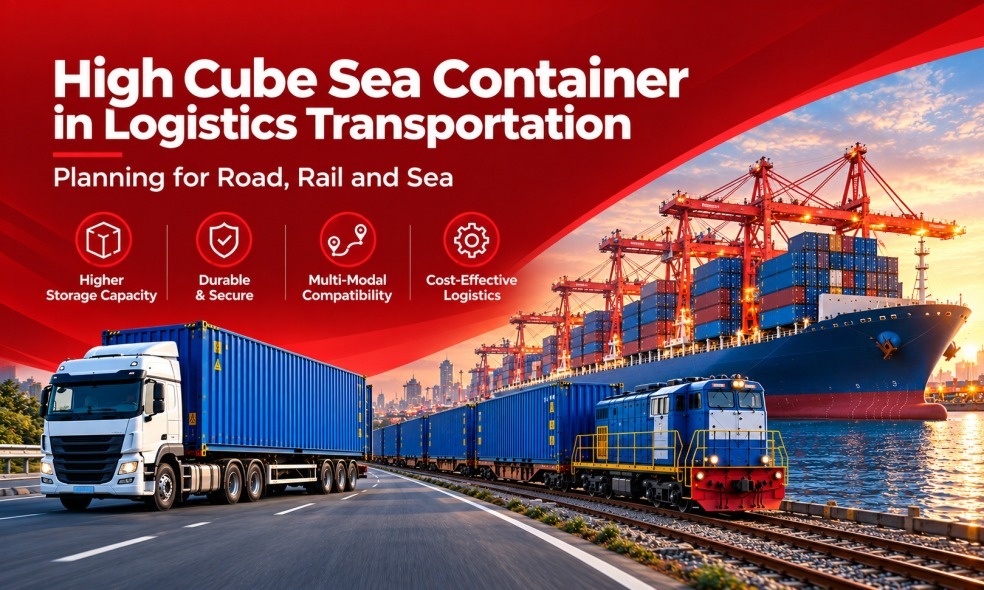
High Cube Sea Container in Logistics Transportation: Planning for Road, Rail and Sea
A high cube sea container offers extra loading height, but that advantage only matters when the container fits the entire transport route. A unit that works inside a factory may create access problems on the road or require additional checks before rail movement.
For Indian manufacturers, exporters and logistics teams, the real decision is not simply which container holds more cargo. It is whether that container can move safely, reach the port on time and deliver value across the complete journey.
What Is a High Cube Sea Container?
A high cube sea container is a freight container with greater external height than a standard-height container. Common 20-foot and 40-foot high cube formats measure approximately 9 ft 6 in (2.896 m) externally, compared with 8 ft 6 in (2.591 m) for standard-height formats. Actual internal dimensions vary by model.
ISO 668 covers container classification, external dimensions and ratings, while ISO 1496-1 specifies requirements and testing for general-purpose freight containers. See the ISO 668 standard and ISO 1496-1.
The additional height can help accommodate bulky, lightweight or tall cargo. It does not automatically increase the permitted payload. Container ratings, cargo weight and loading arrangements still matter.
For example, a manufacturer transporting lightweight electrical assemblies may benefit from the extra height. A business moving dense metal components could reach its weight limit before using the available volume. In that case, the additional height may offer little commercial value.
The right container depends on cargo dimensions and weight together, not height alone.
1. Road Transport: Check the Complete Vehicle Height
A high cube container travels on a chassis, so its external height is only one part of the overall vehicle height. Route clearance and site access should be confirmed before dispatch.
Check these points before loading:
-
Route clearance: Review bridges, flyovers, overhead cables and other height-sensitive structures.
-
Vehicle compatibility: Confirm the container, chassis and tractor configuration suit the movement.
-
Site access: Check factory gates, warehouse entrances, loading bays and unloading areas.
-
Cargo security: Ensure the load is appropriately distributed and secured within permitted limits.
This matters on Indian industrial routes, where a suitable highway journey may end at a restricted factory entrance or a narrow approach road.
Consider an exporter collecting tall electrical equipment from a plant outside an industrial city. The main highway may be suitable, but an overhead obstruction near the facility could prevent the loaded vehicle from completing the journey. Checking the approach beforehand is far easier than arranging a revised movement after loading.
Route feasibility should be confirmed before dispatch, not assumed from the container specification.
2. Rail Transport: Confirm Route and Terminal Compatibility
Rail can support long-distance container movement, particularly when businesses have regular volumes and predictable dispatch schedules. However, a high cube sea container should not be assumed suitable for every rail route simply because it follows a standard container footprint.
Before committing the movement, confirm the container's dimensions and loaded weight against the intended wagon arrangement, applicable route restrictions and terminal handling system.
Three details deserve attention:
Wagon compatibility: Check dimensional and weight requirements with the rail operator or service provider.
Route acceptance: Confirm the applicable loading gauge and any route-specific restrictions. Acceptance at one terminal does not guarantee that every route can accommodate the same configuration.
Terminal handling: Verify lifting equipment, stacking arrangements, storage availability and transfer schedules at both ends.
For a manufacturer moving goods from an inland facility to a port, missing a rail cut-off can disrupt the onward plan. The container may have to wait for another service, affecting delivery commitments and potentially adding storage or handling costs.
Planning the road-to-rail handover early reduces the chance of avoidable delays.
3. Sea Transport: Protect the Export Schedule
Sea transport requires more than a vessel booking. The container must suit the cargo, be in appropriate condition and meet the requirements of the intended service.
Before port entry, confirm:
-
Payload and distribution: Check the rated limits and distribute the cargo appropriately.
-
Container condition: Inspect the doors, floor, roof, seals and structural condition, particularly for a used unit.
-
Cargo securing: Use suitable packing and securing arrangements to limit movement during handling and transit.
-
Documentation and cut-offs: Align container details, cargo declarations, terminal entry and vessel deadlines.
A container may be ready while its documentation is not. Missing a port cut-off can disrupt the export schedule even when the physical movement has gone smoothly.
Extra height is useful only when cargo can be loaded, secured and handled safely within the available space.
4. When Does a High Cube Container Actually Pay Off?
The value of a high cube sea container becomes clearer when cargo dimensions are compared with weight limits.
Suppose a manufacturer exports two types of products. The first consists of bulky, lightweight electrical assemblies that use much of the available volume but remain within the permitted weight. The extra height may allow a more efficient loading arrangement.
The second consists of dense metal parts. Their weight limit may be reached while substantial space remains unused. A high cube container may not improve the economics of that movement.
Before choosing a container, assess:
-
Cargo dimensions and total loaded weight.
-
Usable space after allowing for packing and securing.
-
Route restrictions and handling requirements.
-
Expected frequency of use and return-movement arrangements.
Compare the total cost per loaded movement, including transport, handling, waiting and repositioning where applicable. A lower container acquisition or rental cost does not necessarily produce a lower overall operating cost.
For stable, recurring demand, purchasing may suit a business that can keep the container productive. Leasing can offer more flexibility when demand is seasonal or a new route is still being tested.
5. Choosing the Right Container Manufacturer
A container manufacturer should be assessed on more than dimensions and delivery timelines. The container must suit the intended cargo, transport modes and operating conditions.
Check the applicable specification, rated capacity, inspection arrangements, documentation and container condition. Also confirm that the selected unit meets the requirements of the intended movement; compliance with a container standard alone does not guarantee acceptance on every road or rail route.
Transafe Services Limited manufactures ISO freight containers and customised container solutions. Its published range includes containers designed for transport by road, rail and sea, while its leasing services support domestic and EXIM operations.
Businesses considering a container for sale can explore Transafe's ISO freight container solutions. Companies that need flexibility rather than long-term ownership can review its container leasing options. The appropriate choice depends on cargo requirements, utilisation and the planned transport cycle.
Conclusion
A high cube sea container can improve space utilisation, but only when it fits the complete journey. Road clearance, rail compatibility, cargo securing and port schedules all need attention before dispatch.
Start with cargo dimensions, weight, route conditions and expected utilisation. Then compare suitable container specifications and buying or leasing options. The objective is not simply to fit more cargo inside a container; it is to move it safely, reliably and without avoidable cost.
Frequently Asked Questions
1. What is a high cube sea container used for?
It is used for cargo that benefits from additional internal height, including bulky, lightweight products and tall equipment that fits within the container's rated limits.
2. Can a high cube sea container move by road, rail and sea?
Yes, high cube freight containers are designed for intermodal use. The specific vehicle, wagon arrangement, route clearances and operator requirements must still be checked before movement.
3. Is a high cube container better than a standard container?
Not always. It can suit bulky, lightweight cargo, while dense goods may reach the payload limit before using the extra volume. The better option depends on cargo dimensions, weight and route conditions.
4. What should businesses check before buying a high cube sea container?
Review its dimensions, rated capacity, condition, applicable standards, cargo compatibility, route restrictions, maintenance requirements and expected utilisation. Compare ownership costs with leasing alternatives.
5. Where can businesses find a high cube container for sale or lease in India?
Businesses can contact Transafe Services to discuss container manufacturing and leasing options. The suitable solution depends on the required specifications, availability and intended use.