A cargo container can travel thousands of kilometres without the goods inside being touched.
It may leave a factory on a truck, move to rail, reach a port and then go onto a vessel. The container stays the same. The equipment carrying it does not.
One small component helps make those transfers possible: the twistlock.
It is easy to overlook because it is a relatively simple piece of equipment. But when a container is being lifted, moved, stacked or carried at speed, the connection between the container and the transportation equipment has to be dependable.
That is where twistlocks come in.
What is a cargo container twistlock?
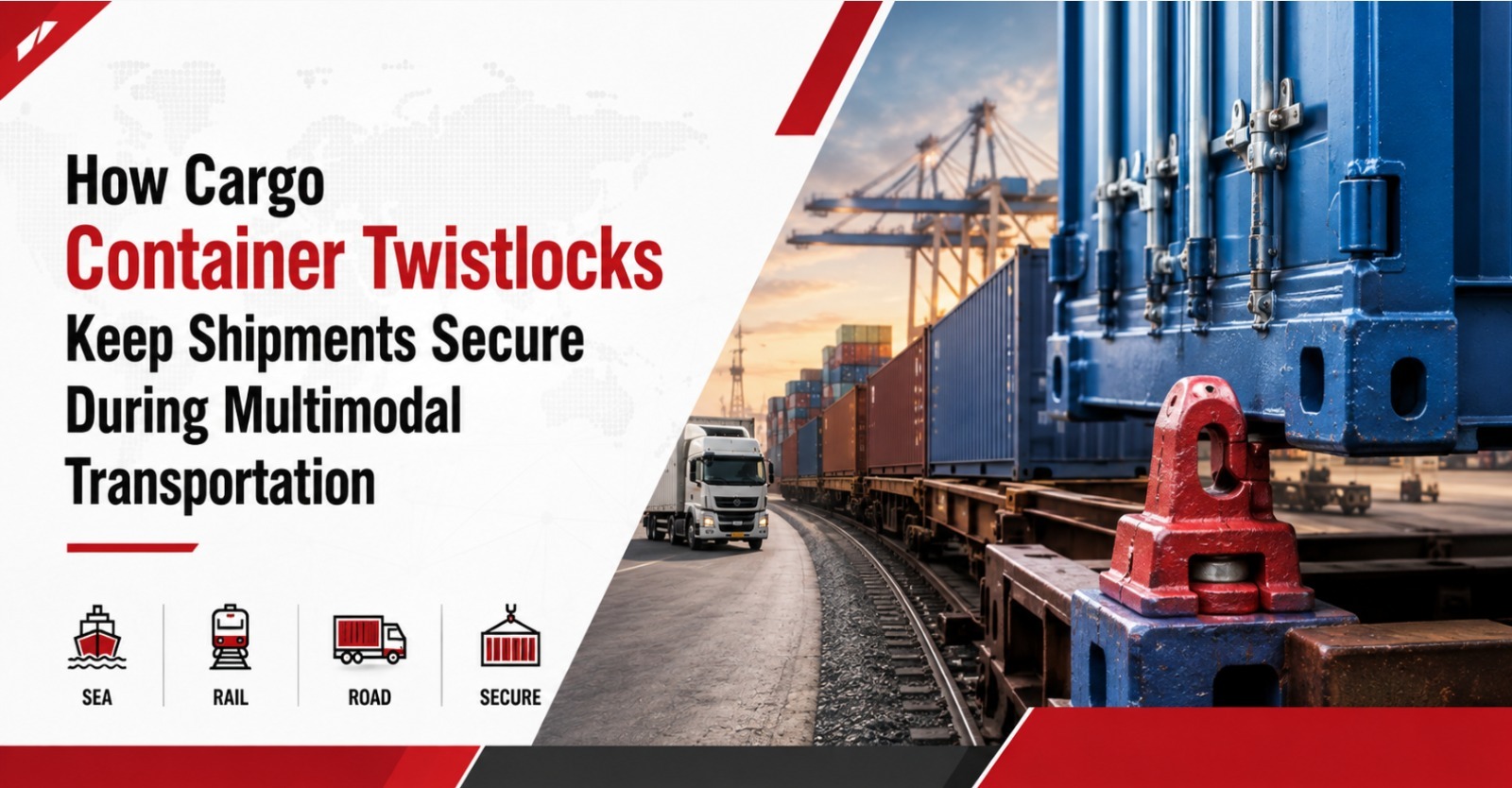
A twistlock is a mechanical securing device that fits into the corner fitting of a cargo container.
The head of the twistlock enters the opening in the corner fitting and turns into the locked position. Once engaged, it prevents the container from lifting away from the chassis, rail wagon or other securing point.
The idea is simple. The forces involved are not.
A container being transported is subjected to braking, acceleration, vibration, turning and lifting. At sea, there are additional forces caused by vessel movement and weather. The securing system has to cope with all of this without allowing the container to move independently of the structure carrying it.
This is also why the corner fitting matters just as much as the lock itself. ISO 1161 sets requirements for the dimensions, function and strength of container corner fittings. Standardised fittings allow handling and securing equipment to work with containers from different manufacturers and across different transport networks.
Why twistlocks matter when containers change transportation modes
Take a normal export movement.
A manufacturer finishes production and loads the goods into a container. A truck collects it and takes it to a rail terminal. From there, the container may travel hundreds of kilometres before reaching a port. At the port, a crane lifts it onto a vessel.
Nobody wants the goods unloaded and repacked at each step. The whole point of containerisation is that the box can move instead.
But every time the container changes equipment, it has to be secured again. The road chassis needs its own connection. The rail wagon has its securing arrangement. The vessel has its own container securing system.
The principle stays the same: the container must remain properly connected to the structure carrying it.
Road and rail movements bring their own stresses. Braking is an obvious one. So are sharp changes in direction, uneven surfaces, acceleration and vibration. On a vessel, the situation is different again. Containers can be exposed to rolling, pitching and other vessel movements.
A twistlock does not eliminate those forces. It helps make sure the container remains where it is supposed to be while those forces are acting on it.
The lock is only as good as the connection
This is something worth remembering when assessing a container.
A twistlock can be in good condition and still not solve a problem caused by a damaged corner fitting.
The corner fitting is where cranes and securing devices connect to the container. It is part of the container's structural framework, not just a convenient hole for a locking device.
When we inspect containers, this is one of the areas that should not be treated as a cosmetic detail. A dent in a side panel may look worse than a small problem around a corner fitting. From an operational point of view, the opposite can sometimes be true.
For companies making a container purchase, the lesson is straightforward: do not judge the condition of a container from its paintwork and external appearance alone. Look at the parts that actually carry and transfer loads.
How twistlock problems happen
There is usually no dramatic warning before a securing problem develops.
Sometimes the equipment is worn. Sometimes a corner fitting has been damaged. Sometimes the wrong securing equipment is being used. And sometimes it is simply an operating mistake.
A busy terminal is not an ideal environment for assumptions. Trucks are waiting. Cranes are moving. Drivers and terminal staff are working to tight schedules. A container may be moved several times in a short period.
A lock that has not been properly engaged can become a serious problem very quickly.
The IMO's guidance on container securing places importance on positive locking, clear indication of locked and unlocked positions, suitable access to the mechanism and protection against unintended unlocking. Inspection and maintenance are also part of keeping securing equipment fit for use.
None of this is particularly complicated. The difficulty is making sure the checks actually happen.
A secured container does not mean secured cargo
This distinction is often missed.
The twistlock secures the container to the vehicle, rail wagon or vessel. It does not secure the goods inside it.
Suppose a company is moving a piece of industrial equipment. The container may be locked correctly onto the trailer, but if the equipment inside has not been restrained properly, it can still move when the driver brakes.
The same problem can arise with poorly distributed heavy cargo, pallets that have not been blocked properly or goods that have too much freedom to move inside the box.
The CTU Code provides guidance for packing and securing cargo transportation units across road, rail and sea transportation.
So there are really two separate checks.
Is the container secured to the transportation equipment?
And:
Is the cargo secured inside the container?
A good logistics operation needs both.
What should businesses look for before buying a cargo container?
There is no shortage of containers in the market. The harder question is finding one that fits the job.
Start with the route.
If the container will stay on the road, the requirements may be different from a unit that will regularly move between road, rail and sea. The handling equipment used at terminals also needs to be considered.
Then look at the container itself.
The corner fittings should be checked. So should the corner posts, rails, flooring and other structural areas. Documentation and applicable certification requirements should be verified for the intended operation. This sounds obvious, but procurement decisions often get reduced to availability, condition and delivery time.
Those are important. They are not the whole decision.
A container is part of the transportation chain. Its design and condition need to make sense for the way that chain actually works.
Why ISO freight containers are suited to multimodal transportation
The strength of ISO freight containers is standardisation.
Road carriers, rail operators, ports and shipping lines all need to handle the same basic container format. Standard dimensions and corner fittings give the different parts of the transportation network a common interface.
That is what allows a container loaded at a factory to keep moving without the goods being unloaded every time the mode changes.
Transafe Services manufactures ISO freight containers designed for road, rail and marine applications and states that its containers comply with applicable ISO 1496-1 requirements. The company also manufactures specialised and customised container solutions for different operational requirements.
For a business buying containers, this is an important way of looking at the decision.
You are not simply buying storage space. You are buying equipment that has to interact with trucks, cranes, rail wagons, ports and vessels.
Where Transafe Services Adds Value
Transafe Services has been in container manufacturing for more than three decades. Its range covers standard ISO freight containers along with specialised and customised solutions used across areas such as transportation, construction, power, telecom, defence and offshore operations.
That broader experience becomes useful when a standard container is not quite right for the job.
A manufacturer may have a particular cargo dimension. A project may require a different access arrangement. A container may need to operate in a demanding environment or serve a specialised handling requirement.
In those situations, the right starting point is not a catalogue number. It is the actual operating requirement. That is where an experienced container manufacturer can add value.
Conclusion:
Twistlocks are not complicated pieces of equipment. They are important pieces of equipment.
They provide the connection between a cargo container and the equipment carrying it. If the lock, corner fitting and securing arrangement are suitable and properly maintained, they help the container remain where it belongs as it moves between transportation modes.
But it is worth looking beyond the twistlock.
The container has to be structurally sound. The cargo inside has to be secured. The handling equipment has to be compatible. The container itself needs to suit the route.
That is why a good container purchase starts with the movement the container is expected to make.
Look at the cargo, route and handling conditions. Then choose the container.
Frequently Asked Questions
1. What is the purpose of a twistlock on a cargo container?
A twistlock connects a container to a chassis, rail wagon, vessel or another container through its corner fittings. Its purpose is to keep the container securely connected during handling and transportation.
2. Are twistlocks used in multimodal transport?
Yes. Containers can use securing arrangements involving twistlocks when moving between road, rail and marine transportation. The exact arrangement depends on the equipment and transportation operation.
3. Do twistlocks secure goods inside the container?
No. Twistlocks secure the container externally. Cargo inside the container needs separate packing and securing measures appropriate to the goods and the journey.
4. What should I inspect before purchasing a cargo container?
Pay particular attention to corner fittings, corner posts, structural condition, flooring, applicable standards, documentation and compatibility with the handling equipment and transportation modes you intend to use.
5. Why are ISO freight containers important?
ISO freight containers use standardised dimensions and interfaces, allowing them to be handled across road, rail and marine networks without unloading the cargo every time the transportation mode changes.