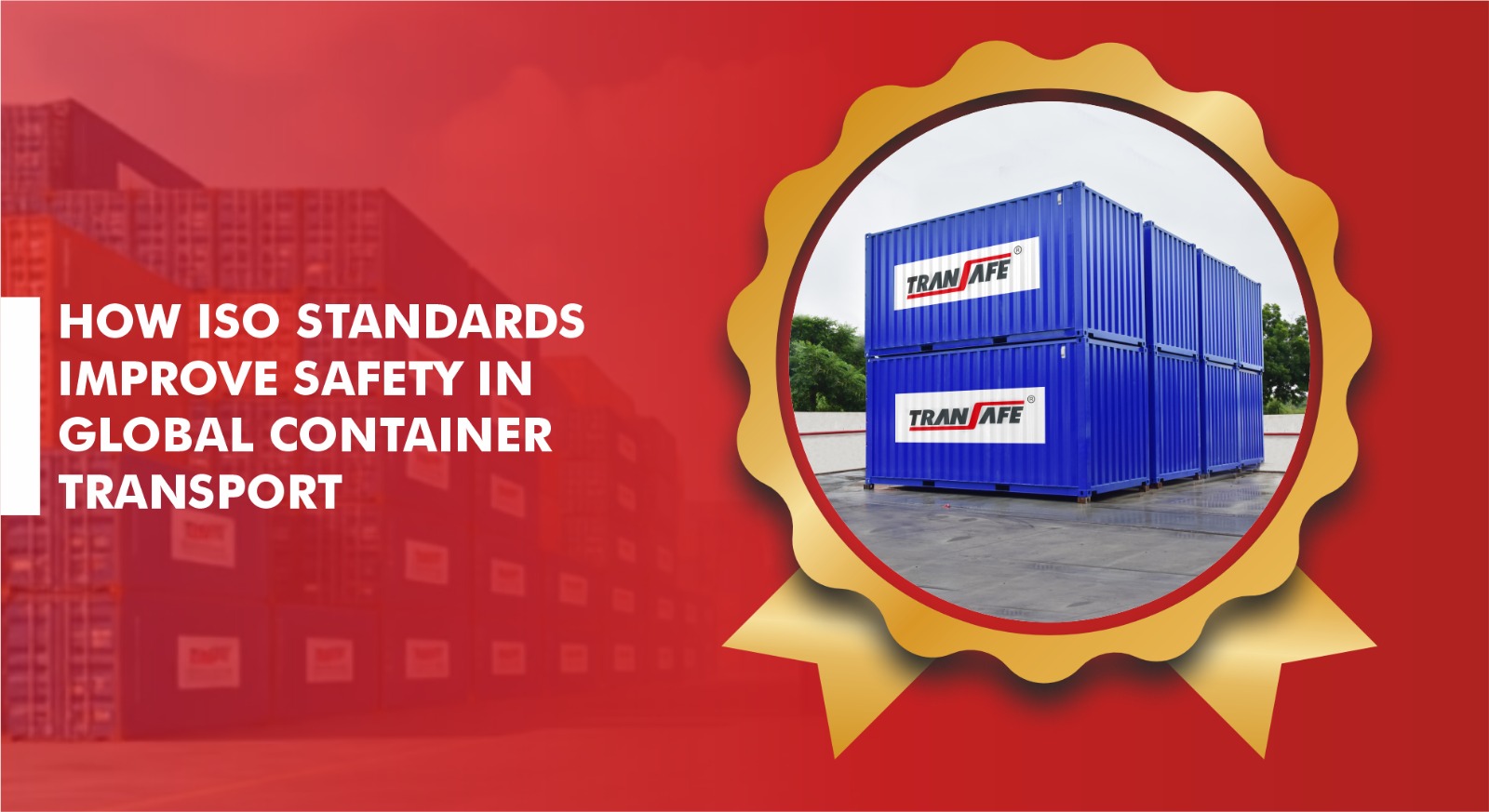
National and global trade moves on containers; every shipment travels through several checkpoints before reaching its destination. Ports, terminals, trucks, rail lines and ships handle the same container during the journey. Safety and consistency across these stages matter a lot for cargo owners, transport companies and manufacturers.
Clear technical rules guide how containers are built, tested and used. ISO standards for shipping containers play a major role in setting these rules. These standards define the size, structure, identification and safety requirements of containers used in global logistics.
Transafe Services, an Indian manufacturer of ISO freight and customized containers, follows these standards to ensure that every container performs reliably across international supply chains.
What Are ISO Standards for Shipping Containers?
ISO container standards are technical specifications issued by the International Organization for Standardization. These standards ensure that containers used in international transport maintain uniform design, strength and safety features.
They define critical aspects such as:
-
Standard container dimensions
-
Structural design and material strength
-
Load capacity limits
-
Corner fittings and locking mechanisms
-
Identification markings and codes
-
Inspection and testing procedures
These specifications allow containers to move across ships, trucks and rail wagons without compatibility issues. Global supply chains rely on ISO freight containers because every logistics system recognizes their design and handling requirements. Manufacturers like Transafe Services produce ISO certified containers according to these international guidelines, ensuring that each unit meets the safety expectations of global transport networks.
Importance of Standardization in Global Container Transport
Containerized cargo travels through many countries and transport modes. Lack of uniform standards could create operational risks and delays.
Standardization supports container transport safety in several ways:
Operational consistency
Ports, cranes and handling equipment are designed to lift and stack containers of standardized sizes. Uniform containers reduce the risk of equipment mismatch or handling errors.
Global interoperability
Containers built under global container shipping standards can move easily between ships, rail wagons and trucks in different countries.
Simplified logistics planning
Transport companies know the exact dimensions, weight limits and structural capabilities of standardized containers. This helps plan loading and stacking safely.
Reduced operational risk
Standardized containers prevent issues such as uneven stacking, unstable cargo placement or structural failure during transport.
For manufacturers, following international shipping container regulations ensures that containers perform safely throughout the entire logistics chain.
Structural Strength and Durability Requirements
Containers carry heavy cargo and experience significant stress during shipping. Structural integrity remains a major focus within container safety standards.
ISO standards specify strict requirements for the design and construction of containers.
Key structural elements include:
Corner posts and fittings
Corner posts bear the majority of the container load when stacked on ships or in terminals. Reinforced corner castings allow cranes and locking devices to secure containers safely.
Floor strength
Container floors must support heavy cargo loads and forklift operations during loading and unloading.
Wall and roof panels
Side walls and roof panels must withstand external pressure, vibration and environmental conditions during transit.
Load testing
ISO containers undergo strength tests to confirm that they can safely carry maximum payloads without deformation or structural damage.
Containers built under ISO shipping container safety guidelines are designed to maintain durability across long-distance transport cycles.
Safety During Loading, Unloading and Handling
Containers are frequently lifted, stacked and moved throughout their journey. Safe handling depends on design features defined in ISO container standards.
Handling safety requirements includes the following:
-
Standard corner fittings for crane lifting
-
Compatibility with spreader lifting equipment
-
Secure locking systems for stacking
-
Stable base design for ground handling
These specifications help prevent accidents during cargo movement.
Handling process benefits
|
Safety Feature |
Operational Benefit |
|
Corner casting design |
Enables safe crane lifting |
|
Twist-lock compatibility |
Prevents container movement during transport |
|
Uniform dimensions |
Allows efficient stacking on vessels |
|
Strong flooring |
Supports forklift loading |
Container Identification and Tracking Systems
Clear identification is essential in international shipping. Containers move across multiple checkpoints and must be traceable at every stage.
ISO guidelines establish identification systems used across the industry.
Standard markings include:
-
Unique container number
-
Owner identification code
-
Size and type code
-
Maximum gross weight information
-
Safety approval plate
These markings help authorities, shipping companies and logistics operators identify containers quickly.
Accurate identification supports compliance with international shipping container regulations and improves shipment tracking throughout the supply chain.
Protection of Cargo During International Shipping
Containers are designed to protect goods from damage during transit. Structural reliability plays a major role in safeguarding cargo.
ISO guidelines address several factors related to cargo protection.
Key protection features
Weather resistance
Containers must prevent water ingress during rain or sea exposure.
Structural rigidity
Strong frames prevent bending or deformation during stacking.
Secure door systems
Heavy-duty locking mechanisms protect cargo against accidental opening.
Internal stability
Proper load distribution reduces cargo movement during transport.
These requirements help maintain product quality during long-distance shipping. Businesses transporting industrial equipment, machinery, electronics or retail goods rely on ISO-certified containers for cargo protection.
Manufacturers such as Transafe Services integrate these design features into their container production process to support safe international transport.
Compliance with International Shipping Regulations
Global trade operates under several safety frameworks. Containers must meet established rules before entering international transport networks.
Compliance with international shipping container regulations includes:
-
Structural certification
-
Safety approval plates
-
Inspection and testing standards
-
Manufacturing quality checks
Regulatory authorities and shipping lines verify container compliance before accepting them for cargo transport.
Containers that follow global container shipping standards move smoothly through ports and shipping terminals without regulatory issues.
Why Businesses Prefer ISO-Certified Containers
Companies engaged in global trade require containers that meet recognized safety benchmarks.
ISO-certified containers offer several operational advantages.
Key benefits
-
High structural reliability
-
Compatibility with global logistics infrastructure
-
Reduced cargo damage risk
-
Compliance with international shipping regulations
-
Long service life and durability
Businesses dealing with large-scale exports or imports prefer containers built under ISO shipping container safety standards because they support predictable and safe cargo movement.
Transafe Services manufactures containers that align with these standards while also offering customized container solutions for specialized applications.
Conclusion
Global trade relies heavily on containerized transport. Safety, consistency and reliability remain critical for moving cargo across international supply chains.
ISO standards for shipping containers establish the technical foundation that allows containers to operate safely across ships, rail networks and road transport systems.
These standards define structural strength, handling safety, identification systems and regulatory compliance. Containers manufactured under these guidelines reduce operational risks and support efficient cargo movement worldwide.
Transafe Services follows these global standards while manufacturing ISO freight and customized containers in India. Adhering to these technical requirements ensures that containers perform reliably in demanding logistics environments and protect cargo throughout its journey.
FAQ
What are ISO standards for shipping containers?
ISO standards define the design, dimensions, strength and safety requirements for containers used in international transport. These guidelines ensure that containers remain compatible with global logistics systems.
Why are ISO container standards important?
They provide uniform specifications for container design and handling. This improves safety, operational efficiency and compatibility across shipping lines, ports and transport networks.
What is an ISO-certified container?
An ISO-certified container is built and tested according to ISO container standards and meets the safety requirements for international cargo transport.
How do ISO standards improve container safety?
They set rules for structural strength, load capacity, handling features and identification systems. These guidelines reduce risks during loading, stacking and shipping.
Who issues ISO container standards?
The standards are issued by the International Organization for Standardization, an international body responsible for developing global technical standards across industries.