Managing oversized cargo calls for precise container selection and a clear understanding of equipment capabilities. The right cargo containers protect assets, streamline handling and keep container transport services compliant with global shipping standards. The decision directly influences operational costs, safety and transit timelines.
Why Is Choosing the Right Container Important for Heavy Cargo?
A suitable container ensures:
-
Structural safety during stacking, movement and sea travel
-
Stable load distribution
-
Reduced risk of cargo damage
-
Carrier-specific weight regulations
-
Cost efficiency by avoiding penalties or reloading
-
Seamless integration across multimodal networks
Heavy payloads stress container floors, corner castings and fork pockets. Oversized cargo further challenges clearance measurements and loading angles. A systematic selection process prevents delays and unplanned expenses while aligning shipping container cost and performance expectations.
What Are the Common ISO Container Types for Heavy and Oversized Cargo?
Several ISO-standard units support heavy-duty applications. Each model serves a defined cargo profile.
1. 20 Foot Shipping Container
Ideal for:
-
Dense, weight-heavy consignments
-
Metals, machinery components, stone blocks
-
Applications where payload exceeds volume requirement
Strengths:
-
High floor load capacity
-
Balanced weight distribution
-
Fewer weight restrictions due to smaller length
2. 40 Foot Shipping Container
Suitable for:
-
Bulky goods requiring additional length
-
Palletized cargo with moderate weight
Strengths:
-
Efficient for long items
-
Optimal for high-volume but stable-weight consignments
3. High Cube Containers
High cube containers (20ft and 40ft variants) offer extended vertical clearance.
Best suited for:
-
Lightweight but oversized cargo
-
Stacked industrial components
-
Goods requiring extra height without raising overall weight
These are widely used to manage awkward dimensions where height becomes the primary constraint.
4. Flat Rack Containers
Structured for:
-
Heavy machinery
-
Industrial equipment
-
Vehicles
-
Steel structures
Strengths:
-
Collapsible or fixed-end variations
-
Open sides enable crane-based loading
-
High load-bearing floors
5. Open-Top Containers
Useful for:
-
Cargo that cannot pass through standard container doors
-
Height-surpassing loads
-
Uneven shapes requiring top-loading support
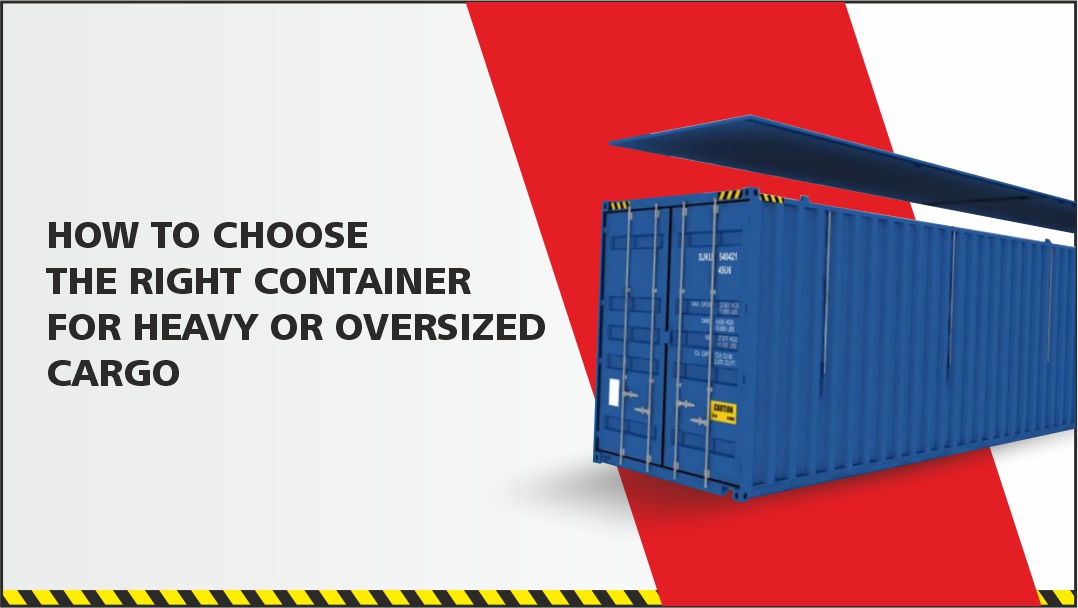
How Does an Open-Top Container Help with Oversized Cargo?
Open-top units simplify handling when cargo height or shape restricts front-door entry.
Advantages include:
-
Crane loading from the top
-
Flexible tarpaulin cover instead of a steel roof
-
Safe accommodation for equipment with vertical extensions
-
Rugged flooring designed to withstand heavy concentrated loads
These containers streamline operations where dimensional irregularities limit traditional loading methods.
What Are Specialized Containers for Heavy Equipment and Machinery?
Certain cargo profiles demand engineered solutions beyond standard ISO units.
Flat Racks
-
Heavy-duty steel frames
-
Support extremely dense loads
-
Ideal for generators, transformers, wheel loaders, industrial boilers
Platform Containers
-
Fully flat, no side walls
-
Designed for cargo extending outward
-
Suitable for exceptionally large machinery that cannot be enclosed
Super Rack Containers
-
Adjustable framework for extra-large items
-
Protect cargo without restricting dimensional flexibility
Specialized containers enhance operational efficiency for equipment that exceeds width, height or handling limits of enclosed units.
What Are the Key Features to Look for in Heavy Cargo Containers?
Technical parameters determine container suitability.
1. Payload Capacity
Check maximum gross weight and usable payload.
Dense materials require containers with stronger floors and reinforced frames.
2. Floor Strength
Heavy cargo stresses container flooring.
Key factors:
-
Material (marine plywood, steel, bamboo composite)
-
Point load tolerance
-
Forklift pocket placement
3. Door Opening Dimensions
Oversized cargo may fail to pass through conventional door frames.
Dimensional clearance must match cargo width and height.
4. Internal Dimensions
Different shipping container price brackets often reflect size variations.
Accurate length, width and height measurements help avoid reloading or redesigning packaging.
5. Lashing Points and Anchor Strength
Essential for securing machinery, steel rolls, or industrial assemblies.
Higher anchor ratings ensure safe restraint during transit.
6. Ventilation Requirements
Certain cargo types require airflow to prevent moisture buildup.
Select containers with adequate vents when transporting moisture-sensitive equipment.
7. Certification and Condition
Used containers must meet CSC (Container Safety Convention) standards.
Structural integrity directly impacts safety in heavy-load applications.
How Do High Cube Containers Benefit Oversized but Lightweight Cargo?
High cube containers add approximately 300 mm of height without altering footprint.
This makes them suitable for:
-
Bulky equipment with lower density
-
Air-filled structures, insulation panels, or industrial housings
-
Cargo requiring upright transport
Key advantages:
-
Extra headspace without exceeding weight limits
-
Cost-effective option compared to specialized containers
-
Improved loading efficiency for tall assemblies
High cube models help optimize shipping container cost by delivering added volume at minimal price difference compared to standard units.
Frequently Asked Questions on Choosing Containers for Heavy Cargo
1. Are 20ft containers better for heavy cargo?
Yes. Dense cargo concentrates weight quickly, making 20ft units structurally safer and easier to handle.
2. Is an open-top container suitable for all oversized items?
Only for height-based constraints. Extreme width or weight may require flat racks or platforms.
3. Do shipping container price variations impact quality?
Price reflects condition, material strength and certification. Lower-cost units may not support heavy or industrial loads.
4. Can heavy equipment extend beyond the container frame?
Only in flat racks or platforms, subject to carrier approvals and port-handling capabilities.
5. Do container transport services require special permissions for oversized cargo?
Yes. Oversized items may need escort vehicles, route approvals and special lifting equipment.
Conclusion
Container selection for oversized cargo demands a structured evaluation of load type, dimensional constraints and transport requirements. Heavy equipment, industrial machinery and irregular-shaped cargo each align with different container specifications. Understanding the strengths of high cube containers, flat racks, open-top units and standard ISO boxes streamlines planning and maintains operational control. A well-chosen container supports safe movement, minimizes shipping container cost variations and aligns with global compliance norms across multimodal logistics networks.