An ISO tank container can simplify bulk liquid transportation, but having the right tank does not guarantee a smooth journey. A cleaning delay, an unsuitable loading arrangement or a missed port cut-off can disrupt the entire movement.
For Indian manufacturers, chemical companies and exporters, the challenge is coordinating the tank, cargo and transport route before dispatch. This requires more than booking a vehicle or reserving space on a train or vessel. Each handover must be planned around equipment compatibility, documentation and receiving-facility readiness.
What Is an ISO Tank Container?
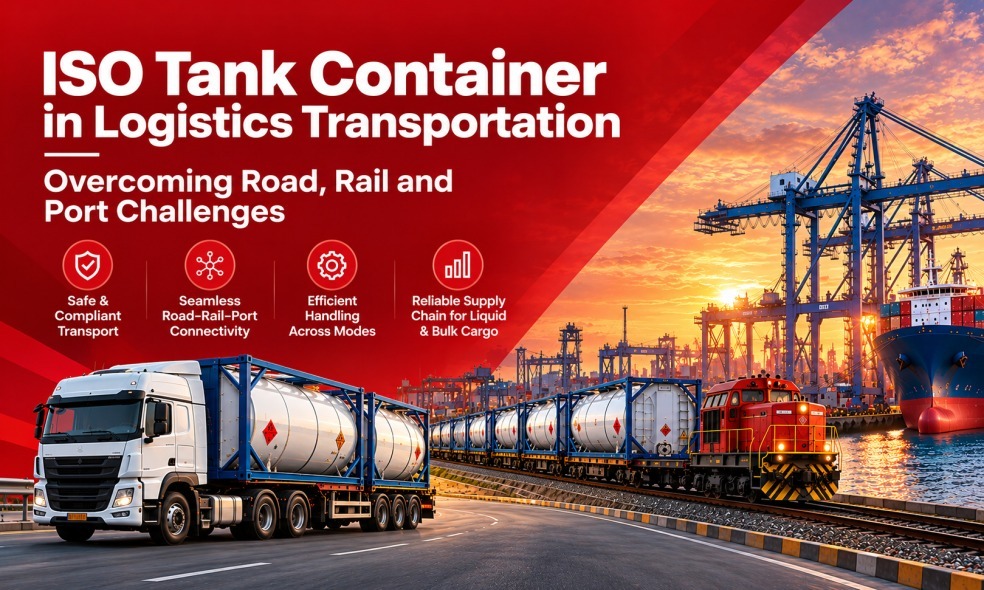
An ISO tank container is a tank mounted within a standardised frame for transporting liquids, gases and certain dry-bulk materials that can be loaded or discharged as liquids. It is designed for intermodal movement by road, rail and sea, allowing cargo to remain in the tank when transport modes change.
ISO 1496-3 specifies requirements and testing for these tank containers. Read the ISO standard.
Transafe Services lists ISO tank containers with capacities ranging from 20,000 to 26,000 litres, with construction options including 316L stainless steel and carbon steel with specialised lining. The suitable configuration depends on the product and its operating requirements.
Capacity alone is not enough to determine suitability. Cargo compatibility, operating temperature, pressure, valves, seals and cleaning requirements must also be considered.
1. Road Transportation: Check the Route and Loading Setup
Road transport often forms the first or final leg of an ISO tank container movement. In India, a tank may need to travel from a manufacturing plant to an inland terminal or port, making factory access and local road conditions important parts of the plan.
Before dispatch, check:
-
Vehicle and weight compatibility: Confirm that the loaded tank, chassis and vehicle comply with applicable weight limits and equipment requirements.
-
Route access: Check bridge restrictions, turning space, road conditions and access to the loading or discharge facility.
-
Tank condition: Inspect the tank, valves, fittings and protective equipment.
-
Site readiness: Ensure the facility has suitable connections, handling equipment and trained personnel.
A vehicle may travel smoothly on a major highway but encounter a narrow approach road or restricted turning space near the factory. Identifying these constraints before dispatch can help avoid waiting time and unplanned route changes.
Liquid cargo also behaves differently from solid cargo. Depending on the tank design and loading condition, liquid movement can affect vehicle handling. Filling limits and loading arrangements must follow the tank's specifications and applicable requirements.
Practical takeaway: Check the route for the actual loaded vehicle and confirm that the receiving facility is ready before dispatch.
2. Rail Transportation: Plan the Handover
Rail can support long-distance liquid cargo movement where suitable services, terminals and equipment are available. However, the availability of a rail service does not automatically guarantee compatibility with every route or tank configuration.
Before booking the rail leg, confirm three things.
Wagon and route compatibility: Verify dimensions, loaded weight and the proposed loading arrangement with the relevant operator or service provider.
Terminal handling: Check lifting arrangements, equipment availability and procedures for transferring the tank between road and rail.
Schedule alignment: Coordinate factory collection, terminal entry and rail cut-off times. A late arrival can mean waiting for the next available service.
Consider a chemical manufacturer moving liquid raw material from an inland plant towards a coastal port. If loading takes longer than planned, the road vehicle may miss its rail connection. The tank then reaches the port later than expected, potentially affecting the customer's production or export schedule.
The issue is not necessarily the rail transit time; it is the missed handover.
Rail costs also depend on first- and last-mile transport, terminal handling, service frequency and waiting time. Compare the complete movement rather than assuming rail will always be cheaper.
3. Port Operations: Avoid Delays Before Vessel Cut-Off
For export and import movements, port readiness depends on more than the vessel booking. Cargo details, tank condition, documentation and terminal schedules must align.
Before dispatching the tank to the port, confirm that:
-
Tank and cargo details match the booking and required documents.
-
Required inspections and testing are current.
-
Dangerous-goods declarations and handling arrangements are completed where applicable.
-
Terminal entry and vessel cut-off times are confirmed.
-
The receiving party is prepared for the next stage.
For dangerous goods carried by sea, check the requirements applicable to the substance and tank under the current International Maritime Dangerous Goods (IMDG) Code. These requirements cover areas such as classification, packing, handling, segregation and the safe placement of cargo aboard vessels. Refer to the International Maritime Organization's IMDG Code information.
A tank can reach the port on time and still miss its intended sailing if documentation or cargo readiness is incomplete. Build these checks into the dispatch plan instead of leaving them until the vehicle is already on its way.
4. Cleaning and Cargo Compatibility: Prevent Problems Before Loading
Cleaning and product compatibility deserve the same attention as transport schedules. Residue from a previous cargo, unsuitable lining or incompatible seals can compromise product quality and make a tank unsuitable for its next load.
Before loading, confirm the previous cargo where relevant, cleaning records, tank condition, material compatibility and any required inspection or testing. Loading and discharge facilities must also be equipped to handle the product safely.
For example, a manufacturer may have its raw material and production schedule ready, but the available tank's cleaning status has not been confirmed. Loading must wait until suitability is established. The vehicle remains idle, dispatch is delayed and the tank becomes unavailable for its next assignment.
A tank is not ready simply because it is available. It must be clean, suitable and compliant for the intended cargo.
5. How to Control ISO Tank Container Transportation Costs
Freight is only one part of the total cost. Positioning, cleaning, inspection, terminal handling, waiting time and empty-tank repositioning can all affect the economics of a movement.
|
Cost factor |
What to evaluate |
|
Utilisation |
How regularly is the tank used? |
|
Cleaning |
What preparation is needed between products? |
|
Waiting time |
Could delays keep the tank occupied? |
|
Empty returns |
Where must the tank go after discharge? |
|
Handling |
Are suitable loading and discharge facilities available? |
Empty returns deserve particular attention. A tank may reach its destination on schedule but remain there because unloading equipment is unavailable or the receiving facility has not planned the next step. This reduces availability for subsequent movements and can increase operating costs.
Track the complete cycle: loading readiness, transit, unloading, cleaning and return to a usable location. For recurring routes, this gives businesses a more realistic basis for comparing logistics providers and planning capacity.
6. Choosing an ISO Tank Container Manufacturer
A manufacturer should be assessed on more than nominal capacity. Check the tank's intended application, construction material, operating limits, documentation and suitability for the cargo.
Transafe Services Limited manufactures ISO tank containers for liquid, gas and pressurised dry-bulk applications. Its published product information outlines different shell materials and discharge arrangements.
When comparing an ISO tank or other ISO containers, share the cargo characteristics, operating conditions, loading and discharge methods and planned transport modes with the supplier. Ask which configuration suits the intended application and what supporting specifications and documentation are available.
Businesses can contact Transafe Services to discuss their container requirements and intended application.
Conclusion
Reliable ISO tank container transportation starts before the tank is loaded. Route access, rail compatibility, cleaning status, port cut-offs and empty returns all need to be considered as part of one coordinated movement.
For businesses moving liquid cargo regularly, the priority is to confirm tank suitability, prepare documentation early and assign clear responsibility at every handover. Planning the complete tank cycle, not just the journey from origin to destination, is key to reducing avoidable delays and controlling operating costs.
Frequently Asked Questions
1. What is an ISO tank container used for?
An ISO tank container transports liquids, gases and certain dry-bulk materials that can be loaded or discharged as liquids. The tank must suit the cargo and its operating requirements.
2. Can an ISO tank container move by road, rail and sea?
Yes. ISO tank containers are designed for intermodal transportation, subject to the tank specification, route, equipment and applicable requirements.
3. What should businesses check before loading an ISO tank container?
Check cargo compatibility, tank materials, valves and seals, cleaning history, tank condition, required inspections and loading equipment.
4. How can businesses reduce ISO tank container transportation costs?
Coordinate loading and unloading schedules, avoid missed cut-offs, plan cleaning in advance and manage empty-tank repositioning. Evaluate the full operating cycle rather than freight alone.
5. Where can businesses find ISO tank containers in India?
Businesses can contact Transafe Services to discuss tank specifications and suitability for their intended application.