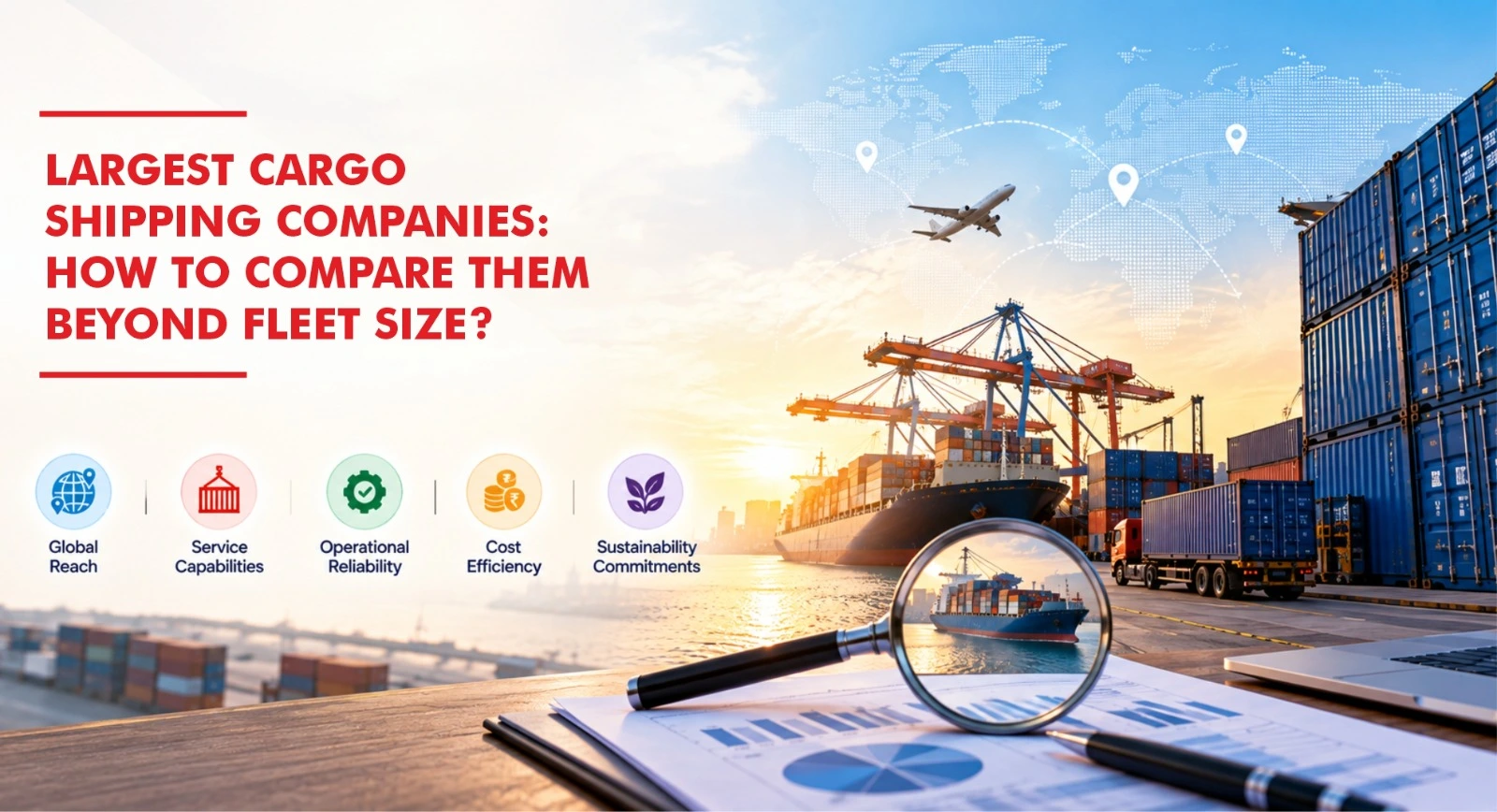
Search for the largest cargo shipping companies and you'll get a list sorted by fleet size within seconds. That's useful, but it skips the question that matters to an exporter: will this company work for my cargo, on my route?
Owning hundreds of vessels doesn't guarantee a good fit for every trade lane. Sometimes a smaller fleet has better connections on the exact route you need and that matters more than company size.
If you're an Indian exporter, importer, or growing SME, it's worth slowing down here instead of just picking a recognisable name.
A Bigger Fleet Doesn't Always Mean Better Service
A big fleet tells you a company has scale, not how good its service actually is. This is the trap most comparisons of the largest cargo shipping companies fall into, treating vessel count as the whole story.
Two carriers can both run enormous fleets and still be quite different in practice. One has stronger India-Europe coverage, another leans toward Southeast Asia and a third puts more resources into refrigerated cargo.
Before locking in on a carrier, it's worth checking a few other things too; port coverage, sailing frequency, how easy containers are to get, cargo handling beyond the port and how they respond to delays. None of that shows up in a fleet ranking, but it affects whether the shipping actually works.
A Large Carrier May Not Always Be the Right Choice
Large carriers bring real advantages: more ships, wider networks, more buying power which is exactly why they show up at the top of every list of the largest cargo shipping companies. But bigger operations tend to be more complicated and a small business doesn't always benefit from that scale.
Take an Indian manufacturer shipping engineering goods to Europe. What actually matters is which port suits their factory, how often sailings run, whether the route is direct, how quickly they can get containers and how the goods reach the port in the first place. That last part gets overlooked a lot, ocean freight is really just one leg of a longer journey.
Why Port Connections Matter
A carrier's route map can look impressive on a screen, but your business ships between two particular places, not to a map.
For most Indian businesses, that starting point is a port like Nhava Sheva, Mundra, or Chennai. From there, cargo may pass through several other ports before reaching its final destination, and every extra stop adds a chance for delay. A carrier with a solid, direct connection on your lane cuts down on that risk. Before signing on, it helps to ask a plain question: does this line run a good route for my cargo, or does it just have a familiar name?
Is the Right Container Available When You Need It?
This is where the gap between a fleet ranking and real-world shipping shows up. A company can have hundreds of vessels, but none of that helps if the container you need isn't available at your port when you need it.
Availability shifts depending on the port, the equipment type, the season and how much cargo is already moving through that region. A reefer container might be hard to find during peak export season even from a carrier with a massive fleet. This is why container transport planning deserves attention on its own, the container has to exist at the right place, get loaded correctly, and arrive at the port on schedule. One weak link there can throw off the whole shipment.
What Happens Before the Cargo Reaches the Port?
Most Indian exporters aren't shipping straight from a port. The cargo starts at a factory, gets loaded into a container, travels by road and only then reaches the terminal — factory, empty container arrives, loading, road transportation, port, vessel, destination port and final delivery. If any single link breaks down, the size of the ocean carrier won't rescue the shipment. This is one reason businesses rely on partners who handle container transport services as part of the whole movement, rather than treating ocean freight and inland logistics as separate problems.
Faster Doesn't Always Mean Better
A fast-looking schedule on paper can hide a tight connection or an extra transfer. A service that takes a bit longer might actually get your cargo there more consistently. For a factory waiting on components to keep production running, a missed connection causes far more damage than a slower, dependable sailing would.
The better question isn't which carrier is fastest, it's which one shows up when they say.
What Smaller Businesses Should Actually Check
Bigger companies usually have teams whose job is negotiating with shipping lines. Most smaller businesses don't, which makes it tempting to just go with a familiar name. A short list of questions helps instead: where's the cargo going and how often, what container type is needed, fixed schedule or flexibility, how time-sensitive is delivery, what's the backup plan for delays and who's handling the inland leg. Running through these stops the decision from turning into "whoever's biggest wins."
Big Doesn't Automatically Mean Right
There's nothing wrong with picking one of the largest cargo shipping companies in the world, the scale can genuinely help. The mistake is assuming size alone settles the question for every business.
Route, cargo type, volume, and delivery timelines should drive the decision, not the size of the logo. A company moving thousands of containers a year needs something different than an SME sending a handful a month, the right carrier matches the shipment in front of you.
The Right Container Matters Too
Transafe Services approaches this from the equipment side rather than the shipping-line side. The company designs and builds ISO containers and specialised units for different cargo types, and also offers container leasing — standard and high-cube containers along with specialised equipment for refrigerated cargo, offshore work and other industrial uses.
Picking a shipping line only solves part of the problem, the right container ready on time matters just as much.
Conclusion
Skip the ranking. Comparing the largest cargo shipping companies on paper won't tell you much, start with what your business needs: route, equipment, sailing schedule and the road journey on either end. Then check carriers against that list.
A fleet ranking tells you how large a company is, not whether their route, equipment and service fit your cargo, that's the comparison worth making.
Frequently Asked Questions
1. Who are the largest cargo shipping companies?
Names like MSC, Maersk, CMA CGM, COSCO and Hapag-Lloyd typically top these lists. Rankings shift as carriers add capacity, so check current data rather than an old article.
2. Is fleet size the best way to compare shipping companies?
Not on its own. Port coverage, sailing frequency, transit time, container availability and how a carrier handles delays matter just as much.
3. Why does container availability matter so much?
Fleet size means nothing if you can't get the container you need, when you need it. Availability changes by location, season and cargo type.
4. What are container transport services?
They cover moving containers, loaded or empty, between factories, warehouses, ports and rail yards, the part of shipping that happens outside the ocean leg.
5. Should small Indian businesses always pick the biggest shipping company?
Not necessarily. Being among the largest cargo shipping companies doesn't automatically make a carrier right for a smaller business, it comesdown to route, cargo type, volume and service needs.