Table of Contents
-
Introduction
-
Why More Businesses Are Choosing a Container House Instead of Traditional Construction
-
The Real Cost of Construction Delays Most Businesses Ignore
-
Why Move-In Ready Container Homes Work Better in Industrial Environments
-
Container House Price vs Traditional Construction: What Businesses Often Miss
-
Understanding Container House Price India in Practical Terms
-
The Biggest Mistakes Buyers Make Before Purchasing a Container House
-
Why Portable Container Homes Are Becoming a Long-Term Infrastructure Strategy
-
Faster Infrastructure Without Construction Chaos
-
FAQs
Why More Businesses Are Choosing a Container House Instead of Traditional Construction
A factory expands faster than expected. A mining project starts in a remote location. A warehouse operator suddenly needs staff accommodation near a logistics yard. In most of these situations, companies do not have the luxury of waiting 12 to 18 months for conventional construction of a Container house.
And it is one of the biggest reasons the demand for a modern Container house has increased sharply across India in the last few years. The shift is not only about affordability. It is about predictability, scalability and long-term infrastructure efficiency linked to the cost of container house development.
Traditional building projects often create disruptions before they even become usable. Delayed contractors, material shortages, labour dependency, local approvals, weather interruptions and constant site supervision turn small infrastructure requirements into long-running projects compared to a modular Container house solution.
Portable container homes solve a very different business problem. They reduce execution uncertainty through structured Container house deployment.
A properly manufactured Container house can be delivered, installed and made operational in a fraction of the time required for civil construction, with far less on-site chaos. For industrial operators, exporters, logistics companies and infrastructure businesses, that matters more than aesthetics and often influences overall container house price planning.
The Real Cost of Construction Delays Most Businesses Ignore
Many companies calculate only the construction expense. Very few calculate the cost of waiting during a Container house comparison with conventional construction. It is where project budgets usually go wrong.
If a warehouse expansion is delayed by six months because labour work is incomplete, the business may continue paying for temporary accommodation, rented office space, idle equipment, transportation inefficiencies and much more instead of shifting into a ready Container house setup.
In industrial operations, delayed infrastructure affects workflow continuity. The reason is simple. Operations can begin immediately with a modular Container house instead of waiting for permanent construction completion.
This operational flexibility provided by a Container house is often more valuable than the initial savings on construction itself and directly affects the overall cost of container house ownership.
Why Move-In Ready Container Homes Work Better in Industrial Environments
A standard residential building project assumes stable conditions.
Industrial and logistics environments rarely operate that way. This is where a Container house becomes commercially practical.
Land availability changes. Operations scale unexpectedly. Temporary projects become long-term. Remote sites need infrastructure quickly. Workforce movement changes accommodation requirements. This is where a move-in ready Container house becomes practical rather than experimental.
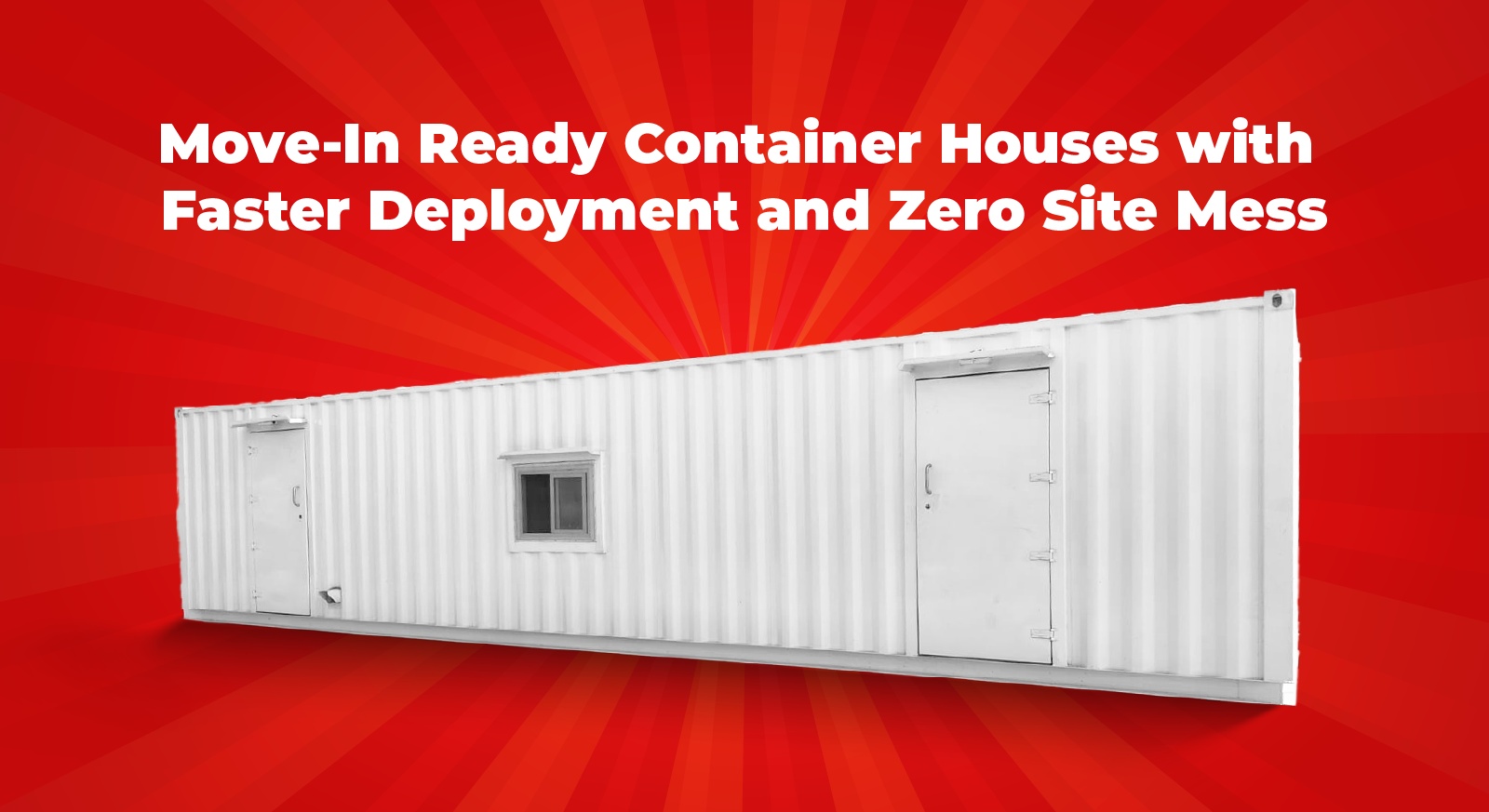
The biggest advantage of a Container house is deployment speed. Instead of managing brickwork, civil contractors, plumbing coordination, electrical subcontractors, finishing teams and on-site material storage, the buyer receives a pre-fabricated ready-to-use Container house structure.
In many industrial projects, reducing site activity is itself a major advantage because active construction inside operational facilities creates safety risks, movement disruptions and coordination problems that a modular Container house helps minimize.
That is why sectors like logistics, manufacturing, mining, infrastructure, renewable energy, warehousing and EPC projects are increasingly using modular Container house infrastructure.
Container House Price vs Traditional Construction: What Businesses Often Miss
Most online discussions around container house price focus only on upfront numbers, which is incomplete.
The actual comparison should include:
-
Construction timeline
-
Labour dependency
-
Relocation capability
-
Maintenance downtime
-
Future scalability
-
Site disruption costs
-
Approval complexity
-
Operational interruption
A traditional building may appear cheaper initially in some cases, especially on owned land with low urgency. But once project delays start, budgets move quickly compared to a modular Container house setup.
The cost of container house projects becomes easier to control because manufacturing happens in a structured environment instead of an unpredictable construction site.
This matters particularly in India where labour availability fluctuates, monsoon delays are common, raw material prices shift frequently and local contractor quality differs majorly by region. These realities heavily influence container house price india discussions.
Businesses that prioritize execution certainty often prefer modular Container house solutions for this reason alone.
Understanding Container House Price India in Practical Terms
The discussion around container house price india has changed significantly over the last few years. Earlier, a Container house was treated as a temporary low-cost structure.
Today, buyers expect insulation, proper ventilation, electrical integration, washrooms, office-grade interiors, air conditioning compatibility, modular expansion capability and aesthetic finishing in every Container house.
As expectations rise, pricing naturally varies based on specifications and overall container house price considerations.
The home container price usually depends on:
-
Container size
-
Structural modifications
-
Insulation quality
-
Interior finishing
-
Electrical systems
-
Plumbing requirements
-
Transportation distance
-
Installation complexity
A site office for a logistics operator will have completely different requirements compared to a workforce accommodation unit near a manufacturing facility. That is why businesses should avoid comparing Container house pricing purely on square-foot calculations and instead evaluate the long-term cost of container house ownership.
The Biggest Mistakes Buyers Make Before Purchasing a Container House
Choosing Only on Price
This is the most common mistake while selecting a Container house.
Very low-cost suppliers often compromise on:
-
Steel reinforcement
-
Insulation
-
Waterproofing
-
Electrical safety
-
Flooring durability
-
Corrosion protection
The result is higher maintenance later and increased container house price over the long term.
Ignoring Transportation Constraints
A Container house structure that looks good in a factory yard may become difficult to transport to remote project sites.
Experienced manufacturers design every Container house while considering road clearance, unloading limitations, crane access and interstate movement realities.
This is something inexperienced buyers often overlook while evaluating container house price india comparisons.
Underestimating Heat Management
In India, thermal insulation is not optional for a Container house.
Poor insulation can make portable cabins uncomfortable and increase long-term cooling costs substantially. While a good manufacturer accounts for roof heat absorption, ventilation airflow, insulation thickness and climate conditions before fabrication starts for every Container house.
Why Portable Container Homes Are Becoming a Long-Term Infrastructure Strategy
Many businesses initially purchase portable cabins as temporary infrastructure but then operations evolve. The temporary office becomes permanent. The project site expands. Additional units are added. Accommodation blocks grow around a scalable Container house infrastructure model.
This scalability is one of the strongest advantages of modular Container house construction.
Unlike conventional buildings, a Container house can often be relocated, expanded, modified, repurposed and even transported to new sites without starting construction again from scratch.
For companies operating across multiple industrial locations, this flexibility creates long-term infrastructure efficiency and better control over the cost of container house expansion.
Businesses evaluating modular infrastructure increasingly compare home container price, durability and deployment speed before investing in a modern Container house.
Faster Infrastructure Without Construction Chaos
Businesses today are under pressure to move faster than traditional construction systems allow. Operational delays are expensive, site disruption affects productivity and labour uncertainty complicates planning for every infrastructure project involving a Container house.
That is why move-in ready modular infrastructure is becoming part of mainstream industrial planning rather than a niche alternative. A well-designed Container house is no longer viewed as a temporary compromise. In many industries, it has become the smarter operational decision.
Especially when speed, flexibility and execution certainty matter more than managing another long construction cycle involving conventional buildings and unpredictable container house price india fluctuations.
Businesses looking for portable cabins and modular infrastructure solutions are increasingly turning to experienced companies like Transafe Services for faster deployment, optimized home container price planning and more operationally efficient Container house setups.
FAQs
What is the average container house price in India?
The container house price india depends on size, insulation, interiors, plumbing, electrical work and customization requirements. Basic units cost significantly less than fully furnished modular setups designed for commercial or residential use. The final container house price also varies depending on transportation and installation complexity.
Is the cost of a container house lower than traditional construction?
In many cases, yes. But the bigger advantage of a Container house is faster deployment, reduced labour dependency and lower project delays rather than only lower upfront cost. The long-term cost of container house ownership often becomes more predictable compared to traditional construction.
Are container homes suitable for Indian weather conditions?
Yes, if proper insulation, waterproofing and ventilation systems are installed inside the Container house. Heat management is critical in Indian climates and directly affects long-term home container price efficiency.
Can container houses be relocated later?
One of the biggest advantages of a Container house is mobility. Many Container house units can be shifted and reused across different project locations, helping businesses optimize the overall cost of container house infrastructure over time.