Need some extra cold storage for a few weeks or a few months?
It sounds like a straightforward requirement until you start looking at the options. A cold room is the first solution many businesses think of, but building one may not make much sense if the additional storage is only temporary.
For example, a food distributor may need extra space during a busy season. A manufacturing company may need somewhere to keep temperature-sensitive products while its existing facility is being repaired.
In cases like these, a refrigeration container can be a practical alternative.
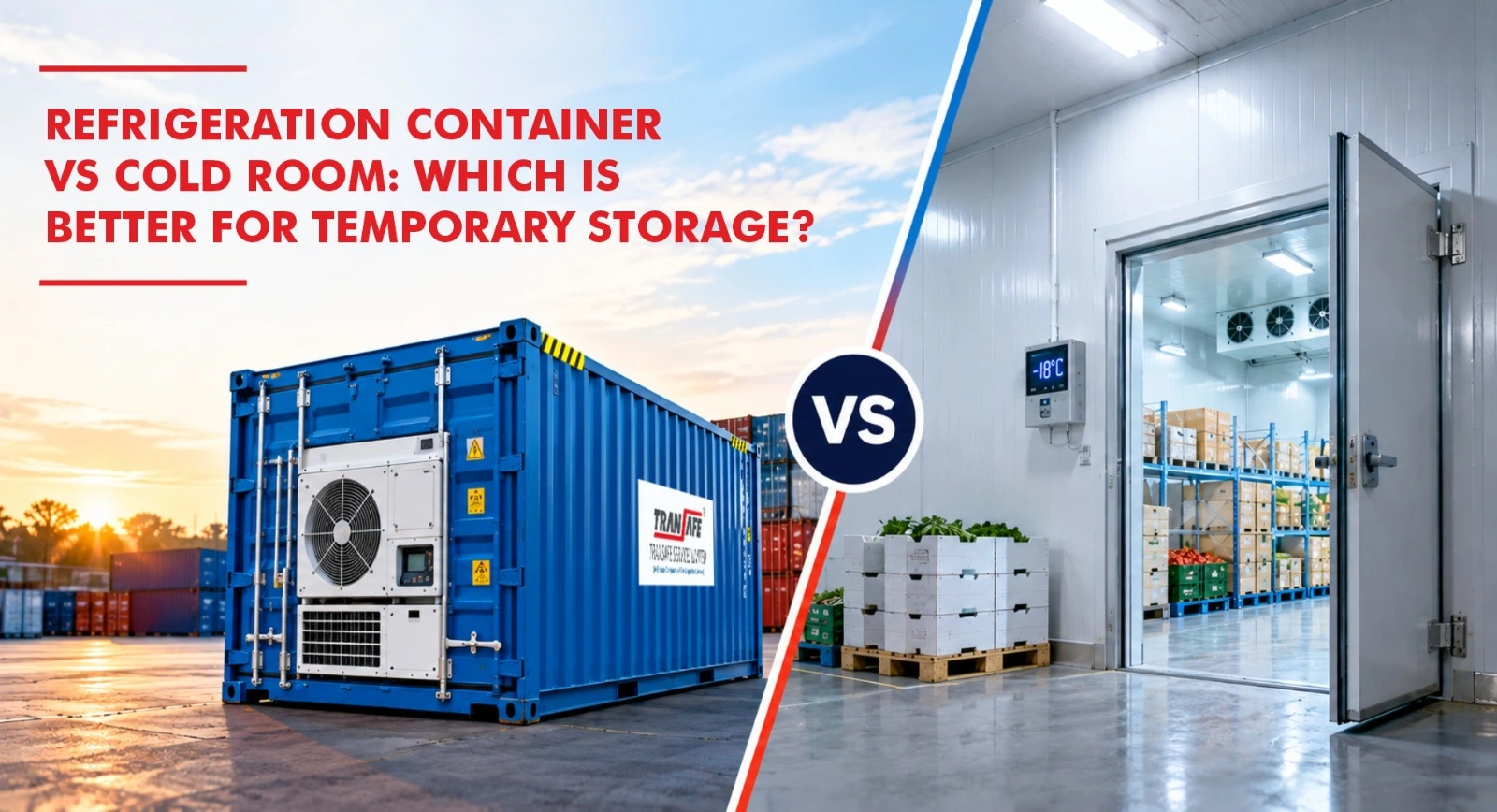
Both cold rooms and refrigerated containers are used to keep temperature-sensitive products within a controlled range. The huge difference is how they fit into your operation. A cold room becomes part of the building, while a refrigeration container can be brought to the site, connected to power and used for the period you need it.
So, which one is better?
There is no single answer for every business. But if the requirement is temporary, a refrigeration container often makes more sense than investing in permanent construction.
Refrigeration Container vs Cold Room: What Is the Difference?
The simplest way to compare the two is to look at how they are installed and used.
A refrigeration container is an insulated shipping container fitted with a refrigeration unit. It provides a closed, temperature-controlled space and can be placed at a warehouse, factory, distribution centre or other suitable location.
A cold room, on the other hand, is a permanent insulated room built at a specific site. Its size, doors, insulation, cooling system and internal arrangement can be designed around the operation, and that difference becomes important when your storage requirement changes.
|
Requirement |
Refrigeration Container |
Cold Room |
|
Temporary storage |
Excellent option |
Usually less convenient |
|
Permanent storage |
Suitable |
Excellent option |
|
Relocation |
Possible |
Not practical |
|
Construction |
Minimal site work |
Usually required |
|
Custom design |
Limited |
More flexibility |
|
Seasonal demand |
Very useful |
May involve unused capacity |
|
Additional capacity |
Add another unit |
Expand the facility |
Why Use a Refrigeration Container for Temporary Storage?
The biggest advantage is that you can get additional refrigerated space without extending your building.
Suppose a fruit distributor normally stores 200 pallets but expects a much larger volume during the mango or apple season. The existing cold room may not have enough capacity for those few months.
Building an extension for a seasonal requirement would leave the company with extra space once demand falls.
A refrigerated container can bridge that gap. The unit can be positioned close to the warehouse and used as additional storage during the busy period. Once demand drops, the container can be removed or used elsewhere.
Choosing the Right Refrigeration Container Size
It's tempting to simply ask for the biggest containers available. More space sounds better, but it isn't always the most sensible choice.
The container should match the cargo and the way you handle it. Before deciding on a size, look at:
-
Number of pallets to be stored
-
Pallet and carton dimensions
-
Total quantity of goods
-
Loading and unloading method
-
Forklift access
-
Available space at the site
-
Required storage duration
For example, a 20-foot refrigerated container may be adequate for a smaller volume, while a 40-foot high-cube unit among the biggest containers commonly available may be more appropriate when the storage requirement is considerably larger.
There is also a practical point about loading. A refrigerated container should not simply be packed from floor to ceiling without considering airflow. Cold air needs to circulate around the stored products. Poor loading can affect temperature consistency and make the refrigeration system work harder.
So the question shouldn't be, "What is the biggest container we can get?" It should be, "What size will handle our actual storage requirement properly?"
When Is a Cold Room the Better Choice?
A cold room starts making more sense when refrigerated storage is going to remain part of the business for years rather than months.
Consider a food-processing facility where products arrive every day, are placed into cold storage and then moved to production or dispatch. In that situation, a purpose-built cold room can be planned around the entire workflow.
There may be dedicated areas for pallets, racks, forklifts and workers. Loading doors can be positioned where they are most useful. The room can also be designed around the required temperature range and storage volume.
A larger operation may even need separate temperature zones for different products — a level of customisation that's difficult to achieve with a standard refrigerated container.
So if your business already knows it will need the same cold-storage capacity year after year, investing in a cold room may be the more appropriate long-term solution.
What to Check Before Choosing (and What It Will Cost You)
The first question shouldn't be about price or container size. Start with the product.
What are you storing? What temperature does it need? How long will it remain in storage? How frequently will stock be moved in and out? Frozen food, fresh produce, dairy products and pharmaceutical products can all have very different storage and handling requirements.
Then look at the site. A refrigeration container needs enough space for positioning and access, plus a suitable electrical connection for the refrigeration equipment. Think about how a truck or forklift will approach the container and whether there's enough room around the doors for loading.
Power supply deserves its own mention. In India, where power interruptions can occur in some locations, businesses storing valuable temperature-sensitive products should have a suitable backup plan, the exact arrangement will depend on the container, site and cargo.
There's also a common misconception worth clearing up: a refrigerated container is designed to maintain the required temperature, not to replace a proper pre-cooling process. If warm products are loaded straight in, the refrigeration system has to work harder to remove that extra heat. Depending on the product, goods may need to be cooled to the required temperature before they enter storage.
Once you've worked through the product and site questions, cost naturally becomes part of the picture. And a refrigeration container isn't automatically cheaper than a cold room, it depends on the situation. For temporary storage, a container can make financial sense because there's no need to build a permanent room for a requirement that may disappear after a few months. For a long-term operation, though, a cold room may offer better value, particularly when large quantities are being stored continuously.
The mistake is comparing only the upfront price. A fair comparison should factor in:
-
Rental or purchase cost
-
Site preparation
-
Electricity consumption
-
Maintenance
-
Installation requirements
-
Loading and unloading arrangements
-
Backup power
-
Expected period of use
Refrigeration Containers from Transafe Services
For businesses looking for temporary temperature-controlled storage, Transafe Services provides refrigerated and insulated containers for storage and transportation requirements.
The company offers refrigerated containers with integrated refrigeration systems, including 20-foot and 40-foot high-cube options. Container leasing can also be considered when the requirement is for a defined period rather than a permanent installation.
Before choosing a container, it's worth discussing the type of cargo, required temperature, quantity, storage duration and site conditions. These details help determine whether a refrigerated container is suitable and which configuration is appropriate.
Frequently Asked Questions
-
Is a refrigeration container good for temporary storage?
Yes. It can provide extra temperature-controlled space without permanent construction.
-
What is the main difference between a refrigeration container and a cold room?
A refrigeration container is movable, while a cold room is a permanent structure.
-
Which refrigeration container size should I choose?
It depends on your cargo volume, pallet size, loading method and available site space.
-
Can refrigerated containers store food and pharmaceuticals?
They can be suitable for temperature-sensitive products, depending on the required temperature and storage conditions.
-
Should I rent a refrigeration container or build a cold room?
For short-term needs, renting a refrigeration container may be more practical. Long-term requirements may justify a cold room.