A container is not simply a steel box with dimensions.
For many businesses, the wrong container decision shows up much later as loading delays, damaged equipment, poor utilisation, difficult handling, or an expensive redesign after manufacturing has already started.
That is why the conversation with a container manufacturer should begin with the cargo, not the container.
At Transafe Services, this cargo-first approach matters because different industries place very different demands on a container. Heavy machinery, electrical equipment, coils, temperature-sensitive products and oversized components cannot be treated as variations of the same requirement. The container has to work around the cargo, the handling method and the route.
Your Cargo Profile Should Drive the Container Design
The first question a container manufacturing company should ask is simple:
What exactly are you putting inside it, and how will it move?
That sounds obvious. In practice, it is often where specifications become too vague.
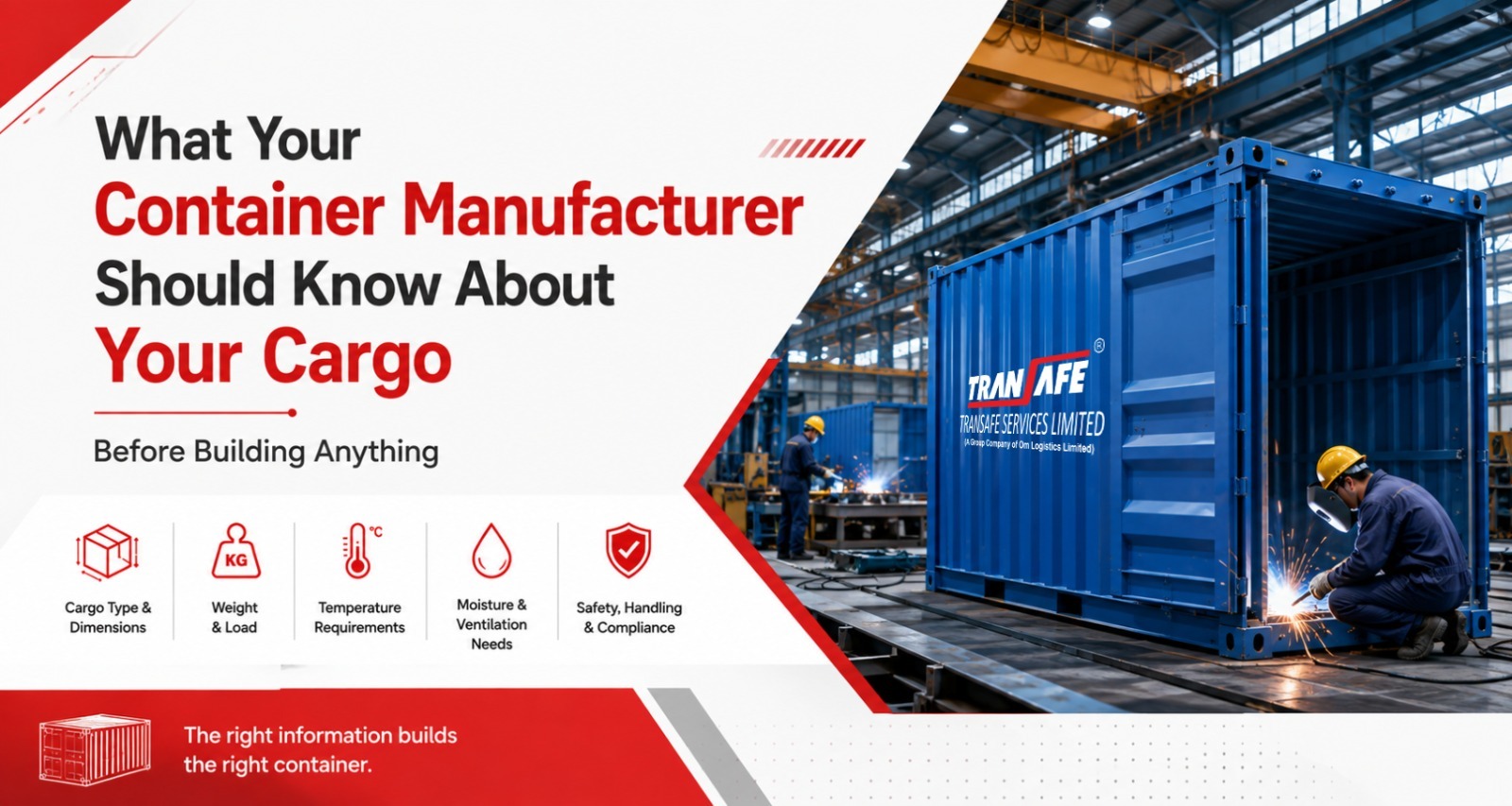
A manufacturer needs to understand:
-
Cargo dimensions, including unusual projections
-
Gross weight and weight distribution
-
Centre of gravity
-
Loading and unloading method
-
Forklift, crane or other handling equipment
-
Number of loading cycles
-
Domestic, export or multimodal movement
-
Whether the cargo needs ventilation, insulation or environmental protection
-
Whether operators need access while the equipment is inside
-
Whether the container will also function as an operating enclosure
A 10-tonne machine and a 10-tonne electrical assembly may have completely different container requirements.
The weight is only one part of the engineering problem.
Why Cargo Weight Alone Is Not Enough
One of the mistakes we see in container planning is treating payload as the main specification.
Consider a heavy machine with a concentrated load at one end. Its total weight may remain within an acceptable limit, but the floor-loading pattern can create a very different engineering requirement from evenly distributed cargo.
The same issue appears with coils, transformers, generators and industrial equipment.
The manufacturer needs to know where the weight sits, not merely how much it weighs.
Centre of gravity matters too. If a tall piece of equipment is top-heavy, the container design and cargo securing arrangement need to account for stability during road movement, rail handling and lifting.
This is where a technically competent container manufacturer in India should add value: not by simply fabricating to a drawing, but by asking questions that expose operational risks before steel is cut.
Loading Method Changes the Container You Need
Cargo does not magically enter a container.
It arrives at a factory, warehouse, CFS, ICD, port or project site and has to be physically loaded. That process should influence the design.
For example, top-loaded machinery may require an open-top or hard-top arrangement. Long or irregular cargo may benefit from a flat-rack configuration. Cargo that needs frequent side access can justify a side-access design rather than forcing operators to unload other material first.
The right question is therefore not:
“Which container size do we need?”
It is:
“How will this cargo enter, sit inside, be secured, inspected and come out again?”
That distinction can save considerable operational frustration.
Transafe’s ISO freight container range includes configurations such as DVC, side-access, open-top, hard-top, flat-rack, ventilated and coil-tainer solutions, allowing the design conversation to start with the cargo application rather than a standard box.
Think About the Entire Route, Not Just the Factory Gate
A container can perform perfectly inside a manufacturing facility and still become a poor logistics solution once it enters the transport network.
Indian cargo frequently moves through combinations of road, rail, coastal and marine transport. A design that works for one handling environment may create problems at another.
Before approving a design, ask:
Where will the container go?
Map the journey:
Factory → local road movement → CFS/ICD → rail or port → vessel → destination → final delivery
Then identify the handling points.
Will cranes lift it? Will forklifts approach from the side? Will it sit outdoors? Will it be exposed to monsoon conditions? Will the destination have the same lifting capability as the origin?
These details influence access arrangements, structural requirements, protection, lifting provisions and overall usability.
Transafe services manufactures standard ISO containers and specialised derivatives for multimodal applications involving marine, road and rail movement. Its portfolio also includes offshore containers designed for demanding marine environments.
Cargo Securing Is Part of the Container Conversation
A container can be structurally sound and still be poorly suited to the cargo. That happens when securing is treated as an afterthought.
For industrial cargo, the manufacturer should understand where lashing points, supports, frames, brackets or other securing arrangements are required. Equipment may need to remain immobilised through repeated handling and transportation conditions.
This becomes particularly important for:
-
Electrical equipment
-
Generators
-
Heavy machinery
-
Pipes and tubes
-
Coils
-
Fragile industrial assemblies
-
High-value project equipment
The objective is not merely to keep cargo inside the container.
It is to make the cargo stable, accessible and practical to handle throughout its movement.
When a Standard Container Is the Wrong Answer
Standardisation has obvious advantages. It simplifies handling, availability and logistics planning. But standardisation should not become a constraint when the cargo itself is unusual.
A customised solution may make more sense when you have:
-
Oversized dimensions
-
Unusual weight distribution
-
Top-loading requirements
-
Frequent access requirements
-
Integrated machinery
-
Electrical systems requiring controlled internal conditions
-
Temperature-sensitive cargo
-
Offshore or harsh-environment applications
-
Special operational or project requirements
Transafe’s product portfolio extends beyond conventional freight containers into refrigerated and insulated containers, ISO tank containers, containerised substations, BESS/CSS containers, genset containers, bunk houses, special-purpose containers and strategic/research applications.
The important point is not that customised containers are always better.
They are better when the operational problem justifies the customisation. That is the business decision procurement teams should make.
Compliance Should Be Built Into the Design Conversation
Compliance should not be the final checkpoint before dispatch.
It should influence the design from the beginning.
For ISO freight containers, relevant standards and application requirements need to be considered alongside cargo characteristics. Offshore applications can involve an entirely different set of environmental and operational demands.
Transafe services states that its ISO freight containers are aligned with ISO 1496-1 requirements, while its offshore containers are designed according to DNV 2.7-1 requirements for demanding marine environments. The company also holds ISO 9001:2015 and ISO 45001:2018 certifications, with ISO 14001:2015 and Make in India credentials listed on its corporate site.
For buyers, the practical lesson is straightforward: ask what standard applies to your application before finalising the design, rather than asking for certification after the design is complete.
What SMEs Should Give Their Container Manufacturer
Smaller and mid-sized businesses often assume they need an elaborate engineering package before approaching a manufacturer.
They do not.
A useful first brief can contain:
Cargo: What is being carried?
Dimensions: Length, width, height and any projections.
Weight: Total weight plus major concentrated loads.
Handling: Crane, forklift, ramp, side loading or top loading.
Route: Road, rail, coastal, marine or multimodal.
Environment: Indoor, outdoor, humid, corrosive, offshore or temperature-controlled.
Access: How frequently must people reach the cargo?
Frequency: One project movement or repeated use?
Destination: Where will the container operate?
The better this information is, the less likely you are to end up with a technically acceptable container that is operationally inconvenient.
Choosing a Container Manufacturer Is an Operational Decision
The cheapest container is rarely the right benchmark.
Instead, evaluate the total operating outcome.
Will the design reduce loading time?
Will it protect the cargo?
Will existing handling equipment work with it?
Will it move efficiently across the intended route?
Will operators have the access they need?
Will the design remain useful as your operation changes?
Those questions lead to better procurement decisions.
Transafe Services brings more than three decades of experience in standard and customised container manufacturing, with manufacturing facilities in Kharagpur, Coimbatore and Dharuhera and a portfolio covering ISO, offshore, specialised and application-specific container solutions.
For an exporter, manufacturer, logistics operator or project business, that is the real objective: build the container around the job it has to perform.
Because when the cargo is understood properly at the design stage, the container becomes more than transport equipment.
It becomes part of the logistics solution.
FAQs
1. What information should I give a container manufacturer before requesting a design?
Provide cargo dimensions, weight, centre of gravity, loading method, securing requirements, intended route, handling equipment, environmental conditions and whether the container will be used repeatedly or for a single project.
2. Does every type of cargo need a customised container?
No. Standard ISO containers are suitable for many applications. Customisation becomes useful when cargo has unusual dimensions, concentrated weight, special access requirements, environmental sensitivity or integrated equipment.
3. How does cargo weight affect container design?
Total weight is important, but distribution matters just as much. Concentrated loads, centre of gravity and the location of heavy components can affect the required floor and structural design.
4. What should an Indian business consider when selecting a container manufacturer?
Look beyond fabrication capacity. Consider relevant standards, engineering capability, cargo-specific design experience, manufacturing locations, quality systems, after-sales support and whether the manufacturer understands the actual transport route and handling environment.
5. Can Transafe provide containers beyond standard freight containers?
Yes. Transafe’s portfolio includes ISO freight containers as well as offshore, insulated and refrigerated, ISO tank, genset, BESS/CSS, containerised substations, bunk houses, special-purpose and strategic/research containers.