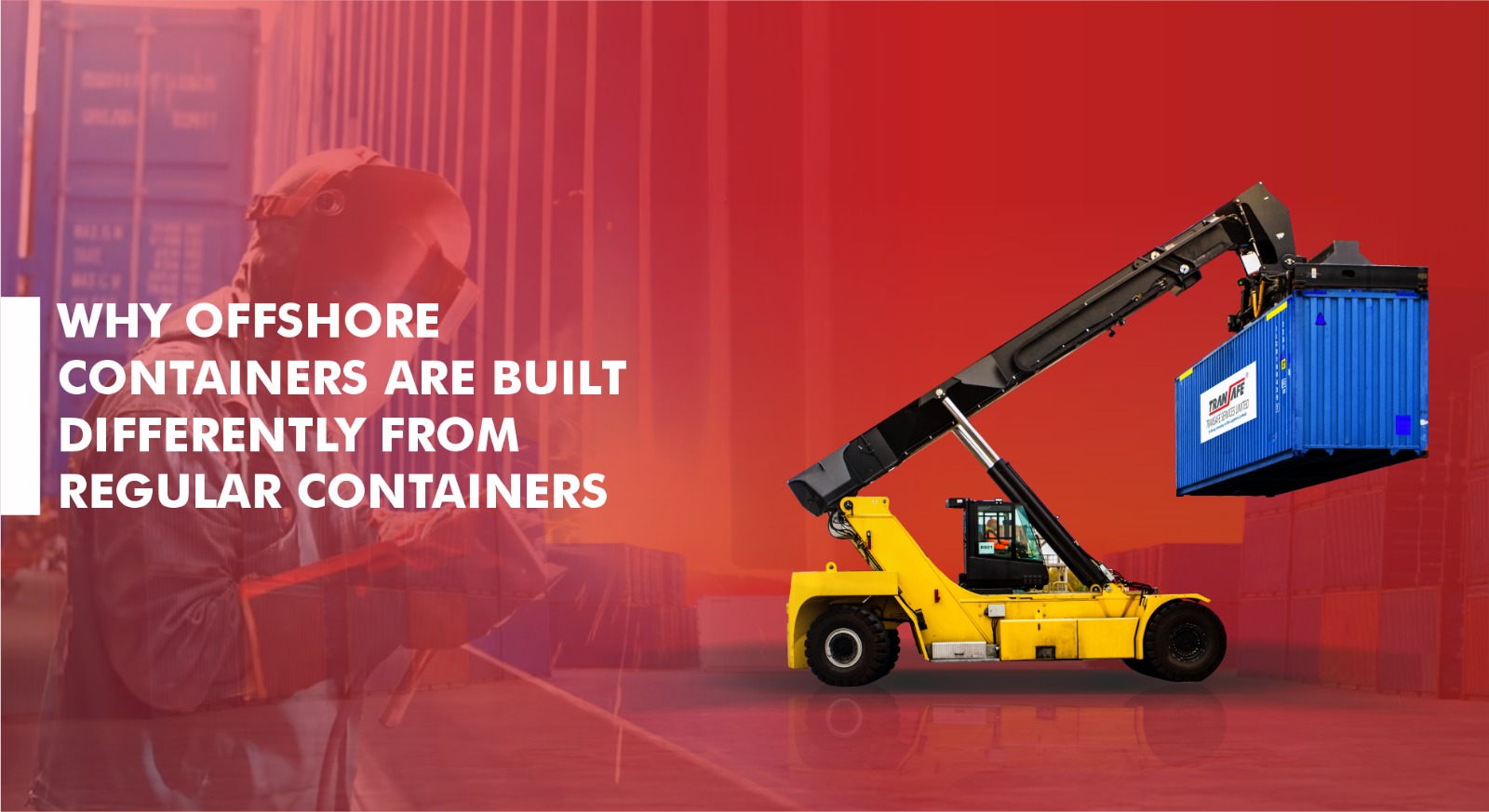
Operations in offshore environments leave no room for compromise. Equipment, supplies and materials move between land and offshore platforms under constant exposure to saltwater, strong winds and heavy handling. Standard containers are not designed for this level of stress. Offshore containers are engineered with a different approach to ensure safety, durability and compliance.
As an ISO freight and customized container manufacturer in India, Transafe Services designs and delivers offshore containers that align with industry-specific requirements and operational realities.
What Are Offshore Containers?
Offshore containers are specialized units used in marine and high-humidity environments, mainly in the oil and gas sector. These containers support the safe transport of equipment, tools, food supplies and waste between offshore platforms and supply vessels.
These units are not standard cargo boxes. They are built to perform in extreme marine conditions where lifting, stacking and transport happen under dynamic forces.
Key characteristics:
-
Designed for offshore logistics operations
-
Suitable for high humidity and saline environments
-
Built to handle repeated lifting and rough handling
-
Used on supply vessels and offshore rigs
Key Differences Between Offshore and Standard Shipping Containers
Offshore containers and standard shipping containers serve different operational needs. The difference lies in design philosophy, safety compliance and durability.
|
Parameter |
Offshore Containers |
Standard Containers |
|
Usage Environment |
Marine, offshore platforms |
Land and sea transport |
|
Design Standards |
DNV 2.7-1 and offshore norms |
ISO standards |
|
Structural Strength |
Reinforced for heavy impact |
Standard load-bearing |
|
Lifting Mechanism |
Certified lifting slings and pad eyes |
Basic lifting provisions |
|
Corrosion Resistance |
High-grade marine coatings |
Basic protective coatings |
|
Safety Features |
Advanced safety fittings |
Limited safety provisions |
Compliance with Strict Offshore Safety Standards
Safety remains a critical factor in offshore operations. Offshore containers are built as per DNV 2.7-1 specification, a globally accepted standard for offshore containers.
This standard defines:
-
Structural integrity requirements
-
Load testing procedures
-
Lifting and handling safety norms
-
Inspection and certification guidelines
Each container undergoes rigorous testing before deployment. This reduces operational risk and ensures safe handling in offshore conditions.
Enhanced Structural Strength for Harsh Marine Conditions
Marine environments create continuous stress on equipment. Offshore containers are engineered with reinforced frames and heavy-duty steel structures to withstand:
-
Rough sea movements
-
Impact during loading and unloading
-
High wind pressure
-
Continuous vibration during transit
The base frame, side walls and roof are strengthened to maintain structural stability even under uneven loading conditions.
Basket containers, for example, are specifically built to carry heavy and irregular cargo like pipes and tubes. Their open design allows flexibility while maintaining strength for secure transport.
Special Lifting and Handling Features
Offshore operations involve frequent lifting using cranes on ships and rigs. Standard lifting methods are not sufficient in such environments.
Offshore containers include:
-
Certified lifting slings
-
Pad eyes designed for multi-point lifting
-
Shock-absorbing structures
-
Secure lashing points
These features ensure safe handling during vertical lifting and movement across unstable surfaces. The design reduces the risk of imbalance or load shifting during operations.
Corrosion Resistance for Marine Environments
Saltwater exposure accelerates corrosion. Offshore containers are treated with advanced protective coatings to ensure long service life.
Protection measures include:
-
Marine-grade anti-corrosion coatings
-
Surface treatment for moisture resistance
-
Sealed joints to prevent water ingress
Safety Features for Transporting Equipment and Supplies
Offshore logistics often includes sensitive and essential cargo. Containers are designed to secure and protect these materials during transit.
Key safety features:
-
Anti-slip flooring for internal safety
-
Ventilation systems for airflow
-
Secure locking mechanisms
-
Internal lashing points for cargo stability
These features help prevent damage to goods and ensure safe handling of supplies like tools, machinery and consumables.
Industries That Rely on Offshore Containers
Offshore containers play a critical role across industries that operate in marine or high-risk environments.
Primary sectors include:
-
Oil and gas industry
-
Offshore drilling operations
-
Marine logistics providers
-
Energy and utility companies
These industries depend on reliable container solutions to maintain uninterrupted operations between offshore sites and mainland facilities.
Conclusion
Offshore operations demand more than standard logistics solutions. Offshore containers address this gap through specialized design, high-strength construction and strict compliance with safety standards. Transafe Services focuses on delivering industrial offshore containers that align with operational demands across marine and energy sectors. Each unit is engineered for performance, safety and long-term durability in extreme environments.
FAQ
1. What makes offshore containers different from regular containers?
Offshore containers are built with reinforced structures, advanced safety features and corrosion-resistant coatings. They meet strict offshore standards like DNV 2.7-1, unlike regular containers.
2. Where are offshore containers used?
They are mainly used in the oil and gas industry for transporting equipment, supplies and waste between offshore rigs and supply vessels.
3. What is DNV 2.7-1 certification?
It is a global standard that defines safety, design and testing requirements for offshore containers used in marine environments.
4. What is a basket container?
A basket container is an open-type offshore container used to transport heavy and irregular cargo like pipes and tubes safely.
5. Why is corrosion resistance important in offshore containers?
Marine environments expose containers to saltwater, which can cause rapid corrosion. Special coatings help extend the container’s life and maintain safety.