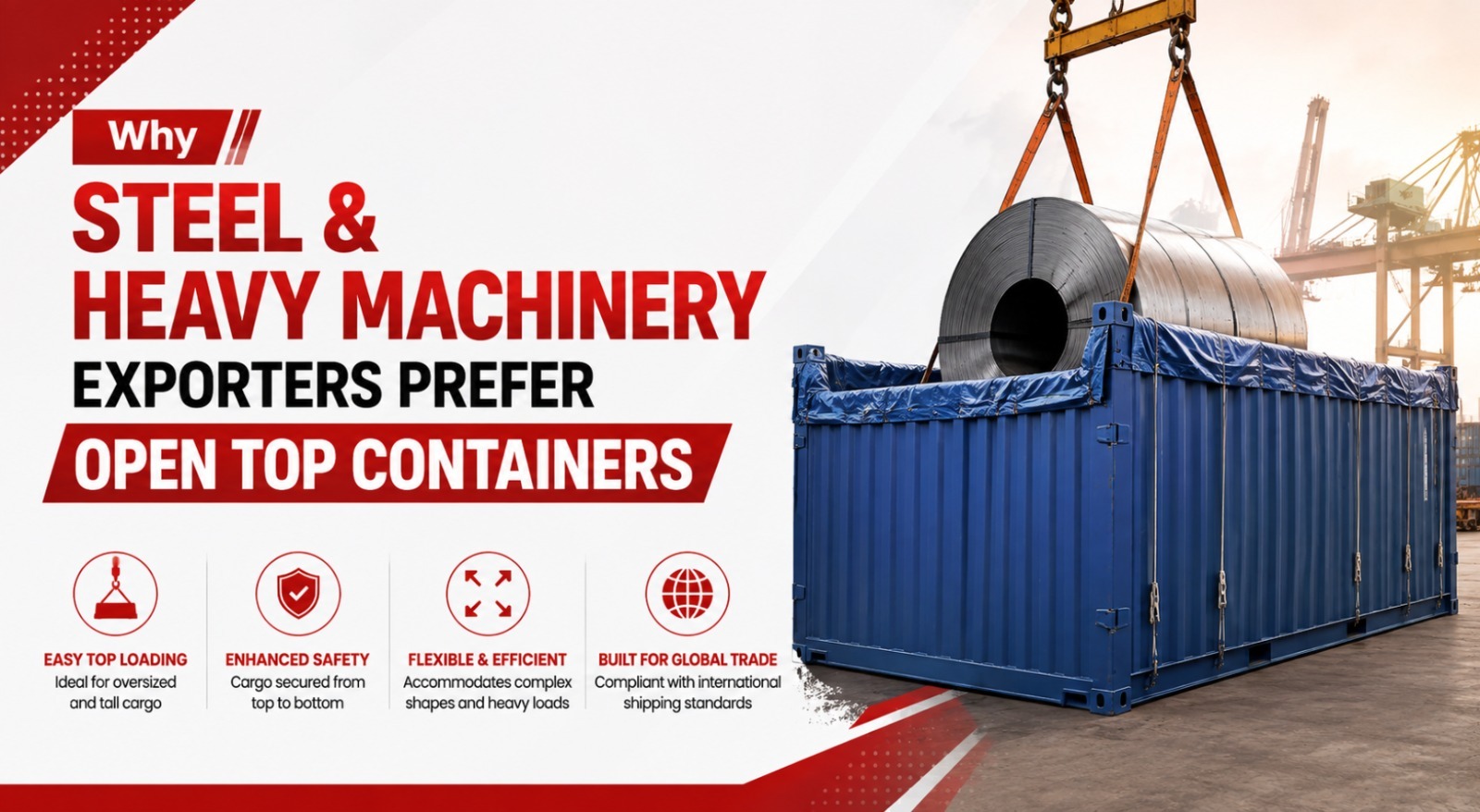
Steel coils, fabricated structures, castings, generators and industrial machines rarely arrive at a loading bay in a convenient shape. That is why an open top container is often a practical logistics decision, not a specialist luxury.
An open top container gives loading teams access from above while retaining ISO container handling advantages. For Indian manufacturers, that difference can remove a major operational headache.
Why Heavy Industrial Cargo Needs an Open Top Container
A standard dry box works when cargo enters through end doors; an open top container works when top access changes the loading equation.
A machine may have a tall housing, uneven profile, lifting points or a centre of gravity that makes forklift entry awkward. Steel fabrications can be dense or difficult to rotate inside a closed box. This configuration changes the loading sequence: cargo can be lifted directly from above and positioned with a crane.
Every extra handling step creates risk. We have seen loading plans slow down because a machine could not be angled through standard doors. The open configuration removes that bottleneck and simplifies crane positioning.
The Real Advantage Is Loading Flexibility
The strongest case for an open top container is loading flexibility. Consider it when a crane is available, standard doors are impractical, the load is high or irregular, dismantling affects alignment or warranty, or controlled lifting is safer than forklift handling.
Consider a fabricated steel assembly from Gujarat. If it must be dismantled just to fit a dry box, the apparent savings can disappear through extra labour, packing, reassembly and inspection. An open top design can preserve the finished configuration.
Why Steel Exporters Watch Weight Distribution
Steel cargo is dense and unforgiving. An open top container can make crane placement more controlled, but weight, floor loading, centre of gravity, securing, route restrictions and terminal equipment still need checking.
The loading plan can address axle loads, floor loading, centre of gravity and lashing. This type of container does not mean “load without limits.”
For steel fabricators, this configuration suits structural members, assemblies, castings and pieces with protrusions.
Heavy Machinery: Avoid Dismantling When It Creates More Risk
Machinery exporters often face a false choice: dismantle the equipment or move it as project cargo. Dismantling can require technicians, alignment checks, disconnection, protection, packing and reassembly. An open top container can reduce those interventions where dimensions and weight suit the transportation plan, while crane loading improves visibility.
Before choosing an open top container, ask:
-
Can the cargo be lifted safely from its designated lifting points?
-
Does loaded height suit the route and terminal?
-
Can it be secured without pressure damage?
-
Would a flat rack or hard top be better?
The answer depends on the cargo, not the booking label.
Open Top Container vs Dry Container vs Flat Rack
A dry container suits standard enclosed cargo. It offers a rigid roof and straightforward door loading. An open top container becomes more attractive when vertical access is the constraint.
A flat rack is different from an open top container. It is better suited to cargo that is exceptionally wide, long or otherwise needs open sides. If the cargo needs side support and weather protection while the main challenge is top loading, this configuration can be the more balanced solution.
Choosing a flat rack simply because cargo is heavy can create unnecessary exposure and handling complexity. Choosing this configuration for extremely wide machinery can be equally unsuitable.
For this type of container, start with a cargo drawing, packed dimensions, gross weight, lifting arrangement and destination handling plan.
Where Indian Exporters Commonly Lose Time
The factory-to-port leg can expose problems invisible during quoting. Check gate restrictions, crane capacity, road height, bridges, port cut-offs, handling equipment and lashing. An open top container cannot remove route constraints.
For exporters around Pune, Ahmedabad, Chennai, Coimbatore, Faridabad and other manufacturing centres, the inland leg deserves the same attention as the ocean leg.
What to Ask a Container Manufacturing Company
If you are sourcing specialised equipment, do not stop at “Is an open top container available?”
Ask the container manufacturing company about the intended cargo, loading method, structural configuration, securing points, roof-cover arrangement, applicable standards and maintenance support.
A credible container manufacturing company should explain whether the unit is suitable for the operating application. A container manufacturing company should also clarify. Another container manufacturing company check is how the unit will work with your existing handling process.
For repeat exporters, this matters. If the same machinery family moves regularly, the container solution should become a repeatable process rather than a fresh improvisation.
Why the Right Container Manufacturer in India Matters
Working with a container manufacturer in india that supplies an open top container is useful; an experienced supplier can also help address modifications, availability and deployment. A specialist supplier can be valuable when specialised requirements need engineering discussion.
A capable manufacturer should understand that containers are not merely steel boxes. The design has to work with lifting, handling, road movement, rail interfaces and marine transportation.
Transafe Services operates manufacturing facilities in Kharagpur, Coimbatore and Dharuhera and supplies an open top container alongside hard top, flat rack and side-access configurations. That range matters because the best answer is sometimes not an open top container at all.
Choosing the Right Container Partner for Heavy Cargo
Transafe Services manufactures ISO freight containers and specialised solutions, including open top, hard top, flat rack and side-access configurations. Its wider range lets teams compare an open top container with other configurations.
Instead of treating container selection as a commodity purchase, exporters can discuss the cargo, handling method and intended use with a manufacturer that works across multiple container types.
For regular heavy-engineering exports, select the container as part of the logistics plan and evaluate the configuration against the actual handling method.
A Practical Decision Checklist
Before choosing an open top container, have a cargo plan with dimensions, weight, lifting points, securing method, terminals and route constraints ready.
Conclusion
Steel and heavy machinery exporters prefer an open top container because it makes difficult cargo easier to load without forcing every project into the limitations of a standard dry box.
The value goes beyond top access: less dismantling, better crane handling and more predictable loading.
For regular heavy-engineering exports, select the container as part of the logistics plan and evaluate the configuration against the actual handling method. Transafe Services can help match the cargo, container and movement plan.
FAQs
1. What is an open top container mainly used for?
An open top container is used for crane-loaded heavy machinery, steel fabrications and awkward-height cargo.
2. Is an open top container better than a flat rack?
Not automatically. This configuration suits top-loaded cargo needing sidewall protection; a flat rack often suits exceptionally wide or long cargo.
3. Can steel products be loaded into an open top container?
Yes, where dimensions, weight, floor loading and securing are suitable. Steel fabrications and heavy components can be candidates.
4. What should exporters check before booking?
Confirm dimensions, weight, lifting points, centre of gravity, securing, route restrictions and terminal handling before booking an open top container.
5. Why should SMEs work with an experienced supplier?
Specialised container selection is an operational decision. This configuration still needs cargo-specific planning; an experienced supplier can compare configurations.