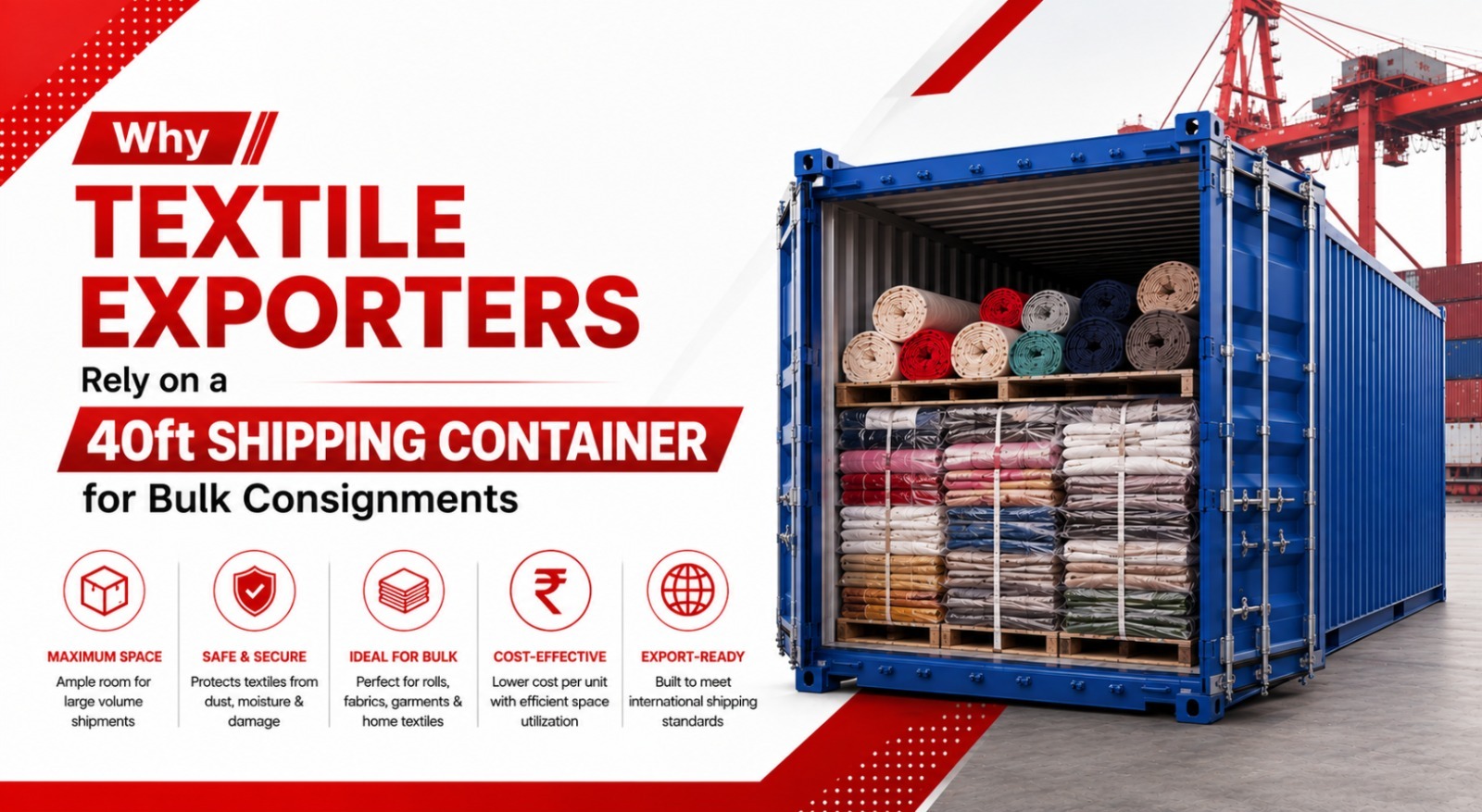
Textile exports are usually constrained by volume before weight. Rolls of fabric, garment cartons, towels and home textiles fill space quickly while leaving payload capacity unused. That is why the 40ft shipping container remains a workhorse for bulk textile movement.
For exporters, the equipment choice affects consolidation, warehouse loading, transportation planning and dispatch discipline. Get the fit right; operations become cleaner. Get it wrong and extra space becomes waste.
Why a 40ft shipping container fits textile cargo
Containers 40 feet offer the floor length and cubic capacity needed for lightweight, bulky cargo. They can let several SKUs move together without excessive splitting.
The real benefit is operational. A larger container can replace multiple smaller loads, reducing coordination between the warehouse, transporter, CFS and port. Fewer units can also mean fewer seals, gate transactions and loading records.
But bigger is not automatically better. A half-filled unit can be less efficient than a smaller, well-utilized box.
The textile exporter’s capacity problem
That makes the 40ft option attractive for high-volume orders. Its longer internal footprint supports organized rows and can simplify mixed-SKU loading.
This is why containers 40 feet should be selected from actual packing data rather than habit.
When a 40ft shipping container makes sense
Containers 40 feet are generally a strong fit when:
-
Cargo is volume-heavy and moderate in density.
-
Several SKUs can be consolidated safely.
-
Production can finish before the gate-in cut-off.
-
The warehouse has enough staging space.
-
The carrier and destination accept the selected equipment.
For many exporters, a 40ft unit is easier to manage when planned early than several smaller units.
40ft shipping container or standard height?
For textiles, height can matter as much as length.
A 40ft shipping container provides extra internal height compared with a standard-height unit. That can help with lightweight cartons, folded garments and other products where cubic capacity is the constraint.
This equipment can suit apparel and home-textile cargo, but weight distribution still matters. More room is never a reason to load unevenly.
For dense textile products, the standard container 40 feet option may already provide enough cube. For lightweight apparel, a 40ft high cube container may be more logical.
40ft versus 20ft: choose by cargo
The question is not whether a 40ft unit is larger. It is whether the extra space is productive.
A 20-foot unit can make sense for dense goods, smaller orders or factories with limited staging space. A 40ft shipping container becomes more compelling when cubic volume is the constraint.
This is where containers 40 feet need a data-led decision.
What to check before booking
Cargo profile: Record carton dimensions, gross weight, carton count and cubic volume.
Loading method: Confirm whether cargo is palletized, slip-sheeted or floor-loaded.
Equipment condition: The selected unit should be clean, dry, cargo-worthy and appropriate for the cargo.
Route compatibility: Check road access, rail movement where applicable, terminal requirements and destination handling.
Cut-off discipline: A container booked perfectly is useless if production misses the gate-in window.
Documentation: Loading records, seals and commercial documents should agree. Small discrepancies become harder to correct once the unit enters the export chain.
Transafe Services supports this requirement through ISO freight containers and leasing for domestic and EXIM operations. Its range includes standard and high-cube equipment, including the 40ft shipping container, while its leasing offering includes 20-foot and 40-foot ISO equipment across India. Its equipment is aligned with ISO 1496-1 requirements for intermodal road, rail and sea use.
An operational check is the loading calendar. The planned unit should arrive when production is ready, not days before. It also needs a pickup plan. Otherwise, equipment can sit idle while trucks wait. A container 40 feet unit should be planned against production. This discipline keeps the process predictable and helps support the export schedule.
Standard container or 40ft high cube container?
The answer should follow the cargo and the loading plan.
A standard container 40 feet can work when carton height is modest and the loading plan already uses the available cube efficiently. A 40ft high cube container becomes more useful when vertical capacity is genuinely needed.
For apparel, bedding and lightweight home textiles, that distinction can affect consolidation. For dense material, the standard option may be adequate.
The phrase container 40 feet covers more than one practical configuration. Equipment should therefore be specified by height, cargo requirements and loading method rather than length alone.
A larger container is not automatically better because it offers more space. It is better when the cargo profile makes the additional cube productive.
What textile exporters should decide before dispatch
Before choosing a 40ft shipping container, ask:
-
How much cubic volume will the finished cargo occupy?
-
What are the carton dimensions and average weights?
-
Can production finish before the planned gate-in?
-
Will the loading pattern use available height and floor length?
-
Is the equipment available near the factory?
-
Will destination handling suit the selected unit?
A 40ft shipping container works best when production, warehouse loading and transportation planning are synchronized.
Conclusion
The strongest case for a 40ft shipping container is not simply “more space.” It is better cubic utilization, fewer avoidable handling events and a more predictable export flow when the cargo profile supports it.
For textile businesses, this equipment has earned its place because it fits the way bulk cargo actually moves. Plan the load early. Match equipment to the cargo. Secure availability before production reaches the loading bay.
Do that consistently, and the 40ft shipping container becomes more than transportation equipment. It becomes a practical lever for export efficiency.
FAQs
1. Why do textile exporters prefer a 40ft shipping container?
Textile cargo is often bulky and relatively light, which makes cubic capacity the main constraint. A 40ft shipping container can consolidate more volume while fitting established road, rail and sea processes.
2. Is a 40ft shipping container always better than a 20-foot unit?
No. Dense cargo, smaller orders and limited staging space can favor a 20-foot unit. The correct choice depends on volume, payload, packing method and route.
3. When should an exporter use a 40ft high cube container?
Use a 40ft high cube container when lightweight cargo can genuinely use the additional internal height. Apparel, bedding and similar products are common examples, provided carton and pallet dimensions support the extra cube.
4. Are containers 40 feet suitable for multimodal transport?
ISO 40ft shipping container units are designed for intermodal use across compatible road, rail and sea networks. Route, terminal and carrier requirements still need to be checked.
5. Can an SME lease a 40ft shipping container?
Yes. Leasing can help exporters avoid tying up capital in equipment, especially where demand varies by season or order cycle. Transafe Services offers domestic and EXIM leasing that includes 40-foot high-cube ISO equipment.