Table of Content
-
Understanding the Core Difference
-
When a 20ft Container Makes More Sense
-
Operational Advantage of 20ft Containers
-
When Containers 40 Feet Become the Better Choice
-
Freight Economics of 40 ft Shipping Containers
-
The Mistake Many Businesses Make
-
What About 40 Feet Container Price?
-
High Cube vs Standard 40 ft Container
-
How Experienced Supply Chain Teams Decide
-
Conclusion
-
FAQs
A wrong container choice rarely looks expensive on paper. The real damage shows up later, higher freight bills, underutilized cargo space, loading inefficiencies, detention charges, unstable cargo movement, or warehouse bottlenecks.
This is exactly why experienced exporters and logistics managers don’t choose a container based only on cargo volume. They look at cargo density, handling limitations, route economics, unloading infrastructure, and how the consignment behaves operationally across the entire supply chain.
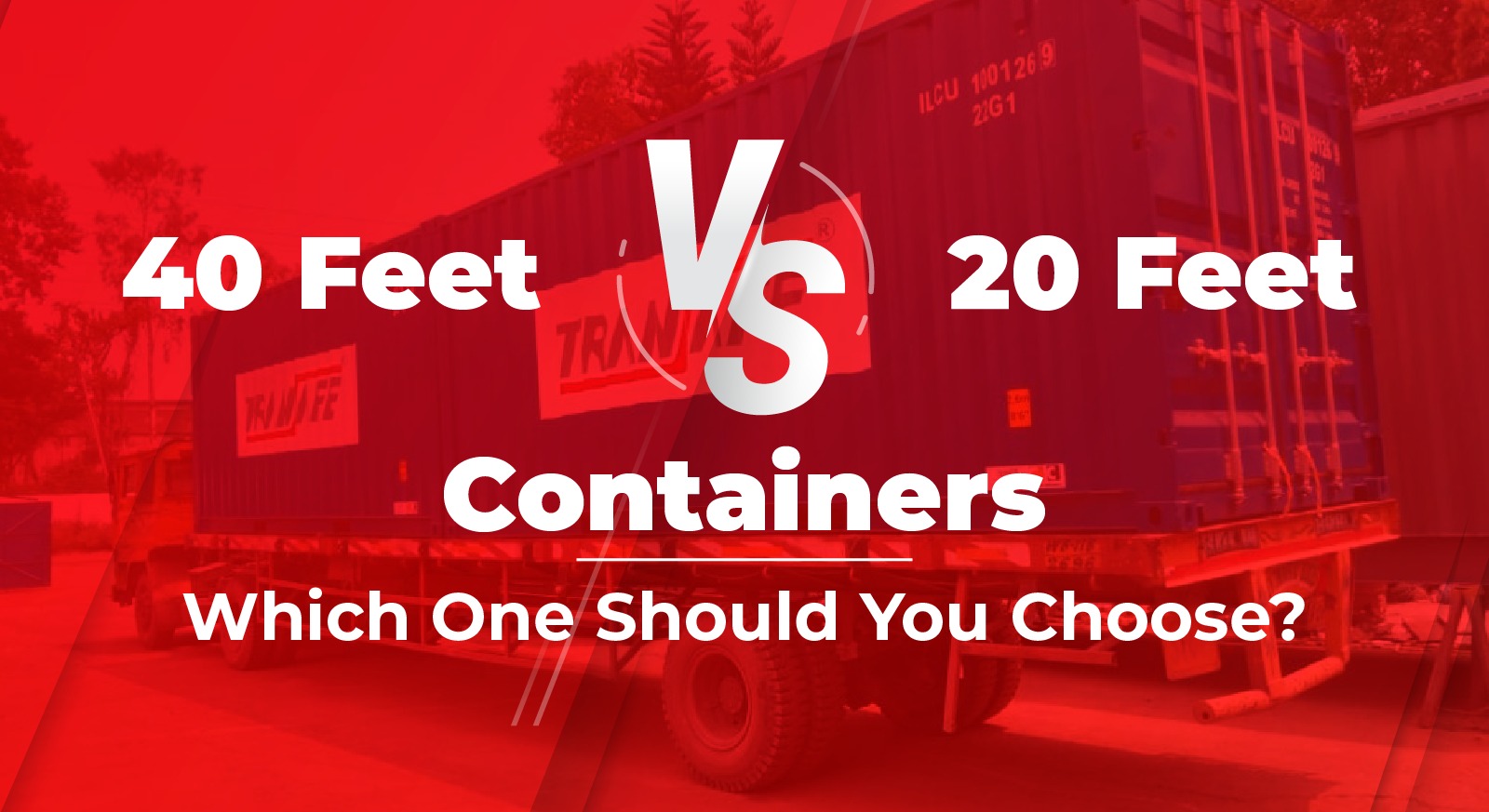
For Indian businesses dealing with manufacturing, exports, imports, project cargo, industrial goods, FMCG distribution, or warehouse movement, the debate between containers 40 feet and 20ft containers is not just about size. It is a cost-efficiency decision.
Understanding the Core Difference
At a basic level:
-
A 20ft container is compact, denser, and operationally easier for heavy cargo.
-
A 40 ft shipping container offers significantly higher cubic capacity for lighter or voluminous cargo.
Here’s the practical difference businesses actually care about:
|
Factor |
20ft Container |
40 ft Container |
|
Best For |
Heavy cargo |
Voluminous cargo |
|
Cargo Capacity |
Lower volume |
Higher volume |
|
Loading Flexibility |
Easier in tight spaces |
Requires more maneuvering space |
|
Freight Efficiency |
Better for dense materials |
Better for lightweight bulk cargo |
|
Warehouse Handling |
Easier |
Slightly complex |
|
Per Unit Shipping Cost |
Higher for large-volume goods |
Lower when fully utilized |
Most businesses oversimplify this decision. The real question is:
Are you volume-heavy or weight-heavy?
That changes everything.
When a 20ft Container Makes More Sense
A 20ft container is usually the smarter operational choice when cargo becomes heavy before the container becomes full.
This happens often in industries like:
-
Metal components
-
Industrial machinery
-
Chemicals
-
Granite and tiles
-
Automotive parts
-
Dense engineering goods
In Indian EXIM operations, many first-time exporters make the mistake of booking a 40 ft container assuming “bigger means better.” Then the cargo hits maximum payload limits long before the container space is fully utilized.
The result:
-
Wasted cubic space
-
Higher container cost
-
Poor freight optimization
For dense cargo, a 20ft unit often delivers better freight economics.
Operational Advantage of 20ft Containers
A 20ft container is also easier to manage operationally inside Indian industrial clusters where:
-
Warehouse access is narrow
-
Loading bays are small
-
Factory roads are congested
-
Crane movement is limited
This becomes highly relevant in older manufacturing zones across Delhi NCR, Bhiwandi, Ludhiana, Faridabad, and parts of Gujarat.
A smaller container reduces:
-
Loading delays
-
Repositioning issues
-
Local transportation complications
That operational efficiency matters more than businesses initially realize.
When Containers 40 Feet Become the Better Choice
A 40 ft container becomes significantly more cost-efficient when cargo is lightweight but space-consuming.
Common examples:
-
Textiles
-
Garments
-
Plastic products
-
FMCG consignment
-
Furniture
-
Consumer goods
-
Packaging materials
-
Electronics
In these sectors, businesses usually “cube out” before they “weigh out.”
Meaning:
-
The container fills completely
-
But weight limits are still far from maximum capacity
That is where containers 40 feet create major cost advantages.
Freight Economics of 40 ft Shipping Containers
A properly utilized 40 ft shipping container can substantially reduce:
-
Per-unit shipping cost
-
Container requirement frequency
-
Inland transportation repetition
-
Handling cycles
For exporters shipping regular high-volume cargo, this directly impacts profitability.
This is especially important now because Indian logistics costs remain relatively high compared to global manufacturing economies. Every avoidable consignment cycle increases landed cost pressure.
Smart procurement teams increasingly calculate:
-
Freight cost per carton
-
Freight cost per pallet
-
Freight cost per SKU movement
Not just total consignment cost.
That shift changes container selection strategy completely.
The Mistake Many Businesses Make
Some companies choose containers based only on current consignment size instead of supply chain flow.
That creates inefficiencies like:
-
Inconsistent dispatch planning
-
Warehouse congestion
-
Partial-load dependency
-
Excess freight frequency
-
Inventory imbalance
Experienced logistics operators evaluate:
-
Dispatch regularity
-
Cargo dimensions
-
Unloading capability
-
Seasonal consignment fluctuation
-
Stacking behavior
-
Palletization pattern
-
Destination infrastructure
For example:
A 40 ft container may look cheaper per cubic foot, but if the consignee warehouse cannot unload efficiently, unloading delays can trigger detention costs quickly.
That operational reality rarely gets discussed in generic container comparison articles.
What About 40 Feet Container Price?
The 40 feet container price varies based on:
-
Container grade
-
New vs used
-
High cube vs standard
-
Steel quality
-
CSC certification
-
Manufacturing standards
-
Market steel rates
In India, price fluctuations often follow:
-
Steel market movement
-
Export demand
-
Global shipping cycles
-
Container shortages
Businesses purchasing containers for storage or domestic movement should focus less on initial pricing and more on:
-
Structural durability
-
Floor condition
-
Corrosion resistance
-
Lock integrity
-
Long-term maintenance
A cheaper container with structural fatigue becomes expensive very quickly in operational use.
High Cube vs Standard 40 ft Container
This is another area where many buyers get confused.
A standard 40 ft container works well for regular cargo.
A high cube container provides additional height, which becomes valuable for:
-
Bulky cargo
-
Lightweight packaged goods
-
Stacked pallet movement
However, high cube units may create transportation restrictions in certain inland movement routes depending on bridge clearance and state regulations.
That needs operational verification before procurement.
How Experienced Supply Chain Teams Decide
The most efficient logistics teams usually evaluate container choice using four questions:
1. Does the cargo hit the weight limit first or the space limit first?
This is the biggest decision factor.
2. How frequently is consignment moving?
Higher consignment frequency changes freight optimization models.
3. What are the unloading conditions at the destination?
Poor unloading infrastructure changes container practicality.
4. Can warehouse operations support larger container movement?
A theoretically efficient container becomes operationally inefficient if yard movement suffers.
Conclusion
Absolutely. Container size directly impacts unloading speed, yard movement, dock management, and cargo handling efficiency.
The right container decision is rarely about dimensions alone. It is about operational fit across transportation, warehousing, cargo handling, and freight economics.
That is why experienced logistics companies evaluate container movement as part of the larger supply chain system, not as an isolated shipping decision.
A business moving lightweight retail cargo every week will optimize differently from a manufacturer transporting industrial machinery twice a month.
The smartest container strategy is the one that reduces friction across the entire logistics chain, not just the freight invoice.
FAQs
Which is better: 20ft or 40 ft shipping container?
Neither is universally better. A 20ft container works better for dense, heavy cargo. A 40 ft shipping container is more efficient for lightweight, high-volume cargo.
Are containers 40 feet cheaper per unit shipped?
Usually yes, when fully utilized. Underutilized 40ft containers often increase effective freight cost.
What industries commonly use 40 ft containers?
Textiles, FMCG, furniture, consumer goods, retail exports, and electronics industries commonly prefer 40 ft containers.
Why do heavy cargo exporters prefer 20ft containers?
Because weight limits are reached faster than volume limits. Using a 40ft unit for dense cargo wastes space and increases inefficiency.