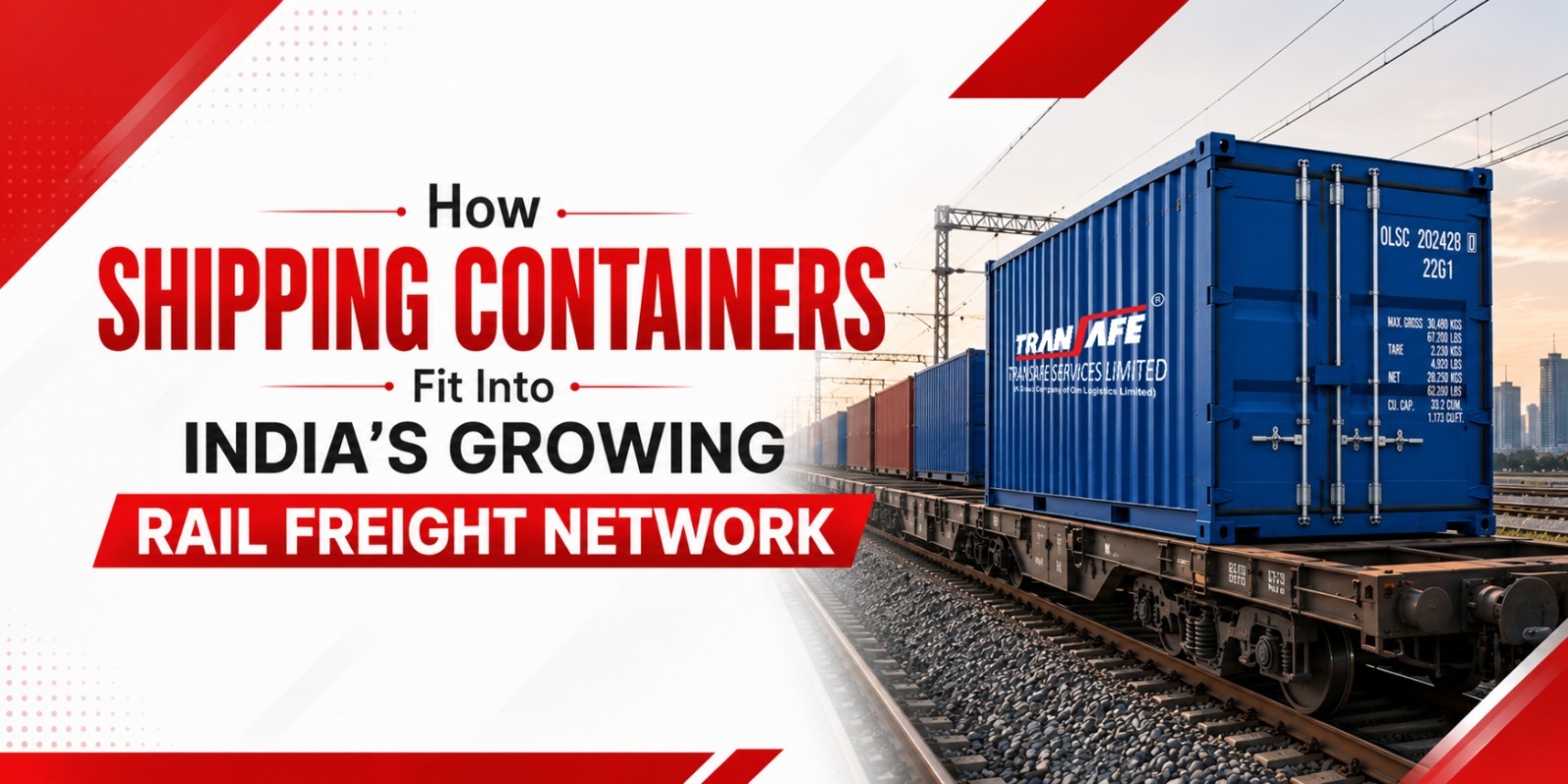
Rail freight in India is no longer only a conversation for large manufacturers and bulk cargo operators. More businesses are looking at it for containerised freight, particularly when road movement over long distances starts becoming difficult to manage consistently.
The interesting part is that the rail journey is only one piece of the puzzle.
For an exporter, manufacturer or growing importer, the real question is whether a container can move smoothly from the warehouse to the rail terminal, travel by train and reach the customer without creating delays at either end. That is where shipping containers have become increasingly important.
Why Shipping Containers Matter as Rail Freight Grows
A container gives cargo one standard physical unit for the journey.
The truck can carry it. A crane can lift it. A rail wagon can carry it. Another truck can pick it up at the destination. The goods themselves do not need to be unloaded every time the transportation mode changes and it sounds like a small operational benefit but it isn't.
Every additional handling point creates another opportunity for delay, damage, miscounting or paperwork problems. For businesses moving valuable manufactured goods, avoiding unnecessary handling can be just as important as reducing transit time.
India's Dedicated Freight Corridors have also strengthened the case for rail on suitable long-distance routes. The Western and Eastern DFCs were developed to increase freight capacity and separate a significant portion of freight movement from heavily utilised passenger routes.
For businesses, this creates another option when planning their transportation network. But rail should not be selected simply because a new freight corridor exists.
The origin, destination, cargo, terminal and road legs all have to make sense together.
A container does more than carry the cargo
One mistake we often see is treating shipping containers as packaging. It is not. A container is part of the transportation system.
Suppose a manufacturer in an industrial area needs to send finished products to a customer in another state. The business might initially compare the cost of one full truck against one container moved by rail and the comparison is incomplete.
With an intermodal movement, the actual sequence may be:
Factory → first-mile truck → rail terminal → train → destination terminal → delivery truck → customer
There may be two truck movements surrounding one rail movement.
So when assessing the economics, the logistics team needs to consider the complete cycle, including loading time, terminal handling, waiting, documentation and final delivery.
We have found that this is where many apparently attractive rail plans become less attractive. The rail leg may be efficient. The problem is what happens before and after it.
Is a 40ft shipping container the right choice?
A 40ft shipping container is an obvious choice for many businesses because it offers considerably more internal volume than a 20ft unit. But selecting a 40 ft container simply because it is larger, can be a mistake.
Cargo has two dimensions that matter immediately: weight and volume.
A business shipping lightweight, bulky products may make excellent use of a 40 ft container. A company moving dense engineering components could reach its practical weight limit long before the available floor space is used.
Then there is the loading pattern.
Can the forklift reach the cargo properly? Are pallets arranged to avoid wasted space? Is the cargo being loaded in a way that keeps the weight distributed properly?
These details rarely appear in a simple freight quotation. They matter on the ground.
Transafe Services manufactures ISO freight containers, including 20 ft and 40 ft formats, designed for multimodal movement and aligned with applicable ISO requirements.
For a business, the useful question is therefore not simply whether a 40 ft container is available. It is whether that container is appropriate for the particular cargo and movement cycle.
The first-mile problem is easy to underestimate
Rail terminals are not usually sitting outside every factory gate which means a truck still has to collect the loaded container and take it to the terminal. This first-mile movement can create more trouble than expected.
A factory may have limited space for a container truck. The loading bay may not be designed for quick container loading. The truck could spend hours waiting because production has not finished loading. Or the terminal may have a fixed cut-off that the warehouse team did not account for.
By the time the container reaches the railway terminal, the supposed efficiency of the rail plan may already be under pressure.
This is why we prefer to look at container utilisation and truck turnaround together, rather than treating them as separate logistics activities.
A container sitting outside a warehouse is not productive. Neither is a truck waiting beside it.
The same issue appears after the train arrives
Getting the container onto a train is only half the movement.
Once it reaches the destination terminal, someone still has to take it to the consignee.
This creates another set of questions:
-
Is a delivery vehicle available when the container is released?
-
Can the destination warehouse receive the cargo immediately?
-
Is there enough space for the vehicle to enter and turn?
-
Who is coordinating terminal release and final delivery?
-
What happens if the customer is not ready to receive the cargo?
These are ordinary operational questions. They are also the questions that determine whether an intermodal plan actually works.
A supply chain manager should therefore measure door-to-door performance, not just rail transit time.
When does rail make commercial sense?
There is no universal answer.
Rail tends to become more interesting when the company has regular long-distance cargo and reasonably predictable volumes.
For example, it may be worth evaluating for:
-
Manufacturing companies moving finished goods between major industrial regions
-
Exporters sending containerised cargo towards ports
-
Importers distributing goods from inland terminals
-
Businesses with recurring origin-destination lanes
-
Cargo where long road journeys create recurring capacity or reliability issues
The word “recurring” is important.
If a company needs a vehicle immediately for a one-off urgent movement, road transportation may remain the better choice.
If the same lane is being used every week, however, there is a much stronger opportunity to design a planned rail-road combination and that is when the conversation becomes interesting.
Container availability can quietly affect the whole supply chain
This is one area that gets surprisingly little attention.
A company can have production ready, a confirmed customer order and a planned rail movement. But if the right shipping containers are not available at the required location, the entire plan can still stall.
For SMEs, this is one reason container leasing can be worth considering.
Buying equipment may make sense when utilisation is consistently high. Leasing can be more practical when demand changes with seasons, contracts or production cycles.
Transafe Services offers container leasing for domestic and EXIM requirements, including 20 ft and 40 ft ISO freight containers. There is another advantage to thinking about containers this way.
You are not just acquiring steel equipment. You are managing capacity and this distinction becomes important as a business grows.
Standard containers are not right for every cargo
Most general cargo will work comfortably with conventional dry containers.
Some cargo will not.
Oversized machinery, awkward industrial components and cargo requiring top loading may need a different approach. Depending on the application, businesses may look at open-top containers, flat racks, side-opening units, hard-top containers or other specialised formats.
Trying to make unusual cargo fit into a standard box can create unnecessary handling work. It can also increase loading risk.
Transafe's product range includes standard ISO freight containers alongside specialised container formats for different cargo and industrial applications.
The important point is simple: choose the container around the cargo and handling process, not around what happens to be available first.
What SMEs should calculate before switching a lane to rail
A basic feasibility check can prevent a lot of frustration. Start with the actual movement.
How many containers are required each week? Where will the empty containers come from? How far is the factory from the rail terminal? How long does loading take? What are the terminal cut-off requirements? How quickly can the destination delivery be arranged?
Then look at the cargo itself.
Is the container usually full by volume or by weight? Does the cargo need special loading equipment? Can the warehouse load safely without repeatedly rearranging pallets?
Finally, look beyond freight cost.
A cheaper transport leg is not necessarily a cheaper supply chain.
Waiting time, inventory holding, handling, missed delivery windows and emergency road movements all have a cost.
That is why experienced logistics teams look at total movement performance rather than one line item on a quotation.
Choosing the Right Container Partner for Multimodal Freight
For businesses using shipping containers across road, rail and sea, the container supplier becomes part of the wider logistics planning process.
Transafe Services has been involved in container manufacturing and leasing in India for more than three decades. Its offering includes ISO freight containers, specialised containers and leasing solutions for domestic and EXIM movements.
That can be useful for companies that do not want their container strategy to become a separate operational headache. The requirement may be straightforward: a fleet of 40 ft containers for regular movements.
Or it may be more specific: a specialised container for industrial cargo, temporary capacity through leasing, or equipment suitable for multimodal movement.
The right answer depends on the cargo and the lane and that is the conversation worth having before selecting equipment.
Frequently Asked Questions
1. Can shipping containers be moved by rail in India?
Yes. ISO-standard shipping containers are designed for multimodal transportation and can be transferred between road, rail and sea, subject to the relevant terminal, equipment and operating arrangements.
2. Is a 40ft shipping container better than a 20ft container?
Not necessarily. A 40ft container is generally more suitable for cargo where volume is the constraint. For dense cargo, weight limitations can make a 20ft container more practical. The choice should be based on cargo weight, dimensions, loading pattern and the planned route.
3. Does using rail eliminate the need for trucks?
No. Most containerised rail movements still require road transport for the first and last mile. The objective is to use each mode where it performs best.
4. Should an SME buy or lease shipping containers?
It depends on utilisation. Stable, high-frequency movements may justify ownership, while seasonal or variable requirements can make leasing more flexible. Businesses should consider utilisation, storage, repositioning and maintenance before deciding.
5. Why is container selection important for rail freight?
The wrong container can create loading, handling and space-utilisation problems. Standard dry containers work for many products, but specialised cargo may require open-top, flat-rack, side-access or other container formats. Selecting equipment according to the cargo and movement process can prevent problems later.