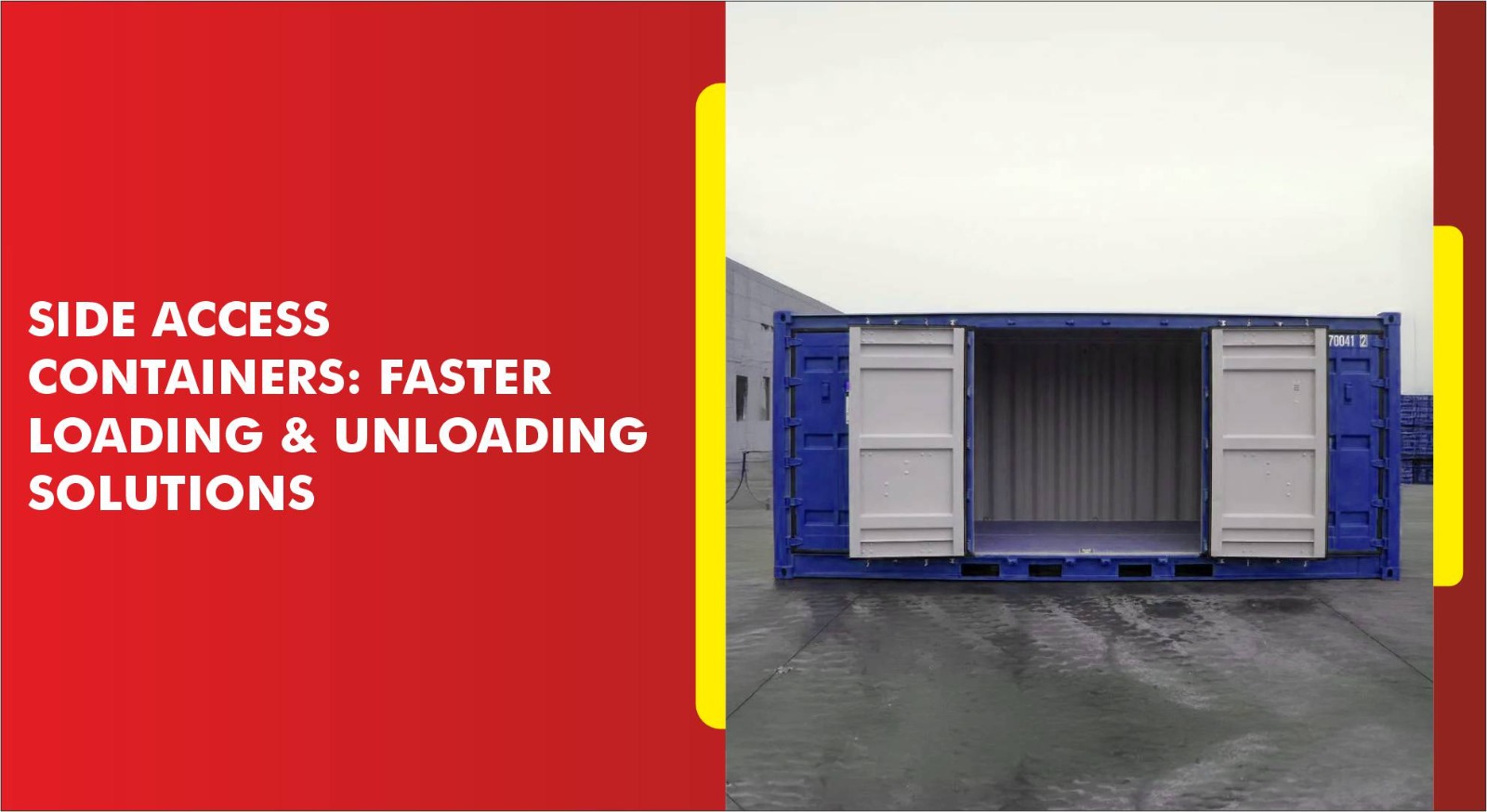
Operational agility often depends on how quickly cargo can be positioned, secured and dispatched. Side access containers have become a decisive asset for logistics teams seeking accelerated turnaround times without compromising structural integrity or compliance. Their lateral entry points streamline handling in environments where speed, precision and ergonomic workflows drive overall throughput.
What Is a Side Access Container?
A side access container, often referred to as a side door container, is a variant of the standard ISO freight container equipped with doors along one or both side panels in addition to the traditional end doors. These containers support easy loading operations, particularly for palletized cargo, oversized goods and shipments requiring rapid, unobstructed access.
Manufacturers engineer these containers to align with ISO 1496-1 specifications, ensuring full compatibility with global intermodal systems across road, rail and maritime transport. The design retains the durability expected of ISO containers, while providing operational flexibility that conventional door-only models cannot match.
Why Side Access Containers Improve Loading Efficiency
Side access solutions unlock lateral entry, which dramatically reduces handling time in constrained loading bays or high-volume distribution environments. Traditional rear-door loading often restricts movement or forces sequential stacking. Side entry changes the workflow:
-
Forklifts gain straight-line access to any pallet position.
-
Operators eliminate the need to shuffle or partially unload cargo to reach rear sections.
-
Bulk or irregularly shaped items can be positioned with minimal maneuvering.
-
Loading and unloading can occur from multiple points, enabling simultaneous workflows.
This configuration proves especially valuable for cross-docking operations, time-bound dispatch cycles and warehouses optimized for rapid material flows.
How Side-Door Access Containers Are Designed
Structural Configuration
Side-door access containers leverage durability-focused side panels fitted with either single-section doors or full-length multi-leaf door systems. These doors are installed on heavy-duty hinges and integrated into a rigid frame engineered to maintain container strength under load.
Key design elements include:
-
Full-height vertical door frames to preserve structural stability.
-
Galvanized or stainless-steel locking systems to secure each door leaf.
-
Weather-sealed joints that protect cargo from dust, moisture and rain.
-
Durable flooring, typically marine-grade plywood or steel, supporting palletized freight.
ISO 1496-1 Compliance
The design remains within the dimensional and performance criteria prescribed for Series 1 freight containers. This ensures:
-
Compatibility with intermodal handling equipment.
-
Stackability with conventional dry cargo units.
-
Uniformity in lifting, securing and transport interfaces.
Side doors augment functionality without compromising global transport standards.
Key Benefits of Side Access Containers
1. Accelerated Throughput
It reduces turnaround time significantly. Forklifts can load or unload pallets directly from the side, eliminating bottlenecks associated with single-point rear entry.
2. Optimized Handling for Palletized Cargo
Straight-line access reduces labor intensity and minimizes product damage. Pallets seat more uniformly, supporting cleaner stacking patterns and smoother transport.
3. Operational Flexibility
The side door configuration supports multiple loading strategies:
-
Partial shipments
-
Irregular cargo placement
-
Multi-stop delivery routes
-
Mixed-category freight
This adaptability allows logistics managers to respond quickly to dynamic supply chain requirements.
4. Improved Safety and Ergonomics
Operators position goods without excessive reversing, pivoting or blind-spot maneuvers. Reduced manual adjustments lead to safer workflows and fewer handling incidents.
5. Enhanced Visibility and Accessibility
Wide side openings improve interior visibility, enabling faster inspections, more accurate cargo counting and simpler load planning.
6. Compliance with Intermodal Standards
Although enhanced with side access, these containers retain the structural and dimensional characteristics of standard ISO-compliant units, ensuring seamless movement across networks.
Best Cargo Types for Side Access Containers
The configuration supports a broad spectrum of applications, but certain cargo types benefit most from side loading:
|
Cargo Type |
Reason for Suitability |
|
Palletized goods |
Fast forklift access and streamlined placement |
|
FMCG goods |
High turnover items needing speed and layout flexibility |
|
Automotive parts |
Efficient placement of boxed or semi-bulky components |
|
Machinery and equipment |
Easier positioning of items that cannot be maneuvered through end doors |
|
Lightweight oversized freight |
Side entry avoids angling or tilting during loading |
|
Fragile, high-value goods |
Reduced handling lowers the risk of impact damage |
This versatility makes side access containers an asset for distribution centers, industrial suppliers and multi-sector logistics providers.
How to Choose the Right Side Access Container
Selection depends on cargo profile, operational workflow and network requirements. Key considerations include:
1. Door Configuration
Evaluate whether the operation needs:
-
Single-side access, suitable for general palletized cargo.
-
Full-side opening doors, optimal for large or irregular freight.
-
Dual-sided access, enabling parallel loading workflows.
2. Material and Build Quality
Confirm specifications such as:
-
Corrosion-resistant steel frames
-
Enhanced-structural door assemblies
-
High-load flooring capability
-
Secure locking systems for transit resilience
Containers aligned with ISO 1496-1 provide predictable durability and transport compatibility.
3. Handling Equipment Compatibility
Verify that side openings match warehouse equipment capabilities:
-
Forklift turning radiuses
-
Pallet truck dimensions
-
Dock height alignment
Adequate compatibility improves process continuity.
4. Cargo Type and Frequency
Assess how often the container will handle:
-
Palletized cargo
-
Oversized Cargo
-
Multi-stop delivery cycles
Patterns of use help determine the most efficient door and structural configurations.
5. Deployment Environment
Consider whether the container will operate mainly across:
-
Distribution hubs
-
Industrial sites
-
Urban delivery corridors
-
Multi-modal routes
Different environments impose variations in operational stress and accessibility requirements.
FAQs – Side Access Container
Are side access containers ISO certified?
Yes. When manufactured in accordance with ISO 1496-1, they meet all intermodal transport standards for road, rail and sea.
Do side door containers compromise structural strength?
No. High-strength frames and engineered door assemblies maintain overall integrity, enabling stacking and lifting similar to standard dry containers.
Can palletized cargo be loaded faster with side access containers?
Yes. Lateral access significantly reduces loading time by allowing direct forklift entry to each pallet position.
Are side access units suitable for long-distance shipping?
Yes. They function like standard ISO containers while offering additional handling flexibility.
What industries use side door containers most commonly?
FMCG, automotive, industrial manufacturing, retail distribution and third-party logistics operators leverage them for speed and accessibility.